

446
L. Chen et al.
between layers due to thermal loading. The analytical model follows Timoshenko’s
bi-thermostat beam theory [69] (which was improved by Suhir [70] later), as well as
the model proposed by Valisetty [71]. The model treats each layer of an N-layer laminated structure as a beam-type plate with orthotropic material properties. The thermal
stress for isothermal loading can be obtained by solving the differential equations
for the classical plate theory with beam-like behavior assumptions, and the displacements of each layer can be solved by the introduction of thermal strain terms into
Valisetty model [71]. Despite the derived formulation is a little complicated, the
model could yield very accurate results in a rapid manner.
15.3.3 Warpage Mechanism and Control Methods
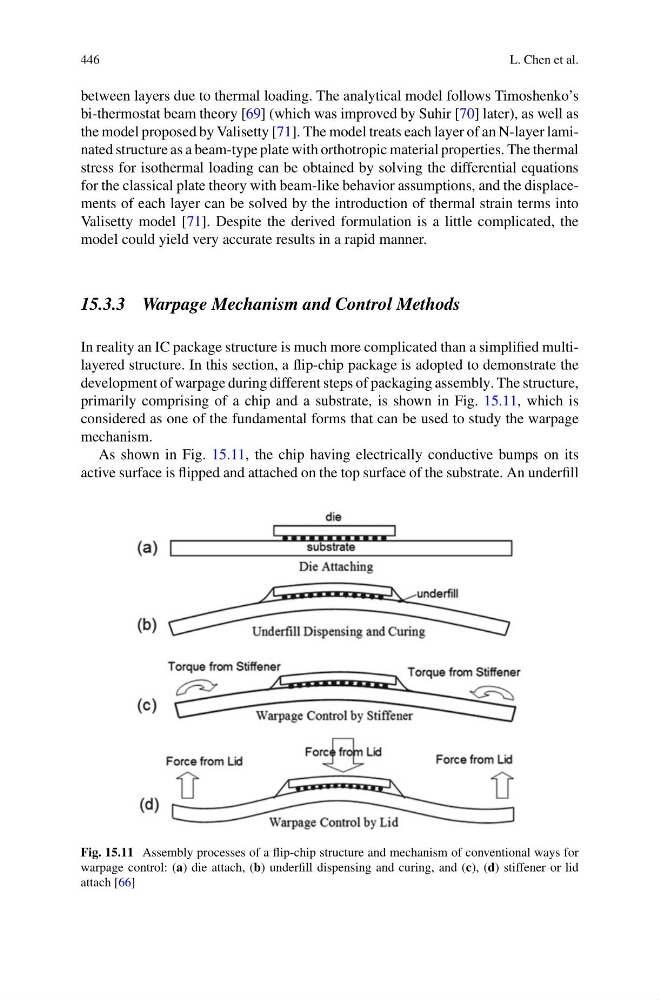
In reality an IC package structure is much more complicated than a simplified multilayered structure. In this section, a flip-chip package is adopted to demonstrate the
development of warpage during different steps of packaging assembly. The structure,
primarily comprising of a chip and a substrate, is shown in Fig. 15.11, which is
considered as one of the fundamental forms that can be used to study the warpage
mechanism.
As shown in Fig. 15.11, the chip having electrically conductive bumps on its
active surface is flipped and attached on the top surface of the substrate. An underfill
Fig. 15.11 Assembly processes of a flip-chip structure and mechanism of conventional ways for
warpage control: (a) die attach, (b) underfill dispensing and curing, and (c), (d) stiffener or lid
attach [66]
L. Chen et al.
between layers due to thermal loading. The analytical model follows Timoshenko’s
bi-thermostat beam theory [69] (which was improved by Suhir [70] later), as well as
the model proposed by Valisetty [71]. The model treats each layer of an N-layer laminated structure as a beam-type plate with orthotropic material properties. The thermal
stress for isothermal loading can be obtained by solving the differential equations
for the classical plate theory with beam-like behavior assumptions, and the displacements of each layer can be solved by the introduction of thermal strain terms into
Valisetty model [71]. Despite the derived formulation is a little complicated, the
model could yield very accurate results in a rapid manner.
15.3.3 Warpage Mechanism and Control Methods
In reality an IC package structure is much more complicated than a simplified multilayered structure. In this section, a flip-chip package is adopted to demonstrate the
development of warpage during different steps of packaging assembly. The structure,
primarily comprising of a chip and a substrate, is shown in Fig. 15.11, which is
considered as one of the fundamental forms that can be used to study the warpage
mechanism.
As shown in Fig. 15.11, the chip having electrically conductive bumps on its
active surface is flipped and attached on the top surface of the substrate. An underfill
Fig. 15.11 Assembly processes of a flip-chip structure and mechanism of conventional ways for
warpage control: (a) die attach, (b) underfill dispensing and curing, and (c), (d) stiffener or lid
attach [66]