

412
S. Shi et al.
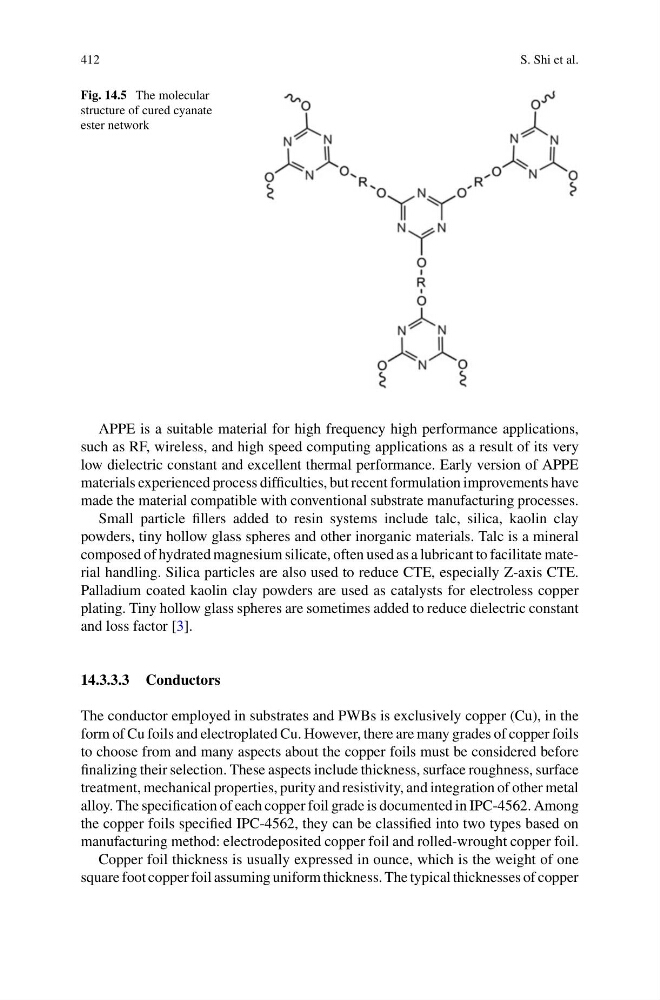
Fig. 14.5 The molecular
structure of cured cyanate
ester network
APPE is a suitable material for high frequency high performance applications,
such as RF, wireless, and high speed computing applications as a result of its very
low dielectric constant and excellent thermal performance. Early version of APPE
materials experienced process difficulties, but recent formulation improvements have
made the material compatible with conventional substrate manufacturing processes.
Small particle fillers added to resin systems include talc, silica, kaolin clay
powders, tiny hollow glass spheres and other inorganic materials. Talc is a mineral
composed of hydrated magnesium silicate, often used as a lubricant to facilitate material handling. Silica particles are also used to reduce CTE, especially Z-axis CTE.
Palladium coated kaolin clay powders are used as catalysts for electroless copper
plating. Tiny hollow glass spheres are sometimes added to reduce dielectric constant
and loss factor [3].
14.3.3.3 Conductors
The conductor employed in substrates and PWBs is exclusively copper (Cu), in the
form of Cu foils and electroplated Cu. However, there are many grades of copper foils
to choose from and many aspects about the copper foils must be considered before
finalizing their selection. These aspects include thickness, surface roughness, surface
treatment, mechanical properties, purity and resistivity, and integration of other metal
alloy. The specification of each copper foil grade is documented in IPC-4562. Among
the copper foils specified IPC-4562, they can be classified into two types based on
manufacturing method: electrodeposited copper foil and rolled-wrought copper foil.
Copper foil thickness is usually expressed in ounce, which is the weight of one
square foot copper foil assuming uniform thickness. The typical thicknesses of copper
S. Shi et al.
Fig. 14.5 The molecular
structure of cured cyanate
ester network
APPE is a suitable material for high frequency high performance applications,
such as RF, wireless, and high speed computing applications as a result of its very
low dielectric constant and excellent thermal performance. Early version of APPE
materials experienced process difficulties, but recent formulation improvements have
made the material compatible with conventional substrate manufacturing processes.
Small particle fillers added to resin systems include talc, silica, kaolin clay
powders, tiny hollow glass spheres and other inorganic materials. Talc is a mineral
composed of hydrated magnesium silicate, often used as a lubricant to facilitate material handling. Silica particles are also used to reduce CTE, especially Z-axis CTE.
Palladium coated kaolin clay powders are used as catalysts for electroless copper
plating. Tiny hollow glass spheres are sometimes added to reduce dielectric constant
and loss factor [3].
14.3.3.3 Conductors
The conductor employed in substrates and PWBs is exclusively copper (Cu), in the
form of Cu foils and electroplated Cu. However, there are many grades of copper foils
to choose from and many aspects about the copper foils must be considered before
finalizing their selection. These aspects include thickness, surface roughness, surface
treatment, mechanical properties, purity and resistivity, and integration of other metal
alloy. The specification of each copper foil grade is documented in IPC-4562. Among
the copper foils specified IPC-4562, they can be classified into two types based on
manufacturing method: electrodeposited copper foil and rolled-wrought copper foil.
Copper foil thickness is usually expressed in ounce, which is the weight of one
square foot copper foil assuming uniform thickness. The typical thicknesses of copper