

354
P. Liu
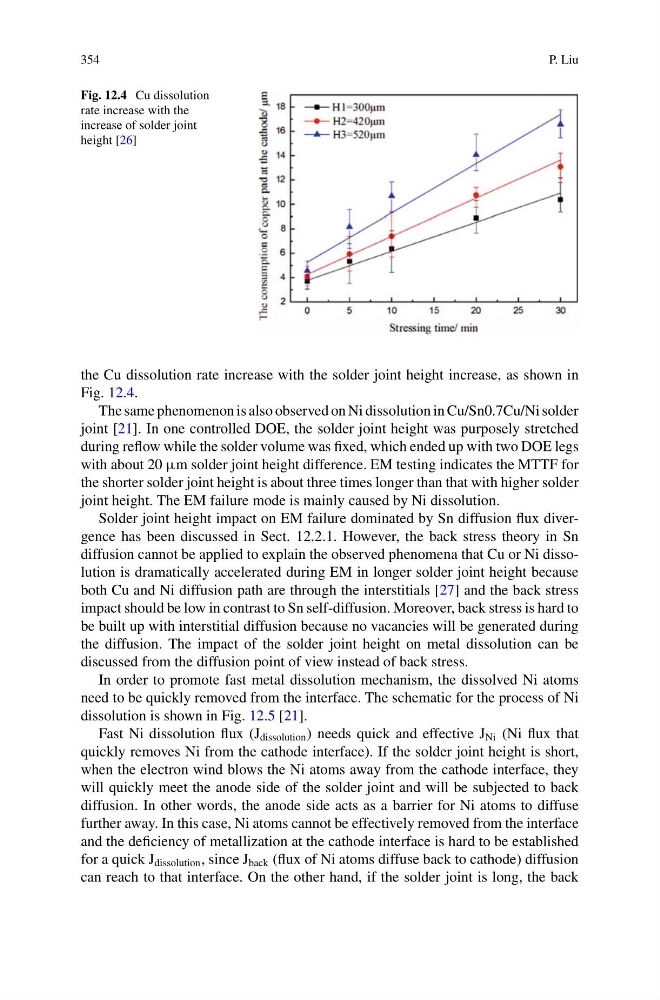
Fig. 12.4 Cu dissolution
rate increase with the
increase of solder joint
height [26]
the Cu dissolution rate increase with the solder joint height increase, as shown in
Fig. 12.4.
The same phenomenon is also observed on Ni dissolution in Cu/Sn0.7Cu/Ni solder
joint [21]. In one controlled DOE, the solder joint height was purposely stretched
during reflow while the solder volume was fixed, which ended up with two DOE legs
with about 20 μm solder joint height difference. EM testing indicates the MTTF for
the shorter solder joint height is about three times longer than that with higher solder
joint height. The EM failure mode is mainly caused by Ni dissolution.
Solder joint height impact on EM failure dominated by Sn diffusion flux divergence has been discussed in Sect. 12.2.1. However, the back stress theory in Sn
diffusion cannot be applied to explain the observed phenomena that Cu or Ni dissolution is dramatically accelerated during EM in longer solder joint height because
both Cu and Ni diffusion path are through the interstitials [27] and the back stress
impact should be low in contrast to Sn self-diffusion. Moreover, back stress is hard to
be built up with interstitial diffusion because no vacancies will be generated during
the diffusion. The impact of the solder joint height on metal dissolution can be
discussed from the diffusion point of view instead of back stress.
In order to promote fast metal dissolution mechanism, the dissolved Ni atoms
need to be quickly removed from the interface. The schematic for the process of Ni
dissolution is shown in Fig. 12.5 [21].
Fast Ni dissolution flux (J dissolution ) needs quick and effective J Ni (Ni flux that
quickly removes Ni from the cathode interface). If the solder joint height is short,
when the electron wind blows the Ni atoms away from the cathode interface, they
will quickly meet the anode side of the solder joint and will be subjected to back
diffusion. In other words, the anode side acts as a barrier for Ni atoms to diffuse
further away. In this case, Ni atoms cannot be effectively removed from the interface
and the deficiency of metallization at the cathode interface is hard to be established
for a quick J dissolution , since J back (flux of Ni atoms diffuse back to cathode) diffusion
can reach to that interface. On the other hand, if the solder joint is long, the back
P. Liu
Fig. 12.4 Cu dissolution
rate increase with the
increase of solder joint
height [26]
the Cu dissolution rate increase with the solder joint height increase, as shown in
Fig. 12.4.
The same phenomenon is also observed on Ni dissolution in Cu/Sn0.7Cu/Ni solder
joint [21]. In one controlled DOE, the solder joint height was purposely stretched
during reflow while the solder volume was fixed, which ended up with two DOE legs
with about 20 μm solder joint height difference. EM testing indicates the MTTF for
the shorter solder joint height is about three times longer than that with higher solder
joint height. The EM failure mode is mainly caused by Ni dissolution.
Solder joint height impact on EM failure dominated by Sn diffusion flux divergence has been discussed in Sect. 12.2.1. However, the back stress theory in Sn
diffusion cannot be applied to explain the observed phenomena that Cu or Ni dissolution is dramatically accelerated during EM in longer solder joint height because
both Cu and Ni diffusion path are through the interstitials [27] and the back stress
impact should be low in contrast to Sn self-diffusion. Moreover, back stress is hard to
be built up with interstitial diffusion because no vacancies will be generated during
the diffusion. The impact of the solder joint height on metal dissolution can be
discussed from the diffusion point of view instead of back stress.
In order to promote fast metal dissolution mechanism, the dissolved Ni atoms
need to be quickly removed from the interface. The schematic for the process of Ni
dissolution is shown in Fig. 12.5 [21].
Fast Ni dissolution flux (J dissolution ) needs quick and effective J Ni (Ni flux that
quickly removes Ni from the cathode interface). If the solder joint height is short,
when the electron wind blows the Ni atoms away from the cathode interface, they
will quickly meet the anode side of the solder joint and will be subjected to back
diffusion. In other words, the anode side acts as a barrier for Ni atoms to diffuse
further away. In this case, Ni atoms cannot be effectively removed from the interface
and the deficiency of metallization at the cathode interface is hard to be established
for a quick J dissolution , since J back (flux of Ni atoms diffuse back to cathode) diffusion
can reach to that interface. On the other hand, if the solder joint is long, the back