

352
P. Liu
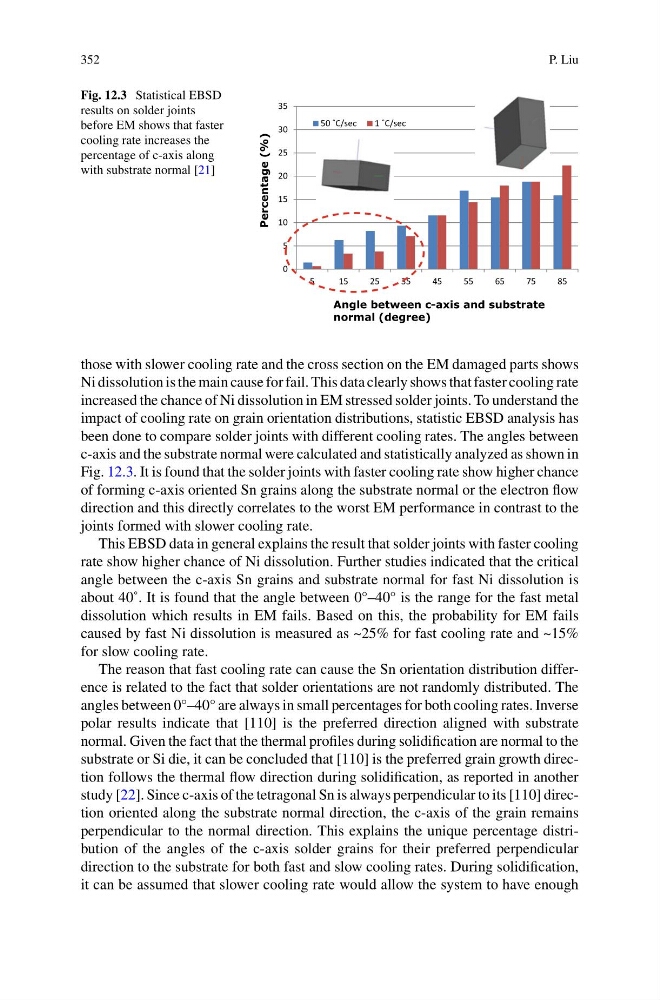
Fig. 12.3 Statistical EBSD
results on solder joints
before EM shows that faster
cooling rate increases the
percentage of c-axis along
with substrate normal [21]
0
5
10
15
20
25
30
35
5
1 5
2 5
3 5
4 5
5 5
6 5
7 5
8 5
50 ˚C/sec
1 ˚C/sec
Percentage (%)
Angle between c-axis and substrate
normal (degree)
those with slower cooling rate and the cross section on the EM damaged parts shows
Ni dissolution is the main cause for fail. This data clearly shows that faster cooling rate
increased the chance of Ni dissolution in EM stressed solder joints. To understand the
impact of cooling rate on grain orientation distributions, statistic EBSD analysis has
been done to compare solder joints with different cooling rates. The angles between
c-axis and the substrate normal were calculated and statistically analyzed as shown in
Fig. 12.3. It is found that the solder joints with faster cooling rate show higher chance
of forming c-axis oriented Sn grains along the substrate normal or the electron flow
direction and this directly correlates to the worst EM performance in contrast to the
joints formed with slower cooling rate.
This EBSD data in general explains the result that solder joints with faster cooling
rate show higher chance of Ni dissolution. Further studies indicated that the critical
angle between the c-axis Sn grains and substrate normal for fast Ni dissolution is
about 40˚. It is found that the angle between 0°–40° is the range for the fast metal
dissolution which results in EM fails. Based on this, the probability for EM fails
caused by fast Ni dissolution is measured as ~25% for fast cooling rate and ~15%
for slow cooling rate.
The reason that fast cooling rate can cause the Sn orientation distribution difference is related to the fact that solder orientations are not randomly distributed. The
angles between 0°–40° are always in small percentages for both cooling rates. Inverse
polar results indicate that [110] is the preferred direction aligned with substrate
normal. Given the fact that the thermal profiles during solidification are normal to the
substrate or Si die, it can be concluded that [110] is the preferred grain growth direction follows the thermal flow direction during solidification, as reported in another
study [22]. Since c-axis of the tetragonal Sn is always perpendicular to its [110] direction oriented along the substrate normal direction, the c-axis of the grain remains
perpendicular to the normal direction. This explains the unique percentage distribution of the angles of the c-axis solder grains for their preferred perpendicular
direction to the substrate for both fast and slow cooling rates. During solidification,
it can be assumed that slower cooling rate would allow the system to have enough
P. Liu
Fig. 12.3 Statistical EBSD
results on solder joints
before EM shows that faster
cooling rate increases the
percentage of c-axis along
with substrate normal [21]
0
5
10
15
20
25
30
35
5
1 5
2 5
3 5
4 5
5 5
6 5
7 5
8 5
50 ˚C/sec
1 ˚C/sec
Percentage (%)
Angle between c-axis and substrate
normal (degree)
those with slower cooling rate and the cross section on the EM damaged parts shows
Ni dissolution is the main cause for fail. This data clearly shows that faster cooling rate
increased the chance of Ni dissolution in EM stressed solder joints. To understand the
impact of cooling rate on grain orientation distributions, statistic EBSD analysis has
been done to compare solder joints with different cooling rates. The angles between
c-axis and the substrate normal were calculated and statistically analyzed as shown in
Fig. 12.3. It is found that the solder joints with faster cooling rate show higher chance
of forming c-axis oriented Sn grains along the substrate normal or the electron flow
direction and this directly correlates to the worst EM performance in contrast to the
joints formed with slower cooling rate.
This EBSD data in general explains the result that solder joints with faster cooling
rate show higher chance of Ni dissolution. Further studies indicated that the critical
angle between the c-axis Sn grains and substrate normal for fast Ni dissolution is
about 40˚. It is found that the angle between 0°–40° is the range for the fast metal
dissolution which results in EM fails. Based on this, the probability for EM fails
caused by fast Ni dissolution is measured as ~25% for fast cooling rate and ~15%
for slow cooling rate.
The reason that fast cooling rate can cause the Sn orientation distribution difference is related to the fact that solder orientations are not randomly distributed. The
angles between 0°–40° are always in small percentages for both cooling rates. Inverse
polar results indicate that [110] is the preferred direction aligned with substrate
normal. Given the fact that the thermal profiles during solidification are normal to the
substrate or Si die, it can be concluded that [110] is the preferred grain growth direction follows the thermal flow direction during solidification, as reported in another
study [22]. Since c-axis of the tetragonal Sn is always perpendicular to its [110] direction oriented along the substrate normal direction, the c-axis of the grain remains
perpendicular to the normal direction. This explains the unique percentage distribution of the angles of the c-axis solder grains for their preferred perpendicular
direction to the substrate for both fast and slow cooling rates. During solidification,
it can be assumed that slower cooling rate would allow the system to have enough