

350
P. Liu
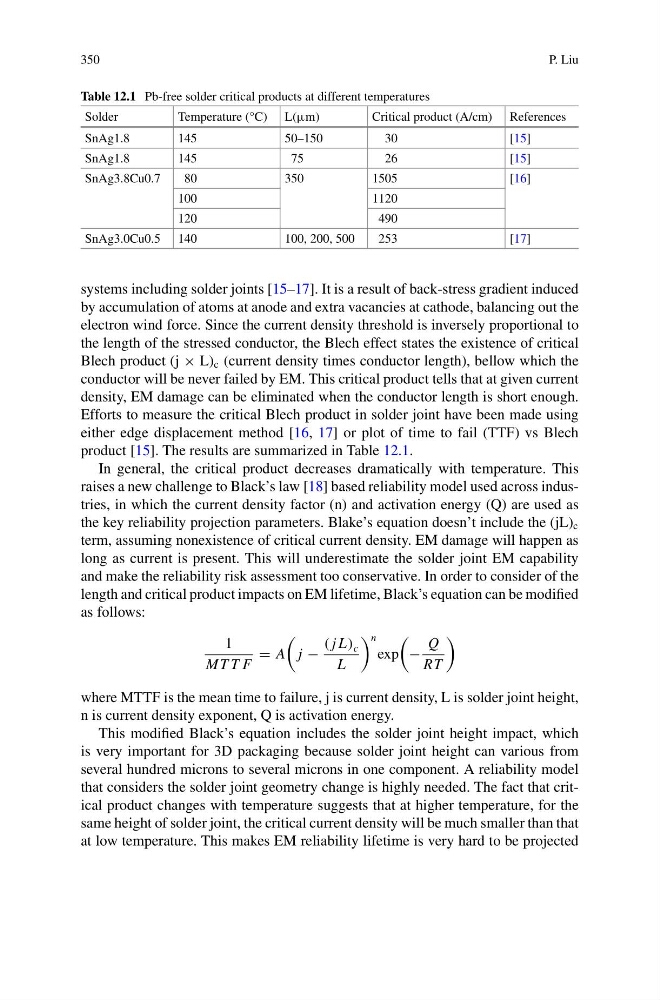
Table 12.1 Pb-free solder critical products at different temperatures
Solder
Temperature (°C) L(μm)
Critical product (A/cm) References
SnAg1.8
145
50–150
30
[15]
SnAg1.8
145
75
26
[15]
SnAg3.8Cu0.7
80
350
1505
[16]
100
1120
120
490
SnAg3.0Cu0.5 140
100, 200, 500
253
[17]
systems including solder joints [15–17]. It is a result of back-stress gradient induced
by accumulation of atoms at anode and extra vacancies at cathode, balancing out the
electron wind force. Since the current density threshold is inversely proportional to
the length of the stressed conductor, the Blech effect states the existence of critical
Blech product (j × L) c (current density times conductor length), bellow which the
conductor will be never failed by EM. This critical product tells that at given current
density, EM damage can be eliminated when the conductor length is short enough.
Efforts to measure the critical Blech product in solder joint have been made using
either edge displacement method [16, 17] or plot of time to fail (TTF) vs Blech
product [15]. The results are summarized in Table 12.1.
In general, the critical product decreases dramatically with temperature. This
raises a new challenge to Black’s law [18] based reliability model used across industries, in which the current density factor (n) and activation energy (Q) are used as
the key reliability projection parameters. Blake’s equation doesn’t include the (jL) c
term, assuming nonexistence of critical current density. EM damage will happen as
long as current is present. This will underestimate the solder joint EM capability
and make the reliability risk assessment too conservative. In order to consider of the
length and critical product impacts on EM lifetime, Black’s equation can be modified
as follows:
1
MT T F
= A
j −
( j L) c
L
n
exp
−
Q
RT
where MTTF is the mean time to failure, j is current density, L is solder joint height,
n is current density exponent, Q is activation energy.
This modified Black’s equation includes the solder joint height impact, which
is very important for 3D packaging because solder joint height can various from
several hundred microns to several microns in one component. A reliability model
that considers the solder joint geometry change is highly needed. The fact that critical product changes with temperature suggests that at higher temperature, for the
same height of solder joint, the critical current density will be much smaller than that
at low temperature. This makes EM reliability lifetime is very hard to be projected
P. Liu
Table 12.1 Pb-free solder critical products at different temperatures
Solder
Temperature (°C) L(μm)
Critical product (A/cm) References
SnAg1.8
145
50–150
30
[15]
SnAg1.8
145
75
26
[15]
SnAg3.8Cu0.7
80
350
1505
[16]
100
1120
120
490
SnAg3.0Cu0.5 140
100, 200, 500
253
[17]
systems including solder joints [15–17]. It is a result of back-stress gradient induced
by accumulation of atoms at anode and extra vacancies at cathode, balancing out the
electron wind force. Since the current density threshold is inversely proportional to
the length of the stressed conductor, the Blech effect states the existence of critical
Blech product (j × L) c (current density times conductor length), bellow which the
conductor will be never failed by EM. This critical product tells that at given current
density, EM damage can be eliminated when the conductor length is short enough.
Efforts to measure the critical Blech product in solder joint have been made using
either edge displacement method [16, 17] or plot of time to fail (TTF) vs Blech
product [15]. The results are summarized in Table 12.1.
In general, the critical product decreases dramatically with temperature. This
raises a new challenge to Black’s law [18] based reliability model used across industries, in which the current density factor (n) and activation energy (Q) are used as
the key reliability projection parameters. Blake’s equation doesn’t include the (jL) c
term, assuming nonexistence of critical current density. EM damage will happen as
long as current is present. This will underestimate the solder joint EM capability
and make the reliability risk assessment too conservative. In order to consider of the
length and critical product impacts on EM lifetime, Black’s equation can be modified
as follows:
1
MT T F
= A
j −
( j L) c
L
n
exp
−
Q
RT
where MTTF is the mean time to failure, j is current density, L is solder joint height,
n is current density exponent, Q is activation energy.
This modified Black’s equation includes the solder joint height impact, which
is very important for 3D packaging because solder joint height can various from
several hundred microns to several microns in one component. A reliability model
that considers the solder joint geometry change is highly needed. The fact that critical product changes with temperature suggests that at higher temperature, for the
same height of solder joint, the critical current density will be much smaller than that
at low temperature. This makes EM reliability lifetime is very hard to be projected