

340
K.-L. Lin
Table 11.2 Intrinsic diffusion coefficients of elements in different phases
Phase
Element
D(m 2 /sec), 170 °C
References
Cu
Cu
1.07 × 10 −29 , 3.46 × 10 −29
[38]
Sn
3.98 × 10 −26
[39]
Sn
Cu
1.06 × 10 −9 (//c), 3.04 × 10 −11 (°C)
[40]
Sn
1.81 × 10 −16 (//c), 4.43 × 10 −16 (°C)
[38]
Ni
Ni
8.95 × 10 −38 , 1.61 × 10 −37
[38]
Sn
Ni
1.47 × 10 −8 (//c), 7.73 × 10 −11 (°C)
[41]
Cu 3 Sn
Cu
5.12 × 10 −16
[24]
Sn
1.46 × 10 −16
[24]
Cu 6 Sn 5
Cu
9.42 × 10 −16
[24]
Sn
9.44 × 10 −16
[24]
Ni 3 Sn 4
Ni
1.36 × 10 −17
[24]
Sn
6.81 × 10 −18
[24]
(//c: parallel to c-axis; °C: perpendicular to c-axis)
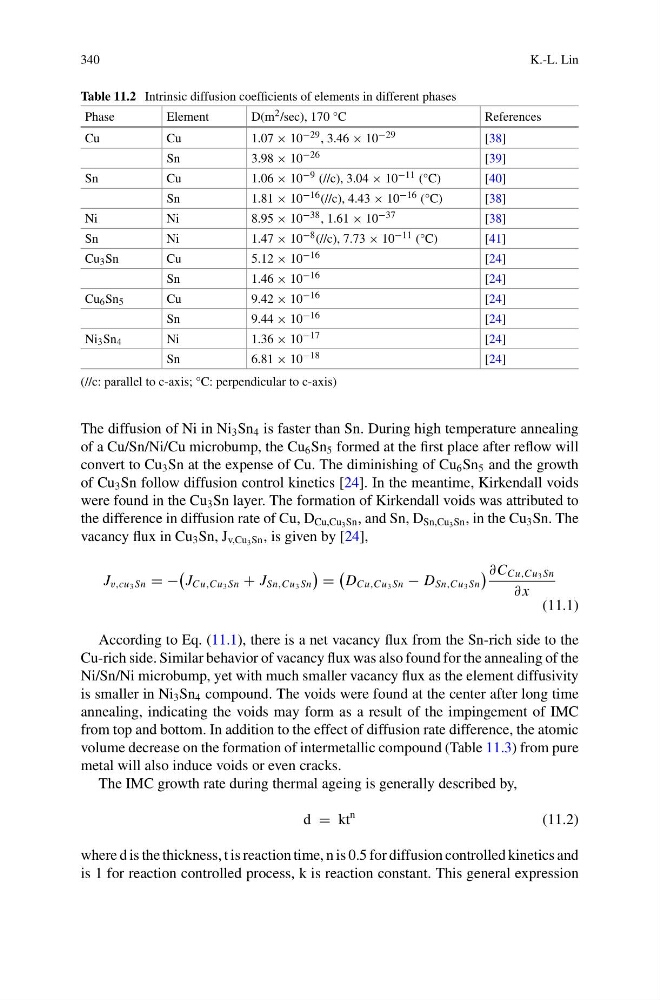
The diffusion of Ni in Ni 3 Sn 4 is faster than Sn. During high temperature annealing
of a Cu/Sn/Ni/Cu microbump, the Cu 6 Sn 5 formed at the first place after reflow will
convert to Cu 3 Sn at the expense of Cu. The diminishing of Cu 6 Sn 5 and the growth
of Cu 3 Sn follow diffusion control kinetics [24]. In the meantime, Kirkendall voids
were found in the Cu 3 Sn layer. The formation of Kirkendall voids was attributed to
the difference in diffusion rate of Cu, D Cu,Cu 3 Sn , and Sn, D Sn,Cu 3 Sn , in the Cu 3 Sn. The
vacancy flux in Cu 3 Sn, J v,Cu 3 Sn , is given by [24],
J v,cu 3 Sn = −
J Cu,Cu 3 Sn + J Sn,Cu 3 Sn
=
D Cu,Cu 3 Sn − D Sn,Cu 3 Sn
∂C Cu,Cu 3 Sn
∂ x
(11.1)
According to Eq. (11.1), there is a net vacancy flux from the Sn-rich side to the
Cu-rich side. Similar behavior of vacancy flux was also found for the annealing of the
Ni/Sn/Ni microbump, yet with much smaller vacancy flux as the element diffusivity
is smaller in Ni 3 Sn 4 compound. The voids were found at the center after long time
annealing, indicating the voids may form as a result of the impingement of IMC
from top and bottom. In addition to the effect of diffusion rate difference, the atomic
volume decrease on the formation of intermetallic compound (Table 11.3) from pure
metal will also induce voids or even cracks.
The IMC growth rate during thermal ageing is generally described by,
d = kt
n
(11.2)
where d is the thickness, t is reaction time, n is 0.5 for diffusion controlled kinetics and
is 1 for reaction controlled process, k is reaction constant. This general expression
K.-L. Lin
Table 11.2 Intrinsic diffusion coefficients of elements in different phases
Phase
Element
D(m 2 /sec), 170 °C
References
Cu
Cu
1.07 × 10 −29 , 3.46 × 10 −29
[38]
Sn
3.98 × 10 −26
[39]
Sn
Cu
1.06 × 10 −9 (//c), 3.04 × 10 −11 (°C)
[40]
Sn
1.81 × 10 −16 (//c), 4.43 × 10 −16 (°C)
[38]
Ni
Ni
8.95 × 10 −38 , 1.61 × 10 −37
[38]
Sn
Ni
1.47 × 10 −8 (//c), 7.73 × 10 −11 (°C)
[41]
Cu 3 Sn
Cu
5.12 × 10 −16
[24]
Sn
1.46 × 10 −16
[24]
Cu 6 Sn 5
Cu
9.42 × 10 −16
[24]
Sn
9.44 × 10 −16
[24]
Ni 3 Sn 4
Ni
1.36 × 10 −17
[24]
Sn
6.81 × 10 −18
[24]
(//c: parallel to c-axis; °C: perpendicular to c-axis)
The diffusion of Ni in Ni 3 Sn 4 is faster than Sn. During high temperature annealing
of a Cu/Sn/Ni/Cu microbump, the Cu 6 Sn 5 formed at the first place after reflow will
convert to Cu 3 Sn at the expense of Cu. The diminishing of Cu 6 Sn 5 and the growth
of Cu 3 Sn follow diffusion control kinetics [24]. In the meantime, Kirkendall voids
were found in the Cu 3 Sn layer. The formation of Kirkendall voids was attributed to
the difference in diffusion rate of Cu, D Cu,Cu 3 Sn , and Sn, D Sn,Cu 3 Sn , in the Cu 3 Sn. The
vacancy flux in Cu 3 Sn, J v,Cu 3 Sn , is given by [24],
J v,cu 3 Sn = −
J Cu,Cu 3 Sn + J Sn,Cu 3 Sn
=
D Cu,Cu 3 Sn − D Sn,Cu 3 Sn
∂C Cu,Cu 3 Sn
∂ x
(11.1)
According to Eq. (11.1), there is a net vacancy flux from the Sn-rich side to the
Cu-rich side. Similar behavior of vacancy flux was also found for the annealing of the
Ni/Sn/Ni microbump, yet with much smaller vacancy flux as the element diffusivity
is smaller in Ni 3 Sn 4 compound. The voids were found at the center after long time
annealing, indicating the voids may form as a result of the impingement of IMC
from top and bottom. In addition to the effect of diffusion rate difference, the atomic
volume decrease on the formation of intermetallic compound (Table 11.3) from pure
metal will also induce voids or even cracks.
The IMC growth rate during thermal ageing is generally described by,
d = kt
n
(11.2)
where d is the thickness, t is reaction time, n is 0.5 for diffusion controlled kinetics and
is 1 for reaction controlled process, k is reaction constant. This general expression