

308
S. Lee
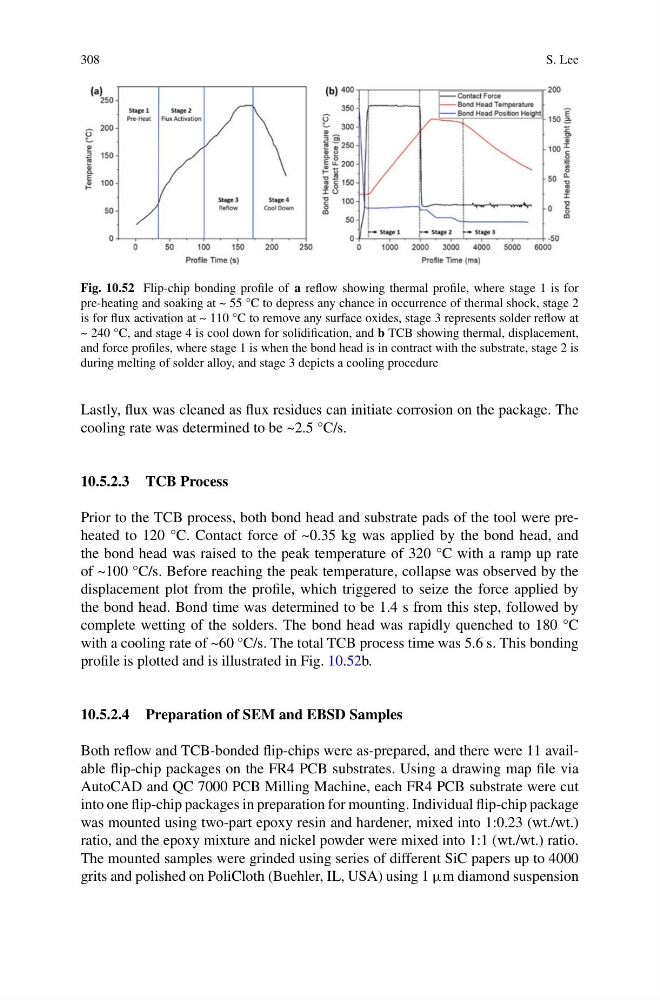
Fig. 10.52 Flip-chip bonding profile of a reflow showing thermal profile, where stage 1 is for
pre-heating and soaking at ~ 55 °C to depress any chance in occurrence of thermal shock, stage 2
is for flux activation at ~ 110 °C to remove any surface oxides, stage 3 represents solder reflow at
~ 240 °C, and stage 4 is cool down for solidification, and b TCB showing thermal, displacement,
and force profiles, where stage 1 is when the bond head is in contract with the substrate, stage 2 is
during melting of solder alloy, and stage 3 depicts a cooling procedure
Lastly, flux was cleaned as flux residues can initiate corrosion on the package. The
cooling rate was determined to be ~2.5 °C/s.
10.5.2.3 TCB Process
Prior to the TCB process, both bond head and substrate pads of the tool were preheated to 120 °C. Contact force of ~0.35 kg was applied by the bond head, and
the bond head was raised to the peak temperature of 320 °C with a ramp up rate
of ~100 °C/s. Before reaching the peak temperature, collapse was observed by the
displacement plot from the profile, which triggered to seize the force applied by
the bond head. Bond time was determined to be 1.4 s from this step, followed by
complete wetting of the solders. The bond head was rapidly quenched to 180 °C
with a cooling rate of ~60 °C/s. The total TCB process time was 5.6 s. This bonding
profile is plotted and is illustrated in Fig. 10.52b.
10.5.2.4 Preparation of SEM and EBSD Samples
Both reflow and TCB-bonded flip-chips were as-prepared, and there were 11 available flip-chip packages on the FR4 PCB substrates. Using a drawing map file via
AutoCAD and QC 7000 PCB Milling Machine, each FR4 PCB substrate were cut
into one flip-chip packages in preparation for mounting. Individual flip-chip package
was mounted using two-part epoxy resin and hardener, mixed into 1:0.23 (wt./wt.)
ratio, and the epoxy mixture and nickel powder were mixed into 1:1 (wt./wt.) ratio.
The mounted samples were grinded using series of different SiC papers up to 4000
grits and polished on PoliCloth (Buehler, IL, USA) using 1 μm diamond suspension
S. Lee
Fig. 10.52 Flip-chip bonding profile of a reflow showing thermal profile, where stage 1 is for
pre-heating and soaking at ~ 55 °C to depress any chance in occurrence of thermal shock, stage 2
is for flux activation at ~ 110 °C to remove any surface oxides, stage 3 represents solder reflow at
~ 240 °C, and stage 4 is cool down for solidification, and b TCB showing thermal, displacement,
and force profiles, where stage 1 is when the bond head is in contract with the substrate, stage 2 is
during melting of solder alloy, and stage 3 depicts a cooling procedure
Lastly, flux was cleaned as flux residues can initiate corrosion on the package. The
cooling rate was determined to be ~2.5 °C/s.
10.5.2.3 TCB Process
Prior to the TCB process, both bond head and substrate pads of the tool were preheated to 120 °C. Contact force of ~0.35 kg was applied by the bond head, and
the bond head was raised to the peak temperature of 320 °C with a ramp up rate
of ~100 °C/s. Before reaching the peak temperature, collapse was observed by the
displacement plot from the profile, which triggered to seize the force applied by
the bond head. Bond time was determined to be 1.4 s from this step, followed by
complete wetting of the solders. The bond head was rapidly quenched to 180 °C
with a cooling rate of ~60 °C/s. The total TCB process time was 5.6 s. This bonding
profile is plotted and is illustrated in Fig. 10.52b.
10.5.2.4 Preparation of SEM and EBSD Samples
Both reflow and TCB-bonded flip-chips were as-prepared, and there were 11 available flip-chip packages on the FR4 PCB substrates. Using a drawing map file via
AutoCAD and QC 7000 PCB Milling Machine, each FR4 PCB substrate were cut
into one flip-chip packages in preparation for mounting. Individual flip-chip package
was mounted using two-part epoxy resin and hardener, mixed into 1:0.23 (wt./wt.)
ratio, and the epoxy mixture and nickel powder were mixed into 1:1 (wt./wt.) ratio.
The mounted samples were grinded using series of different SiC papers up to 4000
grits and polished on PoliCloth (Buehler, IL, USA) using 1 μm diamond suspension