

10 Fundamentals of Bonding Technology and Process Materials …
303
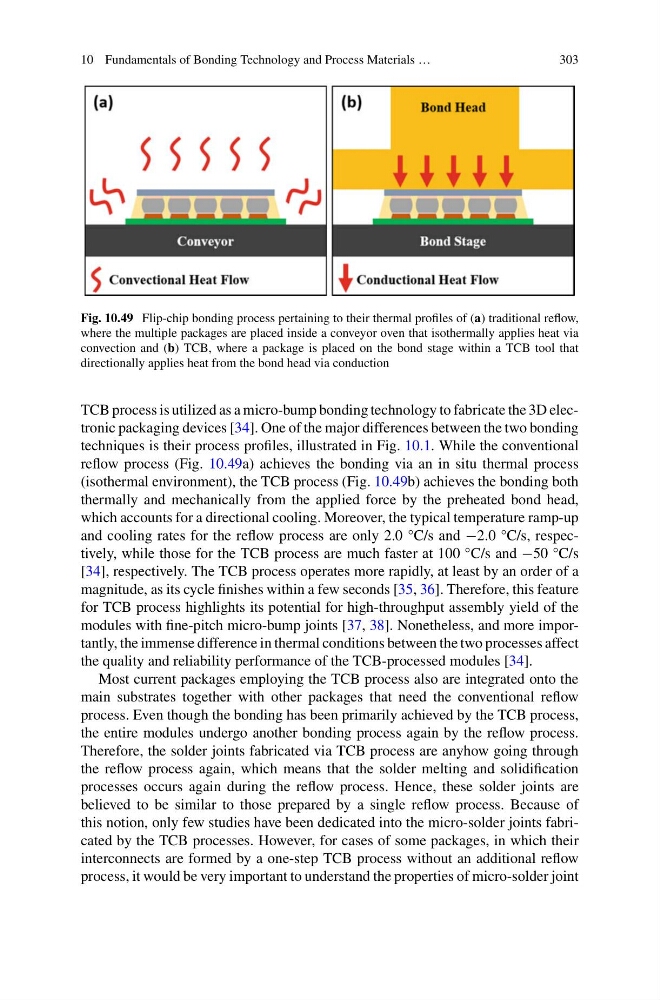
Fig. 10.49 Flip-chip bonding process pertaining to their thermal profiles of (a) traditional reflow,
where the multiple packages are placed inside a conveyor oven that isothermally applies heat via
convection and (b) TCB, where a package is placed on the bond stage within a TCB tool that
directionally applies heat from the bond head via conduction
TCB process is utilized as a micro-bump bonding technology to fabricate the 3D electronic packaging devices [34]. One of the major differences between the two bonding
techniques is their process profiles, illustrated in Fig. 10.1. While the conventional
reflow process (Fig. 10.49a) achieves the bonding via an in situ thermal process
(isothermal environment), the TCB process (Fig. 10.49b) achieves the bonding both
thermally and mechanically from the applied force by the preheated bond head,
which accounts for a directional cooling. Moreover, the typical temperature ramp-up
and cooling rates for the reflow process are only 2.0 °C/s and −2.0 °C/s, respectively, while those for the TCB process are much faster at 100 °C/s and −50 °C/s
[34], respectively. The TCB process operates more rapidly, at least by an order of a
magnitude, as its cycle finishes within a few seconds [35, 36]. Therefore, this feature
for TCB process highlights its potential for high-throughput assembly yield of the
modules with fine-pitch micro-bump joints [37, 38]. Nonetheless, and more importantly, the immense difference in thermal conditions between the two processes affect
the quality and reliability performance of the TCB-processed modules [34].
Most current packages employing the TCB process also are integrated onto the
main substrates together with other packages that need the conventional reflow
process. Even though the bonding has been primarily achieved by the TCB process,
the entire modules undergo another bonding process again by the reflow process.
Therefore, the solder joints fabricated via TCB process are anyhow going through
the reflow process again, which means that the solder melting and solidification
processes occurs again during the reflow process. Hence, these solder joints are
believed to be similar to those prepared by a single reflow process. Because of
this notion, only few studies have been dedicated into the micro-solder joints fabricated by the TCB processes. However, for cases of some packages, in which their
interconnects are formed by a one-step TCB process without an additional reflow
process, it would be very important to understand the properties of micro-solder joint
303
Fig. 10.49 Flip-chip bonding process pertaining to their thermal profiles of (a) traditional reflow,
where the multiple packages are placed inside a conveyor oven that isothermally applies heat via
convection and (b) TCB, where a package is placed on the bond stage within a TCB tool that
directionally applies heat from the bond head via conduction
TCB process is utilized as a micro-bump bonding technology to fabricate the 3D electronic packaging devices [34]. One of the major differences between the two bonding
techniques is their process profiles, illustrated in Fig. 10.1. While the conventional
reflow process (Fig. 10.49a) achieves the bonding via an in situ thermal process
(isothermal environment), the TCB process (Fig. 10.49b) achieves the bonding both
thermally and mechanically from the applied force by the preheated bond head,
which accounts for a directional cooling. Moreover, the typical temperature ramp-up
and cooling rates for the reflow process are only 2.0 °C/s and −2.0 °C/s, respectively, while those for the TCB process are much faster at 100 °C/s and −50 °C/s
[34], respectively. The TCB process operates more rapidly, at least by an order of a
magnitude, as its cycle finishes within a few seconds [35, 36]. Therefore, this feature
for TCB process highlights its potential for high-throughput assembly yield of the
modules with fine-pitch micro-bump joints [37, 38]. Nonetheless, and more importantly, the immense difference in thermal conditions between the two processes affect
the quality and reliability performance of the TCB-processed modules [34].
Most current packages employing the TCB process also are integrated onto the
main substrates together with other packages that need the conventional reflow
process. Even though the bonding has been primarily achieved by the TCB process,
the entire modules undergo another bonding process again by the reflow process.
Therefore, the solder joints fabricated via TCB process are anyhow going through
the reflow process again, which means that the solder melting and solidification
processes occurs again during the reflow process. Hence, these solder joints are
believed to be similar to those prepared by a single reflow process. Because of
this notion, only few studies have been dedicated into the micro-solder joints fabricated by the TCB processes. However, for cases of some packages, in which their
interconnects are formed by a one-step TCB process without an additional reflow
process, it would be very important to understand the properties of micro-solder joint