

256
Y. Dai and C. S. Tan
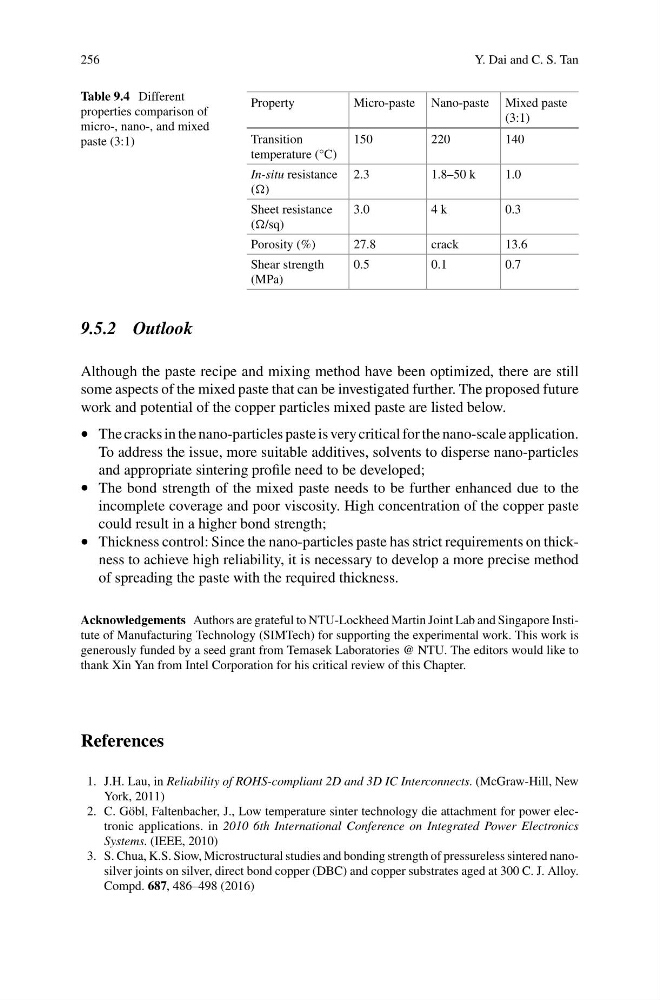
Table 9.4 Different
properties comparison of
micro-, nano-, and mixed
paste (3:1)
Property
Micro-paste Nano-paste Mixed paste
(3:1)
Transition
temperature (°C)
150
220
140
In-situ resistance
()
2.3
1.8–50 k
1.0
Sheet resistance
(/sq)
3.0
4 k
0.3
Porosity (%)
27.8
crack
13.6
Shear strength
(MPa)
0.5
0.1
0.7
9.5.2 Outlook
Although the paste recipe and mixing method have been optimized, there are still
some aspects of the mixed paste that can be investigated further. The proposed future
work and potential of the copper particles mixed paste are listed below.
• The cracks in the nano-particles paste is very critical for the nano-scale application.
To address the issue, more suitable additives, solvents to disperse nano-particles
and appropriate sintering profile need to be developed;
• The bond strength of the mixed paste needs to be further enhanced due to the
incomplete coverage and poor viscosity. High concentration of the copper paste
could result in a higher bond strength;
• Thickness control: Since the nano-particles paste has strict requirements on thickness to achieve high reliability, it is necessary to develop a more precise method
of spreading the paste with the required thickness.
Acknowledgements Authors are grateful to NTU-Lockheed Martin Joint Lab and Singapore Institute of Manufacturing Technology (SIMTech) for supporting the experimental work. This work is
generously funded by a seed grant from Temasek Laboratories @ NTU. The editors would like to
thank Xin Yan from Intel Corporation for his critical review of this Chapter.
References
1. J.H. Lau, in Reliability of ROHS-compliant 2D and 3D IC Interconnects. (McGraw-Hill, New
York, 2011)
2. C. Göbl, Faltenbacher, J., Low temperature sinter technology die attachment for power electronic applications. in 2010 6th International Conference on Integrated Power Electronics
Systems. (IEEE, 2010)
3. S. Chua, K.S. Siow, Microstructural studies and bonding strength of pressureless sintered nanosilver joints on silver, direct bond copper (DBC) and copper substrates aged at 300 C. J. Alloy.
Compd. 687, 486–498 (2016)
Y. Dai and C. S. Tan
Table 9.4 Different
properties comparison of
micro-, nano-, and mixed
paste (3:1)
Property
Micro-paste Nano-paste Mixed paste
(3:1)
Transition
temperature (°C)
150
220
140
In-situ resistance
()
2.3
1.8–50 k
1.0
Sheet resistance
(/sq)
3.0
4 k
0.3
Porosity (%)
27.8
crack
13.6
Shear strength
(MPa)
0.5
0.1
0.7
9.5.2 Outlook
Although the paste recipe and mixing method have been optimized, there are still
some aspects of the mixed paste that can be investigated further. The proposed future
work and potential of the copper particles mixed paste are listed below.
• The cracks in the nano-particles paste is very critical for the nano-scale application.
To address the issue, more suitable additives, solvents to disperse nano-particles
and appropriate sintering profile need to be developed;
• The bond strength of the mixed paste needs to be further enhanced due to the
incomplete coverage and poor viscosity. High concentration of the copper paste
could result in a higher bond strength;
• Thickness control: Since the nano-particles paste has strict requirements on thickness to achieve high reliability, it is necessary to develop a more precise method
of spreading the paste with the required thickness.
Acknowledgements Authors are grateful to NTU-Lockheed Martin Joint Lab and Singapore Institute of Manufacturing Technology (SIMTech) for supporting the experimental work. This work is
generously funded by a seed grant from Temasek Laboratories @ NTU. The editors would like to
thank Xin Yan from Intel Corporation for his critical review of this Chapter.
References
1. J.H. Lau, in Reliability of ROHS-compliant 2D and 3D IC Interconnects. (McGraw-Hill, New
York, 2011)
2. C. Göbl, Faltenbacher, J., Low temperature sinter technology die attachment for power electronic applications. in 2010 6th International Conference on Integrated Power Electronics
Systems. (IEEE, 2010)
3. S. Chua, K.S. Siow, Microstructural studies and bonding strength of pressureless sintered nanosilver joints on silver, direct bond copper (DBC) and copper substrates aged at 300 C. J. Alloy.
Compd. 687, 486–498 (2016)