

252
Y. Dai and C. S. Tan
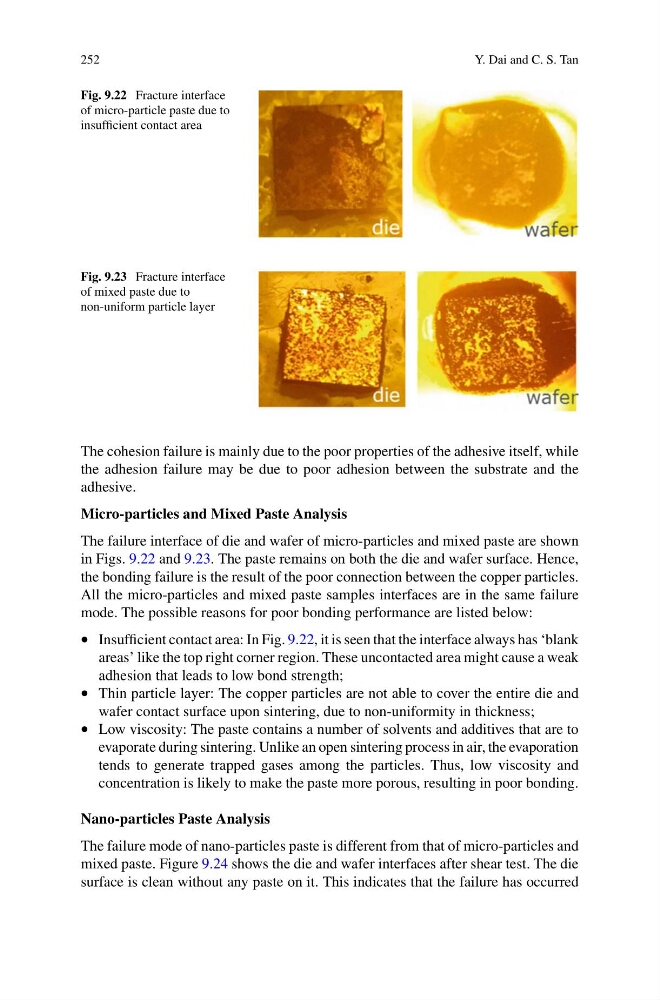
Fig. 9.22 Fracture interface
of micro-particle paste due to
insufficient contact area
Fig. 9.23 Fracture interface
of mixed paste due to
non-uniform particle layer
The cohesion failure is mainly due to the poor properties of the adhesive itself, while
the adhesion failure may be due to poor adhesion between the substrate and the
adhesive.
Micro-particles and Mixed Paste Analysis
The failure interface of die and wafer of micro-particles and mixed paste are shown
in Figs. 9.22 and 9.23. The paste remains on both the die and wafer surface. Hence,
the bonding failure is the result of the poor connection between the copper particles.
All the micro-particles and mixed paste samples interfaces are in the same failure
mode. The possible reasons for poor bonding performance are listed below:
• Insufficient contact area: In Fig. 9.22, it is seen that the interface always has ‘blank
areas’ like the top right corner region. These uncontacted area might cause a weak
adhesion that leads to low bond strength;
• Thin particle layer: The copper particles are not able to cover the entire die and
wafer contact surface upon sintering, due to non-uniformity in thickness;
• Low viscosity: The paste contains a number of solvents and additives that are to
evaporate during sintering. Unlike an open sintering process in air, the evaporation
tends to generate trapped gases among the particles. Thus, low viscosity and
concentration is likely to make the paste more porous, resulting in poor bonding.
Nano-particles Paste Analysis
The failure mode of nano-particles paste is different from that of micro-particles and
mixed paste. Figure 9.24 shows the die and wafer interfaces after shear test. The die
surface is clean without any paste on it. This indicates that the failure has occurred
Y. Dai and C. S. Tan
Fig. 9.22 Fracture interface
of micro-particle paste due to
insufficient contact area
Fig. 9.23 Fracture interface
of mixed paste due to
non-uniform particle layer
The cohesion failure is mainly due to the poor properties of the adhesive itself, while
the adhesion failure may be due to poor adhesion between the substrate and the
adhesive.
Micro-particles and Mixed Paste Analysis
The failure interface of die and wafer of micro-particles and mixed paste are shown
in Figs. 9.22 and 9.23. The paste remains on both the die and wafer surface. Hence,
the bonding failure is the result of the poor connection between the copper particles.
All the micro-particles and mixed paste samples interfaces are in the same failure
mode. The possible reasons for poor bonding performance are listed below:
• Insufficient contact area: In Fig. 9.22, it is seen that the interface always has ‘blank
areas’ like the top right corner region. These uncontacted area might cause a weak
adhesion that leads to low bond strength;
• Thin particle layer: The copper particles are not able to cover the entire die and
wafer contact surface upon sintering, due to non-uniformity in thickness;
• Low viscosity: The paste contains a number of solvents and additives that are to
evaporate during sintering. Unlike an open sintering process in air, the evaporation
tends to generate trapped gases among the particles. Thus, low viscosity and
concentration is likely to make the paste more porous, resulting in poor bonding.
Nano-particles Paste Analysis
The failure mode of nano-particles paste is different from that of micro-particles and
mixed paste. Figure 9.24 shows the die and wafer interfaces after shear test. The die
surface is clean without any paste on it. This indicates that the failure has occurred