

9 Copper Micro and Nano Particles Mixture for 3D Interconnection …
247
The cracks on the nano-particles paste surface is obvious and the micro-particles
and mixed paste do not display such large cracks. Although the nano-particles paste
has less porosity than the mixed paste partially, the nano-particles paste may not
be used as an ideal intermediate layer due to its macro brittle cracks. Compared
to the micro-particles paste, the mixed paste consistently has lesser porosity as the
nano-particles are able to fill the interstitials formed by the micro-particles.
The results obtained from the packing density is consistent with the preceding
results and the cracks in the nano-particles paste are verified. The mixed paste packing
density is improved by mixing the nano—and micro—particles. To find the mixture
ratio with the best performance, mixed paste with different ratios were then prepared
and the sheet resistance test and SEM images analysis were conducted.
Optimum Mixture Ratio Analysis
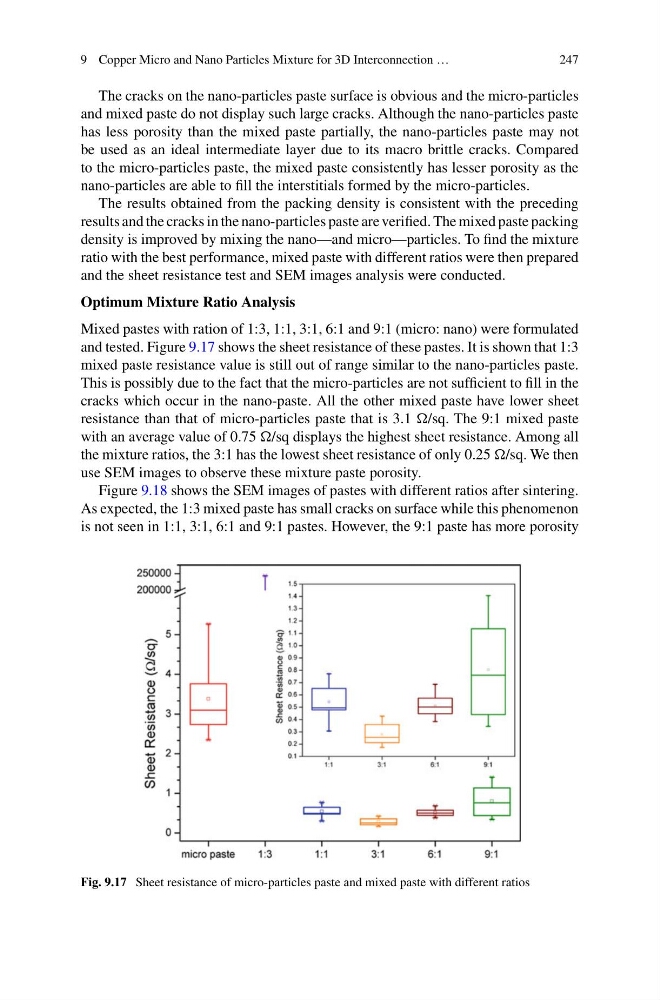
Mixed pastes with ration of 1:3, 1:1, 3:1, 6:1 and 9:1 (micro: nano) were formulated
and tested. Figure 9.17 shows the sheet resistance of these pastes. It is shown that 1:3
mixed paste resistance value is still out of range similar to the nano-particles paste.
This is possibly due to the fact that the micro-particles are not sufficient to fill in the
cracks which occur in the nano-paste. All the other mixed paste have lower sheet
resistance than that of micro-particles paste that is 3.1 /sq. The 9:1 mixed paste
with an average value of 0.75 /sq displays the highest sheet resistance. Among all
the mixture ratios, the 3:1 has the lowest sheet resistance of only 0.25 /sq. We then
use SEM images to observe these mixture paste porosity.
Figure 9.18 shows the SEM images of pastes with different ratios after sintering.
As expected, the 1:3 mixed paste has small cracks on surface while this phenomenon
is not seen in 1:1, 3:1, 6:1 and 9:1 pastes. However, the 9:1 paste has more porosity
Fig. 9.17 Sheet resistance of micro-particles paste and mixed paste with different ratios
247
The cracks on the nano-particles paste surface is obvious and the micro-particles
and mixed paste do not display such large cracks. Although the nano-particles paste
has less porosity than the mixed paste partially, the nano-particles paste may not
be used as an ideal intermediate layer due to its macro brittle cracks. Compared
to the micro-particles paste, the mixed paste consistently has lesser porosity as the
nano-particles are able to fill the interstitials formed by the micro-particles.
The results obtained from the packing density is consistent with the preceding
results and the cracks in the nano-particles paste are verified. The mixed paste packing
density is improved by mixing the nano—and micro—particles. To find the mixture
ratio with the best performance, mixed paste with different ratios were then prepared
and the sheet resistance test and SEM images analysis were conducted.
Optimum Mixture Ratio Analysis
Mixed pastes with ration of 1:3, 1:1, 3:1, 6:1 and 9:1 (micro: nano) were formulated
and tested. Figure 9.17 shows the sheet resistance of these pastes. It is shown that 1:3
mixed paste resistance value is still out of range similar to the nano-particles paste.
This is possibly due to the fact that the micro-particles are not sufficient to fill in the
cracks which occur in the nano-paste. All the other mixed paste have lower sheet
resistance than that of micro-particles paste that is 3.1 /sq. The 9:1 mixed paste
with an average value of 0.75 /sq displays the highest sheet resistance. Among all
the mixture ratios, the 3:1 has the lowest sheet resistance of only 0.25 /sq. We then
use SEM images to observe these mixture paste porosity.
Figure 9.18 shows the SEM images of pastes with different ratios after sintering.
As expected, the 1:3 mixed paste has small cracks on surface while this phenomenon
is not seen in 1:1, 3:1, 6:1 and 9:1 pastes. However, the 9:1 paste has more porosity
Fig. 9.17 Sheet resistance of micro-particles paste and mixed paste with different ratios