

208
T. Suga et al.
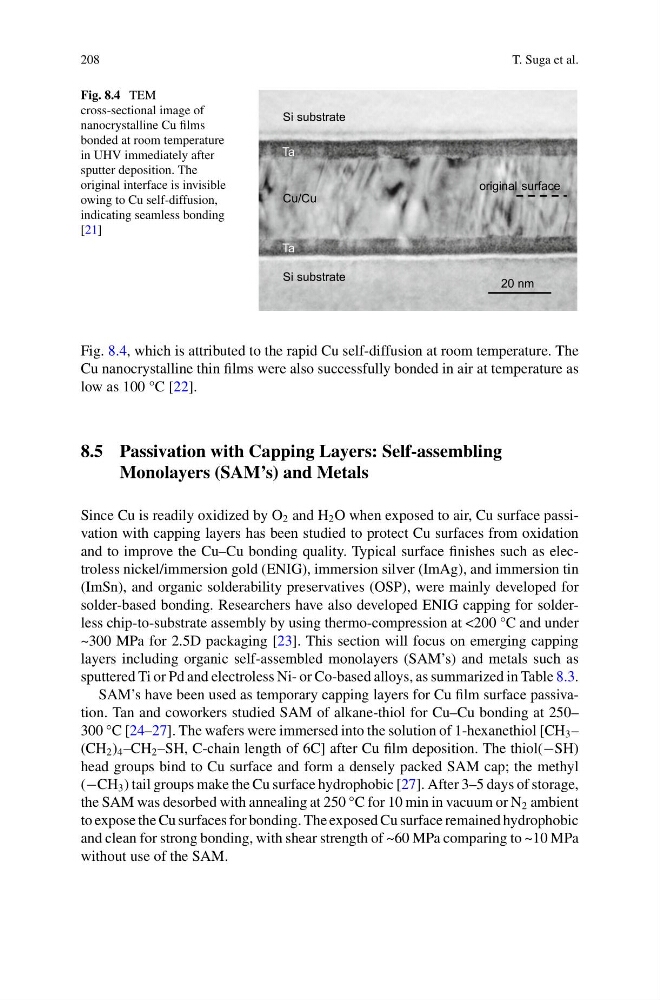
Fig. 8.4 TEM
cross-sectional image of
nanocrystalline Cu films
bonded at room temperature
in UHV immediately after
sputter deposition. The
original interface is invisible
owing to Cu self-diffusion,
indicating seamless bonding
[21]
Si substrate
Si substrate
Cu/Cu
Ta
Ta
original surface
20 nm
Fig. 8.4, which is attributed to the rapid Cu self-diffusion at room temperature. The
Cu nanocrystalline thin films were also successfully bonded in air at temperature as
low as 100 °C [22].
8.5 Passivation with Capping Layers: Self-assembling
Monolayers (SAM’s) and Metals
Since Cu is readily oxidized by O 2 and H 2 O when exposed to air, Cu surface passivation with capping layers has been studied to protect Cu surfaces from oxidation
and to improve the Cu–Cu bonding quality. Typical surface finishes such as electroless nickel/immersion gold (ENIG), immersion silver (ImAg), and immersion tin
(ImSn), and organic solderability preservatives (OSP), were mainly developed for
solder-based bonding. Researchers have also developed ENIG capping for solderless chip-to-substrate assembly by using thermo-compression at <200 °C and under
~300 MPa for 2.5D packaging [23]. This section will focus on emerging capping
layers including organic self-assembled monolayers (SAM’s) and metals such as
sputtered Ti or Pd and electroless Ni- or Co-based alloys, as summarized in Table 8.3.
SAM’s have been used as temporary capping layers for Cu film surface passivation. Tan and coworkers studied SAM of alkane-thiol for Cu–Cu bonding at 250–
300 °C [24–27]. The wafers were immersed into the solution of 1-hexanethiol [CH 3 –
(CH 2 ) 4 –CH 2 –SH, C-chain length of 6C] after Cu film deposition. The thiol(−SH)
head groups bind to Cu surface and form a densely packed SAM cap; the methyl
(−CH 3 ) tail groups make the Cu surface hydrophobic [27]. After 3–5 days of storage,
the SAM was desorbed with annealing at 250 °C for 10 min in vacuum or N 2 ambient
to expose the Cu surfaces for bonding. The exposed Cu surface remained hydrophobic
and clean for strong bonding, with shear strength of ~60 MPa comparing to ~10 MPa
without use of the SAM.
T. Suga et al.
Fig. 8.4 TEM
cross-sectional image of
nanocrystalline Cu films
bonded at room temperature
in UHV immediately after
sputter deposition. The
original interface is invisible
owing to Cu self-diffusion,
indicating seamless bonding
[21]
Si substrate
Si substrate
Cu/Cu
Ta
Ta
original surface
20 nm
Fig. 8.4, which is attributed to the rapid Cu self-diffusion at room temperature. The
Cu nanocrystalline thin films were also successfully bonded in air at temperature as
low as 100 °C [22].
8.5 Passivation with Capping Layers: Self-assembling
Monolayers (SAM’s) and Metals
Since Cu is readily oxidized by O 2 and H 2 O when exposed to air, Cu surface passivation with capping layers has been studied to protect Cu surfaces from oxidation
and to improve the Cu–Cu bonding quality. Typical surface finishes such as electroless nickel/immersion gold (ENIG), immersion silver (ImAg), and immersion tin
(ImSn), and organic solderability preservatives (OSP), were mainly developed for
solder-based bonding. Researchers have also developed ENIG capping for solderless chip-to-substrate assembly by using thermo-compression at <200 °C and under
~300 MPa for 2.5D packaging [23]. This section will focus on emerging capping
layers including organic self-assembled monolayers (SAM’s) and metals such as
sputtered Ti or Pd and electroless Ni- or Co-based alloys, as summarized in Table 8.3.
SAM’s have been used as temporary capping layers for Cu film surface passivation. Tan and coworkers studied SAM of alkane-thiol for Cu–Cu bonding at 250–
300 °C [24–27]. The wafers were immersed into the solution of 1-hexanethiol [CH 3 –
(CH 2 ) 4 –CH 2 –SH, C-chain length of 6C] after Cu film deposition. The thiol(−SH)
head groups bind to Cu surface and form a densely packed SAM cap; the methyl
(−CH 3 ) tail groups make the Cu surface hydrophobic [27]. After 3–5 days of storage,
the SAM was desorbed with annealing at 250 °C for 10 min in vacuum or N 2 ambient
to expose the Cu surfaces for bonding. The exposed Cu surface remained hydrophobic
and clean for strong bonding, with shear strength of ~60 MPa comparing to ~10 MPa
without use of the SAM.