

146
J. Liu et al.
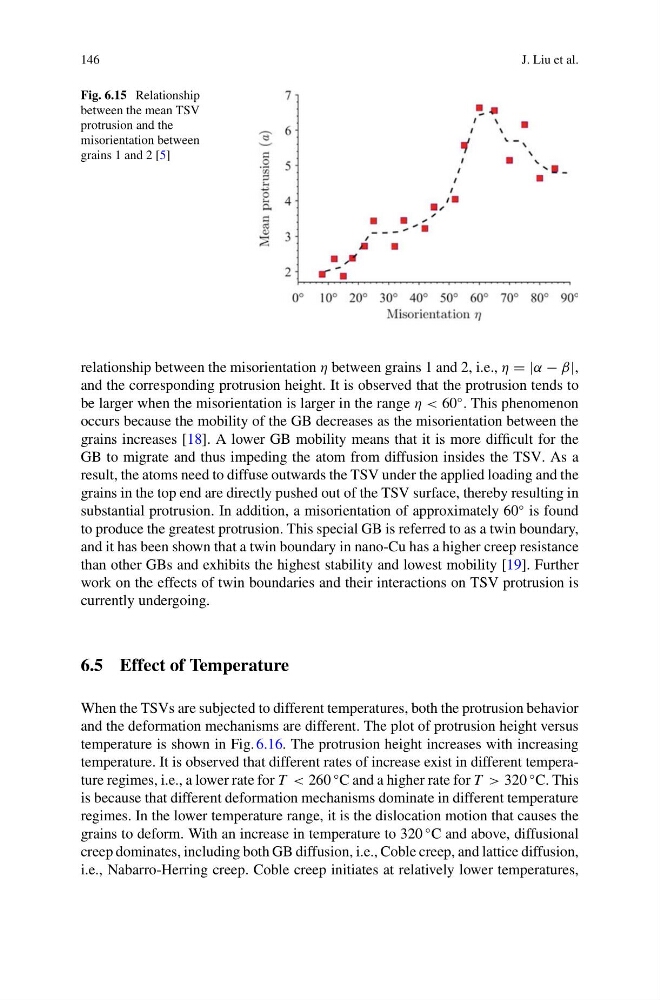
Fig. 6.15 Relationship
between the mean TSV
protrusion and the
misorientation between
grains 1 and 2 [5]
relationship between the misorientation η between grains 1 and 2, i.e., η = |α − β|,
and the corresponding protrusion height. It is observed that the protrusion tends to
be larger when the misorientation is larger in the range η < 60
◦ . This phenomenon
occurs because the mobility of the GB decreases as the misorientation between the
grains increases [18]. A lower GB mobility means that it is more difficult for the
GB to migrate and thus impeding the atom from diffusion insides the TSV. As a
result, the atoms need to diffuse outwards the TSV under the applied loading and the
grains in the top end are directly pushed out of the TSV surface, thereby resulting in
substantial protrusion. In addition, a misorientation of approximately 60
◦ is found
to produce the greatest protrusion. This special GB is referred to as a twin boundary,
and it has been shown that a twin boundary in nano-Cu has a higher creep resistance
than other GBs and exhibits the highest stability and lowest mobility [19]. Further
work on the effects of twin boundaries and their interactions on TSV protrusion is
currently undergoing.
6.5 Effect of Temperature
When the TSVs are subjected to different temperatures, both the protrusion behavior
and the deformation mechanisms are different. The plot of protrusion height versus
temperature is shown in Fig. 6.16. The protrusion height increases with increasing
temperature. It is observed that different rates of increase exist in different temperature regimes, i.e., a lower rate for T < 260
◦ C and a higher rate for T > 320
◦ C. This
is because that different deformation mechanisms dominate in different temperature
regimes. In the lower temperature range, it is the dislocation motion that causes the
grains to deform. With an increase in temperature to 320
◦ C and above, diffusional
creep dominates, including both GB diffusion, i.e., Coble creep, and lattice diffusion,
i.e., Nabarro-Herring creep. Coble creep initiates at relatively lower temperatures,
J. Liu et al.
Fig. 6.15 Relationship
between the mean TSV
protrusion and the
misorientation between
grains 1 and 2 [5]
relationship between the misorientation η between grains 1 and 2, i.e., η = |α − β|,
and the corresponding protrusion height. It is observed that the protrusion tends to
be larger when the misorientation is larger in the range η < 60
◦ . This phenomenon
occurs because the mobility of the GB decreases as the misorientation between the
grains increases [18]. A lower GB mobility means that it is more difficult for the
GB to migrate and thus impeding the atom from diffusion insides the TSV. As a
result, the atoms need to diffuse outwards the TSV under the applied loading and the
grains in the top end are directly pushed out of the TSV surface, thereby resulting in
substantial protrusion. In addition, a misorientation of approximately 60
◦ is found
to produce the greatest protrusion. This special GB is referred to as a twin boundary,
and it has been shown that a twin boundary in nano-Cu has a higher creep resistance
than other GBs and exhibits the highest stability and lowest mobility [19]. Further
work on the effects of twin boundaries and their interactions on TSV protrusion is
currently undergoing.
6.5 Effect of Temperature
When the TSVs are subjected to different temperatures, both the protrusion behavior
and the deformation mechanisms are different. The plot of protrusion height versus
temperature is shown in Fig. 6.16. The protrusion height increases with increasing
temperature. It is observed that different rates of increase exist in different temperature regimes, i.e., a lower rate for T < 260
◦ C and a higher rate for T > 320
◦ C. This
is because that different deformation mechanisms dominate in different temperature
regimes. In the lower temperature range, it is the dislocation motion that causes the
grains to deform. With an increase in temperature to 320
◦ C and above, diffusional
creep dominates, including both GB diffusion, i.e., Coble creep, and lattice diffusion,
i.e., Nabarro-Herring creep. Coble creep initiates at relatively lower temperatures,