

128
J. Liu et al.
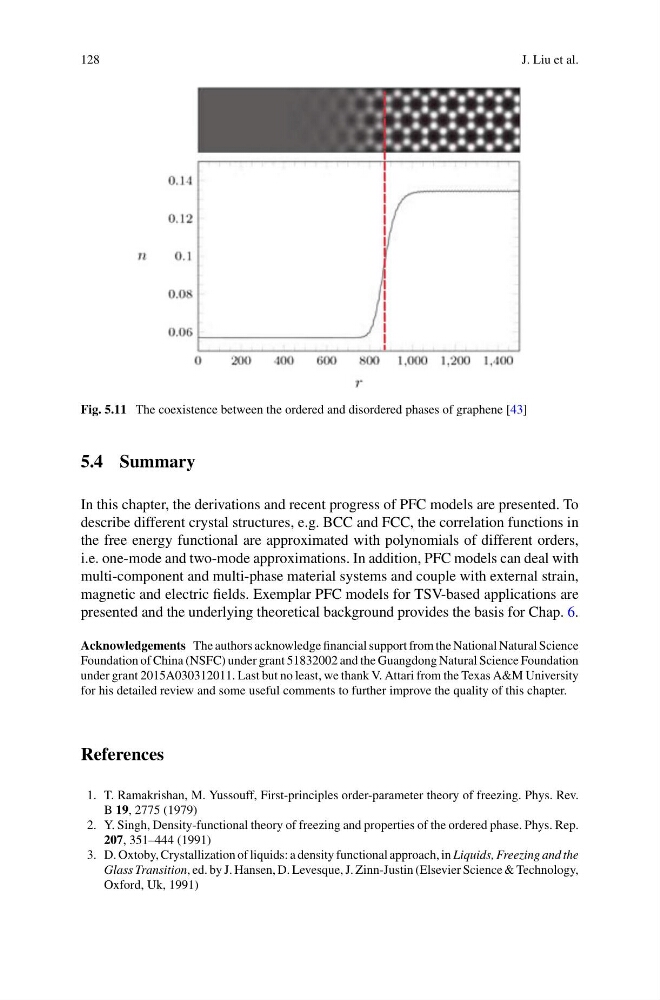
Fig. 5.11 The coexistence between the ordered and disordered phases of graphene [43]
5.4 Summary
In this chapter, the derivations and recent progress of PFC models are presented. To
describe different crystal structures, e.g. BCC and FCC, the correlation functions in
the free energy functional are approximated with polynomials of different orders,
i.e. one-mode and two-mode approximations. In addition, PFC models can deal with
multi-component and multi-phase material systems and couple with external strain,
magnetic and electric fields. Exemplar PFC models for TSV-based applications are
presented and the underlying theoretical background provides the basis for Chap. 6.
Acknowledgements The authors acknowledge financial support from the National Natural Science
Foundation of China (NSFC) under grant 51832002 and the Guangdong Natural Science Foundation
under grant 2015A030312011. Last but no least, we thank V. Attari from the Texas A&M University
for his detailed review and some useful comments to further improve the quality of this chapter.
References
1. T. Ramakrishan, M. Yussouff, First-principles order-parameter theory of freezing. Phys. Rev.
B 19, 2775 (1979)
2. Y. Singh, Density-functional theory of freezing and properties of the ordered phase. Phys. Rep.
207, 351–444 (1991)
3. D. Oxtoby, Crystallization of liquids: a density functional approach, in Liquids, Freezing and the
Glass Transition, ed. by J. Hansen, D. Levesque, J. Zinn-Justin (Elsevier Science & Technology,
Oxford, Uk, 1991)
J. Liu et al.
Fig. 5.11 The coexistence between the ordered and disordered phases of graphene [43]
5.4 Summary
In this chapter, the derivations and recent progress of PFC models are presented. To
describe different crystal structures, e.g. BCC and FCC, the correlation functions in
the free energy functional are approximated with polynomials of different orders,
i.e. one-mode and two-mode approximations. In addition, PFC models can deal with
multi-component and multi-phase material systems and couple with external strain,
magnetic and electric fields. Exemplar PFC models for TSV-based applications are
presented and the underlying theoretical background provides the basis for Chap. 6.
Acknowledgements The authors acknowledge financial support from the National Natural Science
Foundation of China (NSFC) under grant 51832002 and the Guangdong Natural Science Foundation
under grant 2015A030312011. Last but no least, we thank V. Attari from the Texas A&M University
for his detailed review and some useful comments to further improve the quality of this chapter.
References
1. T. Ramakrishan, M. Yussouff, First-principles order-parameter theory of freezing. Phys. Rev.
B 19, 2775 (1979)
2. Y. Singh, Density-functional theory of freezing and properties of the ordered phase. Phys. Rep.
207, 351–444 (1991)
3. D. Oxtoby, Crystallization of liquids: a density functional approach, in Liquids, Freezing and the
Glass Transition, ed. by J. Hansen, D. Levesque, J. Zinn-Justin (Elsevier Science & Technology,
Oxford, Uk, 1991)