

85
In current models, the rice straw floats on the surface of the substrate and gets
stuck. Scientists at Can Tho University are testing a new HDPE model, which could
prevent the floating straw by adjusting the inlet and outlet balance level. This
upgrade could also improve the short retention time of the straw as well.
5.3.2.1 Rice Straw Batch AD
This technology was developed at IRRI (RKB, accessed 2019) by Nguyen et al.
(2016) using a hermetic bag (so called IRRI super bag) to make the digesters. This
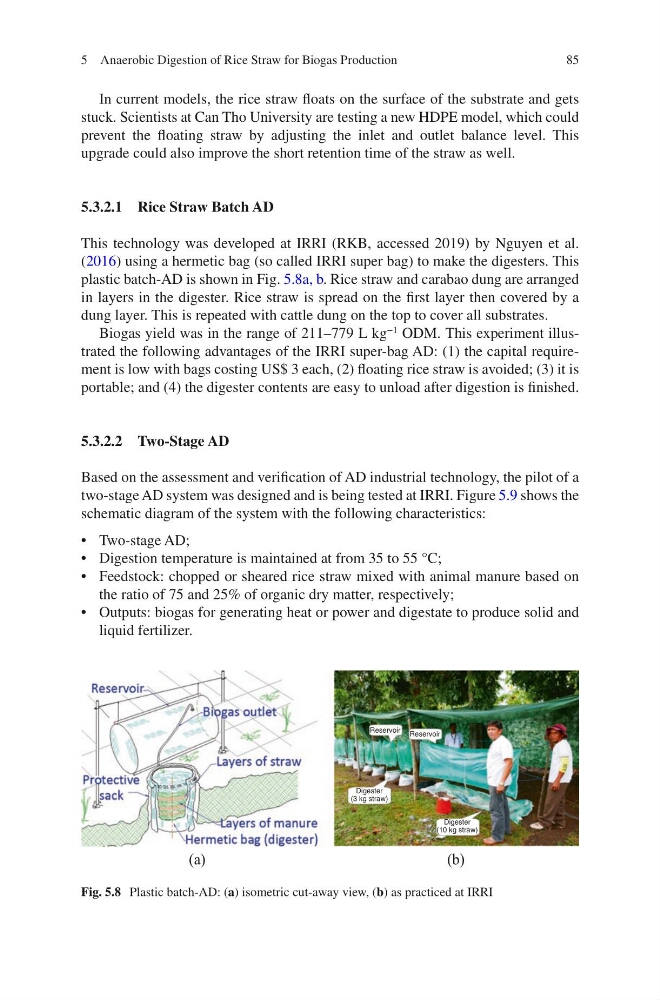
plastic batch-AD is shown in Fig. 5.8a, b. Rice straw and carabao dung are arranged
in layers in the digester. Rice straw is spread on the first layer then covered by a
dung layer. This is repeated with cattle dung on the top to cover all substrates.
Biogas yield was in the range of 211–779 L kg
−1
ODM. This experiment illustrated the following advantages of the IRRI super-bag AD: (1) the capital requirement is low with bags costing US$ 3 each, (2) floating rice straw is avoided; (3) it is
portable; and (4) the digester contents are easy to unload after digestion is finished.
5.3.2.2 Two-Stage AD
Based on the assessment and verification of AD industrial technology, the pilot of a
two-stage AD system was designed and is being tested at IRRI. Figure 5.9 shows the
schematic diagram of the system with the following characteristics:
• Two-stage AD;
• Digestion temperature is maintained at from 35 to 55 °C;
• Feedstock: chopped or sheared rice straw mixed with animal manure based on
the ratio of 75 and 25% of organic dry matter, respectively;
• Outputs: biogas for generating heat or power and digestate to produce solid and
liquid fertilizer.
Reservoir
(a)
(b)
Digester
(3 kg straw)
Digester
(10 kg straw)
Reservoir
Fig. 5.8 Plastic batch-AD: (a) isometric cut-away view, (b) as practiced at IRRI
5 Anaerobic Digestion of Rice Straw for Biogas Production
In current models, the rice straw floats on the surface of the substrate and gets
stuck. Scientists at Can Tho University are testing a new HDPE model, which could
prevent the floating straw by adjusting the inlet and outlet balance level. This
upgrade could also improve the short retention time of the straw as well.
5.3.2.1 Rice Straw Batch AD
This technology was developed at IRRI (RKB, accessed 2019) by Nguyen et al.
(2016) using a hermetic bag (so called IRRI super bag) to make the digesters. This
plastic batch-AD is shown in Fig. 5.8a, b. Rice straw and carabao dung are arranged
in layers in the digester. Rice straw is spread on the first layer then covered by a
dung layer. This is repeated with cattle dung on the top to cover all substrates.
Biogas yield was in the range of 211–779 L kg
−1
ODM. This experiment illustrated the following advantages of the IRRI super-bag AD: (1) the capital requirement is low with bags costing US$ 3 each, (2) floating rice straw is avoided; (3) it is
portable; and (4) the digester contents are easy to unload after digestion is finished.
5.3.2.2 Two-Stage AD
Based on the assessment and verification of AD industrial technology, the pilot of a
two-stage AD system was designed and is being tested at IRRI. Figure 5.9 shows the
schematic diagram of the system with the following characteristics:
• Two-stage AD;
• Digestion temperature is maintained at from 35 to 55 °C;
• Feedstock: chopped or sheared rice straw mixed with animal manure based on
the ratio of 75 and 25% of organic dry matter, respectively;
• Outputs: biogas for generating heat or power and digestate to produce solid and
liquid fertilizer.
Reservoir
(a)
(b)
Digester
(3 kg straw)
Digester
(10 kg straw)
Reservoir
Fig. 5.8 Plastic batch-AD: (a) isometric cut-away view, (b) as practiced at IRRI
5 Anaerobic Digestion of Rice Straw for Biogas Production