

69
5.1.3 Factors Affecting the Anaerobic Digestion Process
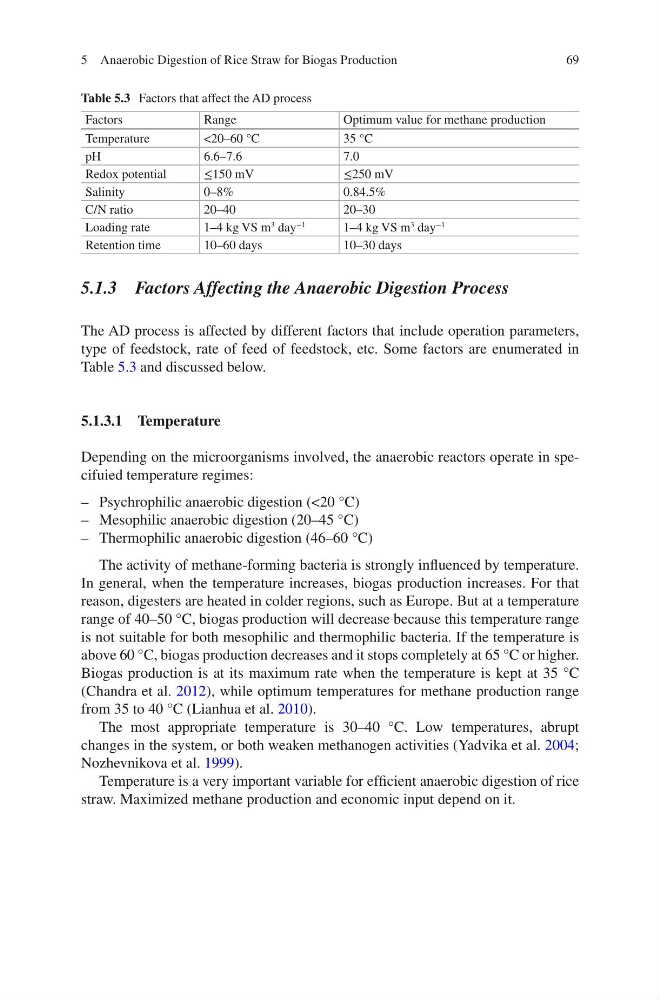
The AD process is affected by different factors that include operation parameters,
type of feedstock, rate of feed of feedstock, etc. Some factors are enumerated in
Table 5.3 and discussed below.
5.1.3.1 Temperature
Depending on the microorganisms involved, the anaerobic reactors operate in specifuied temperature regimes:
– Psychrophilic anaerobic digestion (<20 °C)
– Mesophilic anaerobic digestion (20–45 °C)
– Thermophilic anaerobic digestion (46–60 °C)
The activity of methane-forming bacteria is strongly influenced by temperature.
In general, when the temperature increases, biogas production increases. For that
reason, digesters are heated in colder regions, such as Europe. But at a temperature
range of 40–50 °C, biogas production will decrease because this temperature range
is not suitable for both mesophilic and thermophilic bacteria. If the temperature is
above 60 °C, biogas production decreases and it stops completely at 65 °C or higher.
Biogas production is at its maximum rate when the temperature is kept at 35 °C
(Chandra et al. 2012), while optimum temperatures for methane production range
from 35 to 40 °C (Lianhua et al. 2010).
The most appropriate temperature is 30–40 °C. Low temperatures, abrupt
changes in the system, or both weaken methanogen activities (Yadvika et al. 2004;
Nozhevnikova et al. 1999).
Temperature is a very important variable for efficient anaerobic digestion of rice
straw. Maximized methane production and economic input depend on it.
Table 5.3 Factors that affect the AD process
Factors
Range
Optimum value for methane production
Temperature
<20–60 °C
35 °C
pH
6.6–7.6
7.0
Redox potential
≤150 mV
≤250 mV
Salinity
0–8%
0.84.5%
C/N ratio
20–40
20–30
Loading rate
1–4 kg VS m
3 day
−1
1–4 kg VS m
3
day
−1
Retention time
10–60 days
10–30 days
5 Anaerobic Digestion of Rice Straw for Biogas Production
5.1.3 Factors Affecting the Anaerobic Digestion Process
The AD process is affected by different factors that include operation parameters,
type of feedstock, rate of feed of feedstock, etc. Some factors are enumerated in
Table 5.3 and discussed below.
5.1.3.1 Temperature
Depending on the microorganisms involved, the anaerobic reactors operate in specifuied temperature regimes:
– Psychrophilic anaerobic digestion (<20 °C)
– Mesophilic anaerobic digestion (20–45 °C)
– Thermophilic anaerobic digestion (46–60 °C)
The activity of methane-forming bacteria is strongly influenced by temperature.
In general, when the temperature increases, biogas production increases. For that
reason, digesters are heated in colder regions, such as Europe. But at a temperature
range of 40–50 °C, biogas production will decrease because this temperature range
is not suitable for both mesophilic and thermophilic bacteria. If the temperature is
above 60 °C, biogas production decreases and it stops completely at 65 °C or higher.
Biogas production is at its maximum rate when the temperature is kept at 35 °C
(Chandra et al. 2012), while optimum temperatures for methane production range
from 35 to 40 °C (Lianhua et al. 2010).
The most appropriate temperature is 30–40 °C. Low temperatures, abrupt
changes in the system, or both weaken methanogen activities (Yadvika et al. 2004;
Nozhevnikova et al. 1999).
Temperature is a very important variable for efficient anaerobic digestion of rice
straw. Maximized methane production and economic input depend on it.
Table 5.3 Factors that affect the AD process
Factors
Range
Optimum value for methane production
Temperature
<20–60 °C
35 °C
pH
6.6–7.6
7.0
Redox potential
≤150 mV
≤250 mV
Salinity
0–8%
0.84.5%
C/N ratio
20–40
20–30
Loading rate
1–4 kg VS m
3 day
−1
1–4 kg VS m
3
day
−1
Retention time
10–60 days
10–30 days
5 Anaerobic Digestion of Rice Straw for Biogas Production