

68
sugars; fats degrade into fatty acids; and proteins degrade into amino acids (Gerardi
2003; Eastman and Ferguson 1981).
5.1.2.2 Stage 2: Acid-Producing (Acidogenesis)
Simple organic compounds which were created during hydrolysis stage will be
transformed into volatile fatty acids (VFAs), long chain fatty acids, propionate, and
butyrate by anaerobes (Jördening and Winter 2006). The concentration of H
+
formed
in this stage may affect the products of fermentation. High concentration of H
+
reduces the production of acetate. In general, during this stage, simple sugars, fatty
acids, and amino acids are fermented to form organic acids and alcohol
(Gerardi 2003).
5.1.2.3 Stage 3: Acetic Acid-Producing (Acetogenesis)
The products from the previous stage are the substrate for bacteria in the acetic acidproducing stage. The products from these intermediate substrates are H 2 , CO 2 , and
acetate. Acetogenic bacteria grow together with methanogen bacteria in this stage.
5.1.2.4 Stage 4: Methane-Producing (Methanogenesis)
During this stage, methane is created under completely anaerobic conditions. This
reaction is considered an exothermic reaction. Stage 4 can be divided into two
methane- generating processes: reduction of CH 3 COO
−
and conversion of H 2 with
CO 2 . Acetotrophic methanogens are responsible for the reduction of acetate
(CH 3 COO
−
) into methane, while hydrogenotrophic methanogens are responsible
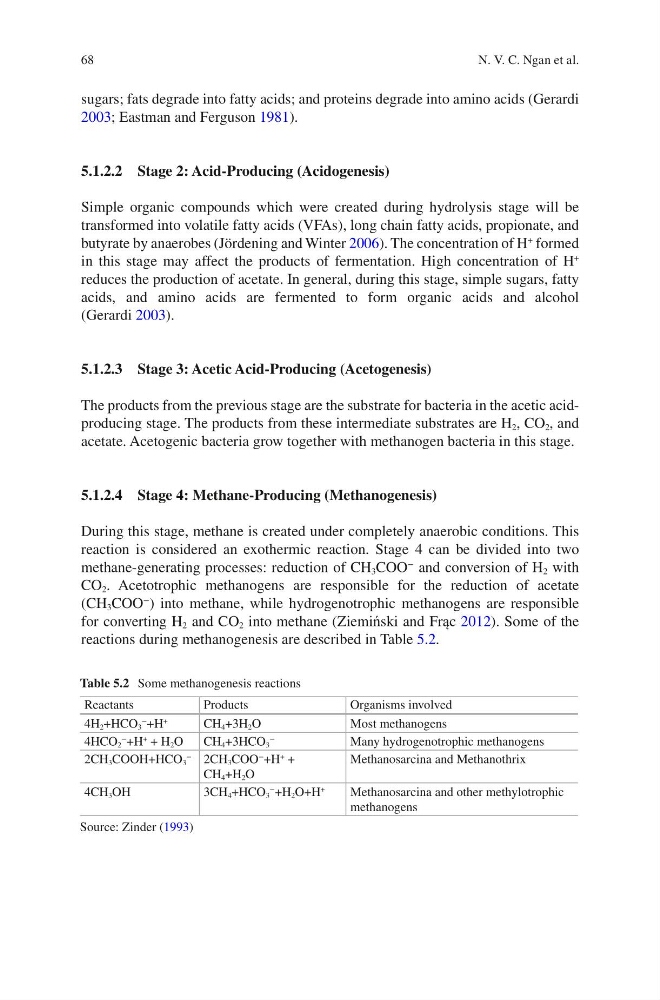
for converting H 2 and CO 2 into methane (Ziemiński and Frąc 2012). Some of the
reactions during methanogenesis are described in Table 5.2.
Table 5.2 Some methanogenesis reactions
Reactants
Products
Organisms involved
4H 2 +HCO 3
− +H
+
CH 4 +3H 2 O
Most methanogens
4HCO 2
−
+H
+ + H 2 O
CH 4 +3HCO 3
−
Many hydrogenotrophic methanogens
2CH 3 COOH+HCO 3
−
2CH 3 COO
−
+H
+ +
CH 4 +H 2 O
Methanosarcina and Methanothrix
4CH 3 OH
3CH 4 +HCO 3
− +H 2 O+H
+
Methanosarcina and other methylotrophic
methanogens
Source: Zinder (1993)
N. V. C. Ngan et al.
sugars; fats degrade into fatty acids; and proteins degrade into amino acids (Gerardi
2003; Eastman and Ferguson 1981).
5.1.2.2 Stage 2: Acid-Producing (Acidogenesis)
Simple organic compounds which were created during hydrolysis stage will be
transformed into volatile fatty acids (VFAs), long chain fatty acids, propionate, and
butyrate by anaerobes (Jördening and Winter 2006). The concentration of H
+
formed
in this stage may affect the products of fermentation. High concentration of H
+
reduces the production of acetate. In general, during this stage, simple sugars, fatty
acids, and amino acids are fermented to form organic acids and alcohol
(Gerardi 2003).
5.1.2.3 Stage 3: Acetic Acid-Producing (Acetogenesis)
The products from the previous stage are the substrate for bacteria in the acetic acidproducing stage. The products from these intermediate substrates are H 2 , CO 2 , and
acetate. Acetogenic bacteria grow together with methanogen bacteria in this stage.
5.1.2.4 Stage 4: Methane-Producing (Methanogenesis)
During this stage, methane is created under completely anaerobic conditions. This
reaction is considered an exothermic reaction. Stage 4 can be divided into two
methane- generating processes: reduction of CH 3 COO
−
and conversion of H 2 with
CO 2 . Acetotrophic methanogens are responsible for the reduction of acetate
(CH 3 COO
−
) into methane, while hydrogenotrophic methanogens are responsible
for converting H 2 and CO 2 into methane (Ziemiński and Frąc 2012). Some of the
reactions during methanogenesis are described in Table 5.2.
Table 5.2 Some methanogenesis reactions
Reactants
Products
Organisms involved
4H 2 +HCO 3
− +H
+
CH 4 +3H 2 O
Most methanogens
4HCO 2
−
+H
+ + H 2 O
CH 4 +3HCO 3
−
Many hydrogenotrophic methanogens
2CH 3 COOH+HCO 3
−
2CH 3 COO
−
+H
+ +
CH 4 +H 2 O
Methanosarcina and Methanothrix
4CH 3 OH
3CH 4 +HCO 3
− +H 2 O+H
+
Methanosarcina and other methylotrophic
methanogens
Source: Zinder (1993)
N. V. C. Ngan et al.