

39
varies in composition. The CO 2 content gradually increases and the O 2 level falls
during composting process. The concentration of O 2 for composting varies from 15
to 20%. (Diaz et al. 2007). Thus, the turning process helps improve aeration and
mixing of compost constituents. The windrow composting method relies on
mechanical aeration, typically with a compost windrow turner, to optimize the
composting process. During turning, microbial inoculum is mixed with water and
sprayed in the windrow to speed up the composting process and obtain the required
moisture content. The interval between turnings is usually 10–14 days (IRRI 2019),
but 15-day intervals have also been reported (Muzamil 2012). After turning, the
windrow is covered using a plastic sheet to maintain the proper moisture content
and temperature. The height and width of the windrows are typically set to fit the
size of the turner.
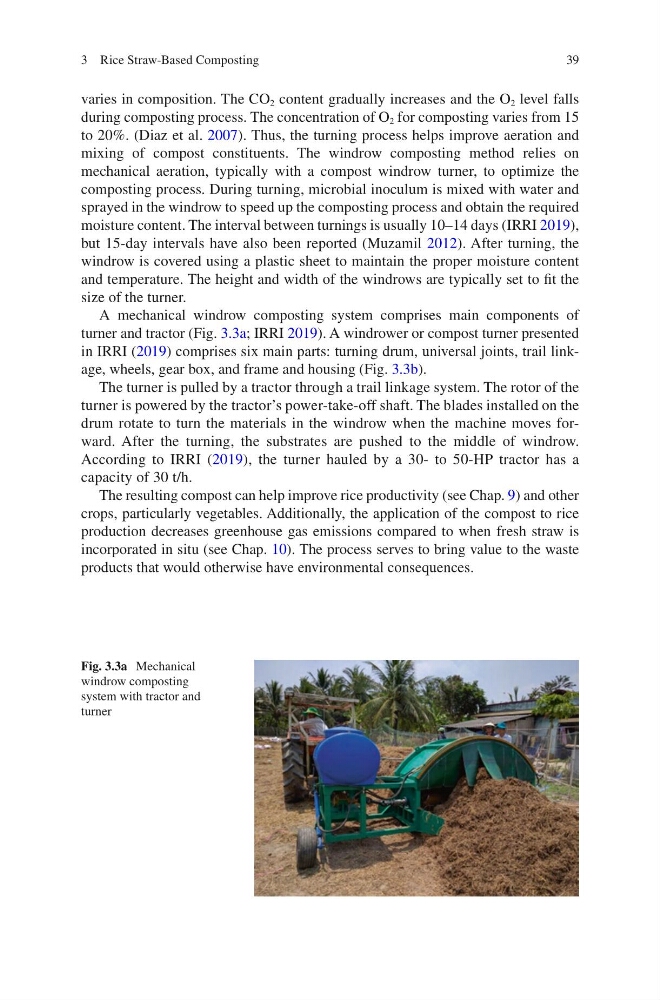
A mechanical windrow composting system comprises main components of
turner and tractor (Fig. 3.3a; IRRI 2019). A windrower or compost turner presented
in IRRI (2019) comprises six main parts: turning drum, universal joints, trail linkage, wheels, gear box, and frame and housing (Fig. 3.3b).
The turner is pulled by a tractor through a trail linkage system. The rotor of the
turner is powered by the tractor’s power-take-off shaft. The blades installed on the
drum rotate to turn the materials in the windrow when the machine moves forward. After the turning, the substrates are pushed to the middle of windrow.
According to IRRI (2019), the turner hauled by a 30- to 50-HP tractor has a
capacity of 30 t/h.
The resulting compost can help improve rice productivity (see Chap. 9) and other
crops, particularly vegetables. Additionally, the application of the compost to rice
production decreases greenhouse gas emissions compared to when fresh straw is
incorporated in situ (see Chap. 10). The process serves to bring value to the waste
products that would otherwise have environmental consequences.
Fig. 3.3a Mechanical
windrow composting
system with tractor and
turner
3 Rice Straw-Based Composting
varies in composition. The CO 2 content gradually increases and the O 2 level falls
during composting process. The concentration of O 2 for composting varies from 15
to 20%. (Diaz et al. 2007). Thus, the turning process helps improve aeration and
mixing of compost constituents. The windrow composting method relies on
mechanical aeration, typically with a compost windrow turner, to optimize the
composting process. During turning, microbial inoculum is mixed with water and
sprayed in the windrow to speed up the composting process and obtain the required
moisture content. The interval between turnings is usually 10–14 days (IRRI 2019),
but 15-day intervals have also been reported (Muzamil 2012). After turning, the
windrow is covered using a plastic sheet to maintain the proper moisture content
and temperature. The height and width of the windrows are typically set to fit the
size of the turner.
A mechanical windrow composting system comprises main components of
turner and tractor (Fig. 3.3a; IRRI 2019). A windrower or compost turner presented
in IRRI (2019) comprises six main parts: turning drum, universal joints, trail linkage, wheels, gear box, and frame and housing (Fig. 3.3b).
The turner is pulled by a tractor through a trail linkage system. The rotor of the
turner is powered by the tractor’s power-take-off shaft. The blades installed on the
drum rotate to turn the materials in the windrow when the machine moves forward. After the turning, the substrates are pushed to the middle of windrow.
According to IRRI (2019), the turner hauled by a 30- to 50-HP tractor has a
capacity of 30 t/h.
The resulting compost can help improve rice productivity (see Chap. 9) and other
crops, particularly vegetables. Additionally, the application of the compost to rice
production decreases greenhouse gas emissions compared to when fresh straw is
incorporated in situ (see Chap. 10). The process serves to bring value to the waste
products that would otherwise have environmental consequences.
Fig. 3.3a Mechanical
windrow composting
system with tractor and
turner
3 Rice Straw-Based Composting