

18
2.3 Overview of Mechanized Straw Collection Technologies
Mechanized collection of straw scattered in the field involves three main operations:
(1) picking up the straw from the field, (2) compressing it into bales, and (3) transporting the bales to the bunds. In some areas, there are also some machines that just
pick up the straw in loose form and transport it to the side of the field for further
densification and transport.
Rice straw balers can be classified according to their mobility, the technical operation of the compacting unit, the manner of straw collection in the field, and/or the
bulk density of produced bales (Fig. 2.3). A mobile baler moves on the field to collect and compress straw into bales; it can be self-propelled or pulled by a tractor. A
stationary baler, on the other hand, can be used to compress rice straw disposed by
stationary threshers, which are still quite common in Asia.
Balers can also be classified according to compression density (high or low),
shape of bales produced (round or square), and scale (large, at least with a 100-HP
tractor or engine or small, with a less than a 60-HP engine). Figure 2.4 shows a
schematic diagram of a round baler gathering rice straw, forming it into cylindrical
bales, and expelling them onto the field. It is pulled by a tractor connected via three
points with hydraulic ports to control pick-up height. It has a series of rollers that
form the round bales. The pressure for baling is delivered through the tractor’s
power take-off (PTO) and the bale expeller consists of a built-in, independent
hydraulic mechanism. It cannot work continuously as the operation must stop periodically so that the bales can be tied with a rope and then unloaded.
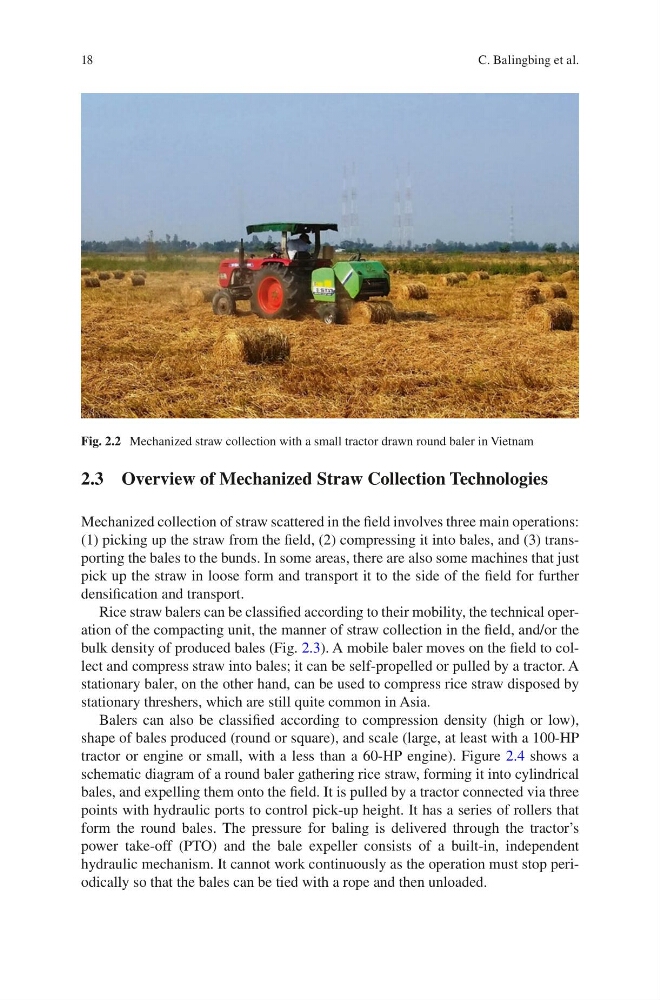
Fig. 2.2 Mechanized straw collection with a small tractor drawn round baler in Vietnam
C. Balingbing et al.
2.3 Overview of Mechanized Straw Collection Technologies
Mechanized collection of straw scattered in the field involves three main operations:
(1) picking up the straw from the field, (2) compressing it into bales, and (3) transporting the bales to the bunds. In some areas, there are also some machines that just
pick up the straw in loose form and transport it to the side of the field for further
densification and transport.
Rice straw balers can be classified according to their mobility, the technical operation of the compacting unit, the manner of straw collection in the field, and/or the
bulk density of produced bales (Fig. 2.3). A mobile baler moves on the field to collect and compress straw into bales; it can be self-propelled or pulled by a tractor. A
stationary baler, on the other hand, can be used to compress rice straw disposed by
stationary threshers, which are still quite common in Asia.
Balers can also be classified according to compression density (high or low),
shape of bales produced (round or square), and scale (large, at least with a 100-HP
tractor or engine or small, with a less than a 60-HP engine). Figure 2.4 shows a
schematic diagram of a round baler gathering rice straw, forming it into cylindrical
bales, and expelling them onto the field. It is pulled by a tractor connected via three
points with hydraulic ports to control pick-up height. It has a series of rollers that
form the round bales. The pressure for baling is delivered through the tractor’s
power take-off (PTO) and the bale expeller consists of a built-in, independent
hydraulic mechanism. It cannot work continuously as the operation must stop periodically so that the bales can be tied with a rope and then unloaded.
Fig. 2.2 Mechanized straw collection with a small tractor drawn round baler in Vietnam
C. Balingbing et al.