

17
The densification of loose biomass, such as rice straw, provides several advantages such as (1) improved handling and conveyance efficiencies throughout the
supply system and biorefinery in feed, (2) controlled particle size distribution for
improved feedstock uniformity and density, (3) fractional structural components for
improved compositional quality, and (4) conformance to predetermined conversion
technology and supply system specifications (Tumuluru et al. 2010). The common
methods used to achieve densification of loose biomass, such as rice straw, includes
extrusion, compacting, briquetting, or pelletizing (Demirbas and Sahin-Demirbas
2009; Tumuluru et al. 2010).
2.2 Mechanized Collection of Rice Straw
Traditionally, rice straw left after harvesting is collected by hand or with tools such
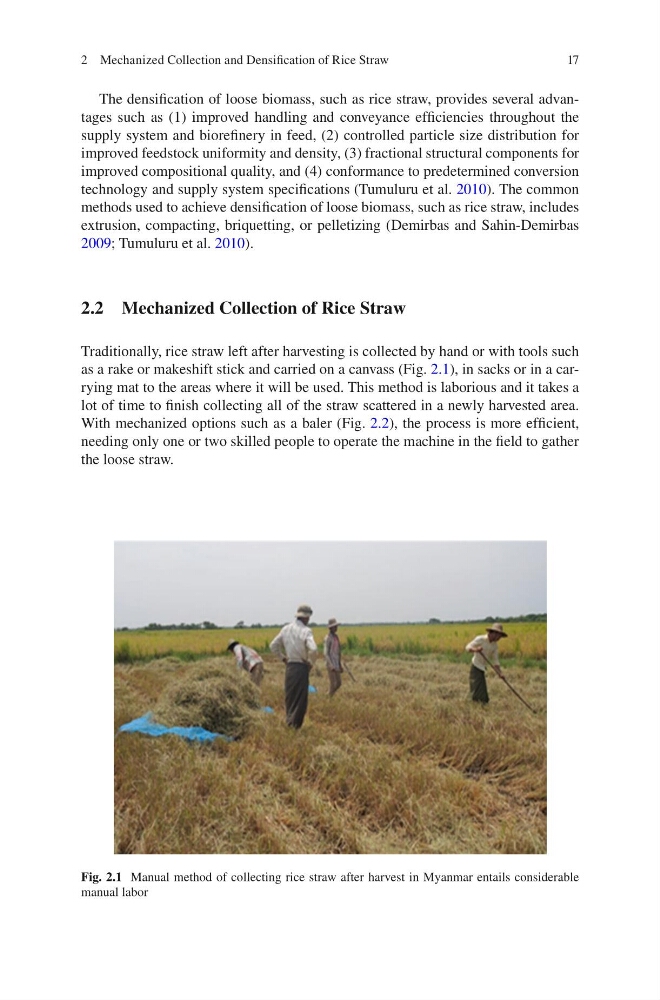
as a rake or makeshift stick and carried on a canvass (Fig. 2.1), in sacks or in a carrying mat to the areas where it will be used. This method is laborious and it takes a
lot of time to finish collecting all of the straw scattered in a newly harvested area.
With mechanized options such as a baler (Fig. 2.2), the process is more efficient,
needing only one or two skilled people to operate the machine in the field to gather
the loose straw.
Fig. 2.1 Manual method of collecting rice straw after harvest in Myanmar entails considerable
manual labor
2 Mechanized Collection and Densification of Rice Straw
The densification of loose biomass, such as rice straw, provides several advantages such as (1) improved handling and conveyance efficiencies throughout the
supply system and biorefinery in feed, (2) controlled particle size distribution for
improved feedstock uniformity and density, (3) fractional structural components for
improved compositional quality, and (4) conformance to predetermined conversion
technology and supply system specifications (Tumuluru et al. 2010). The common
methods used to achieve densification of loose biomass, such as rice straw, includes
extrusion, compacting, briquetting, or pelletizing (Demirbas and Sahin-Demirbas
2009; Tumuluru et al. 2010).
2.2 Mechanized Collection of Rice Straw
Traditionally, rice straw left after harvesting is collected by hand or with tools such
as a rake or makeshift stick and carried on a canvass (Fig. 2.1), in sacks or in a carrying mat to the areas where it will be used. This method is laborious and it takes a
lot of time to finish collecting all of the straw scattered in a newly harvested area.
With mechanized options such as a baler (Fig. 2.2), the process is more efficient,
needing only one or two skilled people to operate the machine in the field to gather
the loose straw.
Fig. 2.1 Manual method of collecting rice straw after harvest in Myanmar entails considerable
manual labor
2 Mechanized Collection and Densification of Rice Straw