

101
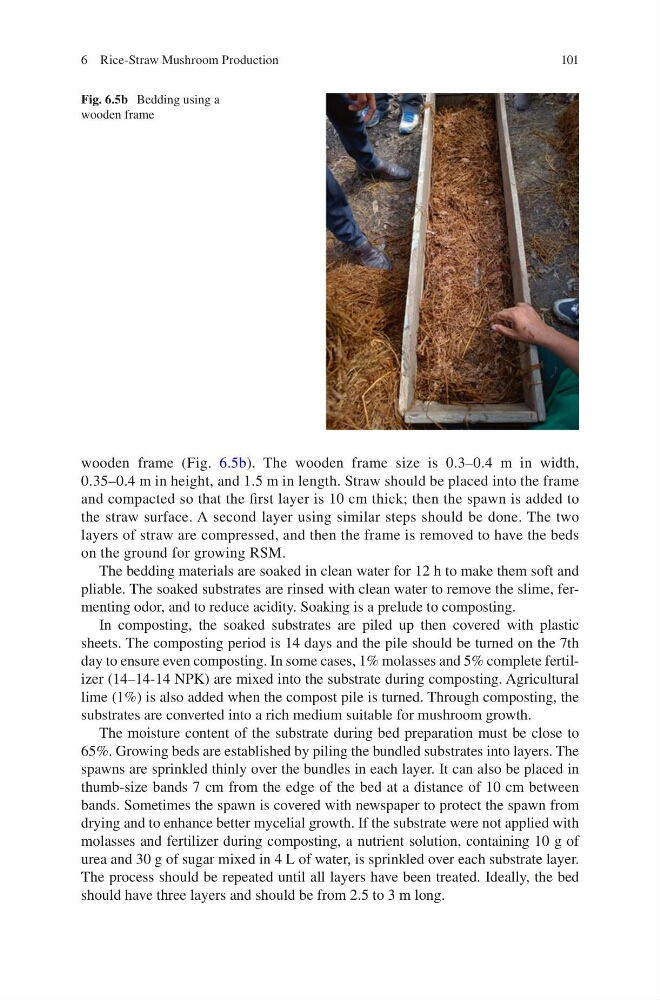
wooden frame (Fig. 6.5b). The wooden frame size is 0.3–0.4 m in width,
0.35–0.4 m in height, and 1.5 m in length. Straw should be placed into the frame
and compacted so that the first layer is 10 cm thick; then the spawn is added to
the straw surface. A second layer using similar steps should be done. The two
layers of straw are compressed, and then the frame is removed to have the beds
on the ground for growing RSM.
The bedding materials are soaked in clean water for 12 h to make them soft and
pliable. The soaked substrates are rinsed with clean water to remove the slime, fermenting odor, and to reduce acidity. Soaking is a prelude to composting.
In composting, the soaked substrates are piled up then covered with plastic
sheets. The composting period is 14 days and the pile should be turned on the 7th
day to ensure even composting. In some cases, 1% molasses and 5% complete fertilizer (14–14-14 NPK) are mixed into the substrate during composting. Agricultural
lime (1%) is also added when the compost pile is turned. Through composting, the
substrates are converted into a rich medium suitable for mushroom growth.
The moisture content of the substrate during bed preparation must be close to
65%. Growing beds are established by piling the bundled substrates into layers. The
spawns are sprinkled thinly over the bundles in each layer. It can also be placed in
thumb-size bands 7 cm from the edge of the bed at a distance of 10 cm between
bands. Sometimes the spawn is covered with newspaper to protect the spawn from
drying and to enhance better mycelial growth. If the substrate were not applied with
molasses and fertilizer during composting, a nutrient solution, containing 10 g of
urea and 30 g of sugar mixed in 4 L of water, is sprinkled over each substrate layer.
The process should be repeated until all layers have been treated. Ideally, the bed
should have three layers and should be from 2.5 to 3 m long.
Fig. 6.5b Bedding using a
wooden frame
6 Rice-Straw Mushroom Production
wooden frame (Fig. 6.5b). The wooden frame size is 0.3–0.4 m in width,
0.35–0.4 m in height, and 1.5 m in length. Straw should be placed into the frame
and compacted so that the first layer is 10 cm thick; then the spawn is added to
the straw surface. A second layer using similar steps should be done. The two
layers of straw are compressed, and then the frame is removed to have the beds
on the ground for growing RSM.
The bedding materials are soaked in clean water for 12 h to make them soft and
pliable. The soaked substrates are rinsed with clean water to remove the slime, fermenting odor, and to reduce acidity. Soaking is a prelude to composting.
In composting, the soaked substrates are piled up then covered with plastic
sheets. The composting period is 14 days and the pile should be turned on the 7th
day to ensure even composting. In some cases, 1% molasses and 5% complete fertilizer (14–14-14 NPK) are mixed into the substrate during composting. Agricultural
lime (1%) is also added when the compost pile is turned. Through composting, the
substrates are converted into a rich medium suitable for mushroom growth.
The moisture content of the substrate during bed preparation must be close to
65%. Growing beds are established by piling the bundled substrates into layers. The
spawns are sprinkled thinly over the bundles in each layer. It can also be placed in
thumb-size bands 7 cm from the edge of the bed at a distance of 10 cm between
bands. Sometimes the spawn is covered with newspaper to protect the spawn from
drying and to enhance better mycelial growth. If the substrate were not applied with
molasses and fertilizer during composting, a nutrient solution, containing 10 g of
urea and 30 g of sugar mixed in 4 L of water, is sprinkled over each substrate layer.
The process should be repeated until all layers have been treated. Ideally, the bed
should have three layers and should be from 2.5 to 3 m long.
Fig. 6.5b Bedding using a
wooden frame
6 Rice-Straw Mushroom Production