

100
ing. Next, the folded part is secured by tying with a rubber band. The PVC neck
opening is plugged with a rolled cotton waste then covered with paper secured with
rubber band.
The PP bags containing the spawn substrates are sterilized using an autoclave at
15 psi pressure and 121 °C for 30 min. The sterilized PP bags with the spawn substrates are then transferred to the inoculation room and allowed to cool down.
The sterilized bags are kept inside the laminar flow under a UV tube or inoculation chamber for 20–30 min. Inoculation is done by removing the cotton plug of
each bag, then placing a 1-sq mm pure culture mycelial block on top of the spawn
substrate using a sterilized inoculation needle, then replacing the cotton plug. The
process is repeated until all the bags with substrates have been inoculated.
The inoculated bags are kept in the incubation room at 32 °C temperature for
2 weeks, or until mycelial growth reaches the bottom of each bag. The bags should
always be checked for contamination during the incubation period. The shelf life of
the spawn is about 4 weeks at room temperature. It can also be refrigerated at 4 °C
to prolong storage. The refrigerated spawn should be primed at room temperature
before using in order to activate spawn growth.
6.4.1.3 Preparation of Growing Beds and Spawning
Rice straw or stubble can be used as bedding materials or substrates. These
materials collected from the field must be sun-dried. If bundled substrates are
used as bedding, the straw should be cut into 30-cm long strips to make bundles
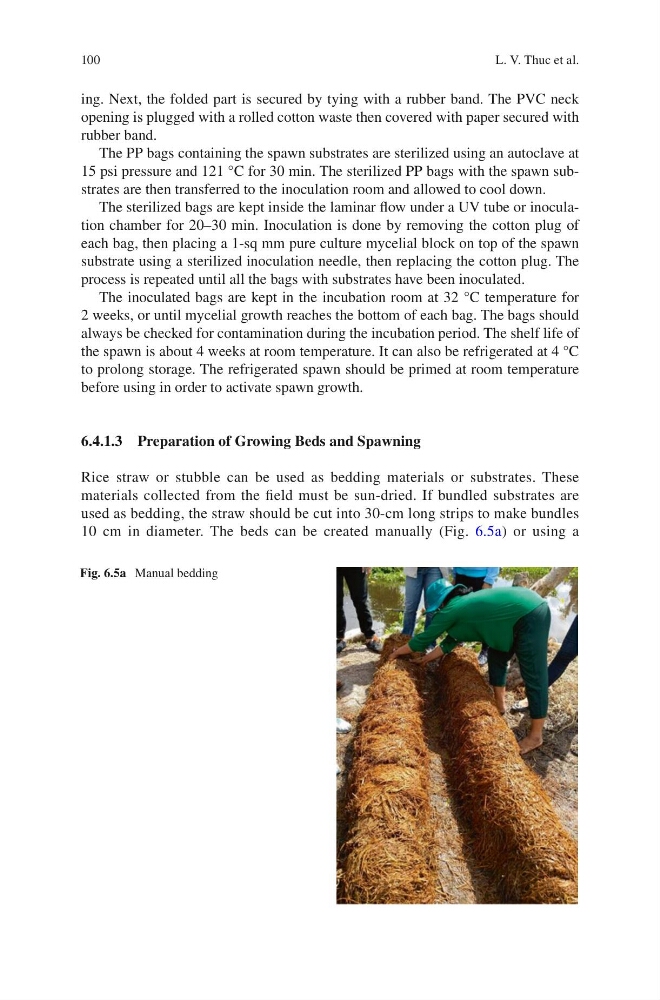
10 cm in diameter. The beds can be created manually (Fig. 6.5a) or using a
Fig. 6.5a Manual bedding
L. V. Thuc et al.
ing. Next, the folded part is secured by tying with a rubber band. The PVC neck
opening is plugged with a rolled cotton waste then covered with paper secured with
rubber band.
The PP bags containing the spawn substrates are sterilized using an autoclave at
15 psi pressure and 121 °C for 30 min. The sterilized PP bags with the spawn substrates are then transferred to the inoculation room and allowed to cool down.
The sterilized bags are kept inside the laminar flow under a UV tube or inoculation chamber for 20–30 min. Inoculation is done by removing the cotton plug of
each bag, then placing a 1-sq mm pure culture mycelial block on top of the spawn
substrate using a sterilized inoculation needle, then replacing the cotton plug. The
process is repeated until all the bags with substrates have been inoculated.
The inoculated bags are kept in the incubation room at 32 °C temperature for
2 weeks, or until mycelial growth reaches the bottom of each bag. The bags should
always be checked for contamination during the incubation period. The shelf life of
the spawn is about 4 weeks at room temperature. It can also be refrigerated at 4 °C
to prolong storage. The refrigerated spawn should be primed at room temperature
before using in order to activate spawn growth.
6.4.1.3 Preparation of Growing Beds and Spawning
Rice straw or stubble can be used as bedding materials or substrates. These
materials collected from the field must be sun-dried. If bundled substrates are
used as bedding, the straw should be cut into 30-cm long strips to make bundles
10 cm in diameter. The beds can be created manually (Fig. 6.5a) or using a
Fig. 6.5a Manual bedding
L. V. Thuc et al.