

66
R. Lulli et al.
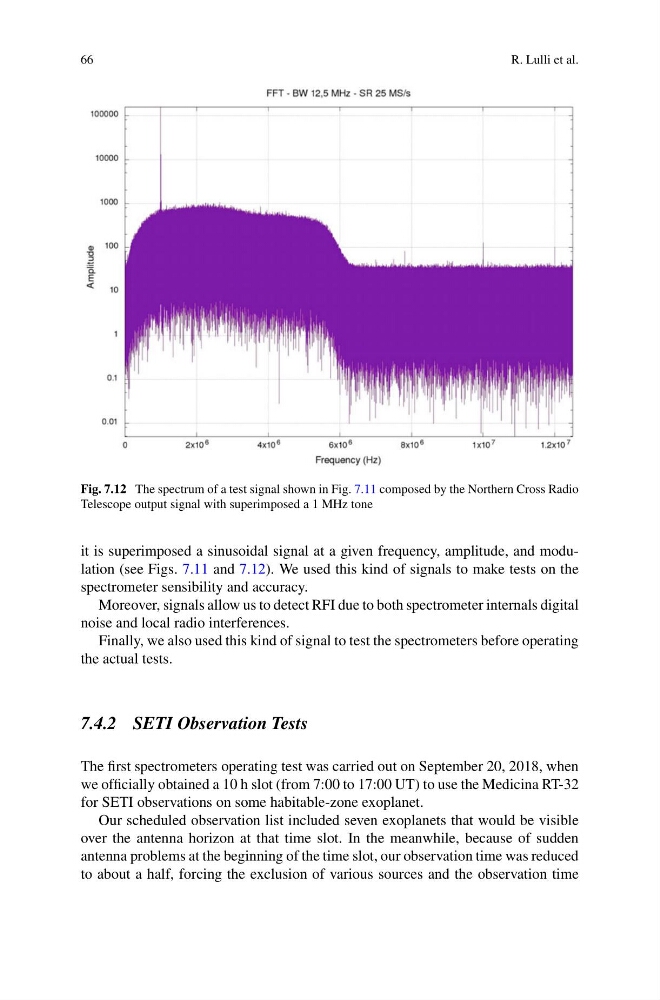
Fig. 7.12 The spectrum of a test signal shown in Fig. 7.11 composed by the Northern Cross Radio
Telescope output signal with superimposed a 1 MHz tone
it is superimposed a sinusoidal signal at a given frequency, amplitude, and modulation (see Figs. 7.11 and 7.12). We used this kind of signals to make tests on the
spectrometer sensibility and accuracy.
Moreover, signals allow us to detect RFI due to both spectrometer internals digital
noise and local radio interferences.
Finally, we also used this kind of signal to test the spectrometers before operating
the actual tests.
7.4.2 SETI Observation Tests
The first spectrometers operating test was carried out on September 20, 2018, when
we officially obtained a 10 h slot (from 7:00 to 17:00 UT) to use the Medicina RT-32
for SETI observations on some habitable-zone exoplanet.
Our scheduled observation list included seven exoplanets that would be visible
over the antenna horizon at that time slot. In the meanwhile, because of sudden
antenna problems at the beginning of the time slot, our observation time was reduced
to about a half, forcing the exclusion of various sources and the observation time
R. Lulli et al.
Fig. 7.12 The spectrum of a test signal shown in Fig. 7.11 composed by the Northern Cross Radio
Telescope output signal with superimposed a 1 MHz tone
it is superimposed a sinusoidal signal at a given frequency, amplitude, and modulation (see Figs. 7.11 and 7.12). We used this kind of signals to make tests on the
spectrometer sensibility and accuracy.
Moreover, signals allow us to detect RFI due to both spectrometer internals digital
noise and local radio interferences.
Finally, we also used this kind of signal to test the spectrometers before operating
the actual tests.
7.4.2 SETI Observation Tests
The first spectrometers operating test was carried out on September 20, 2018, when
we officially obtained a 10 h slot (from 7:00 to 17:00 UT) to use the Medicina RT-32
for SETI observations on some habitable-zone exoplanet.
Our scheduled observation list included seven exoplanets that would be visible
over the antenna horizon at that time slot. In the meanwhile, because of sudden
antenna problems at the beginning of the time slot, our observation time was reduced
to about a half, forcing the exclusion of various sources and the observation time