

11 SETI Program at the Medicina INAF Radioastronomy …
109
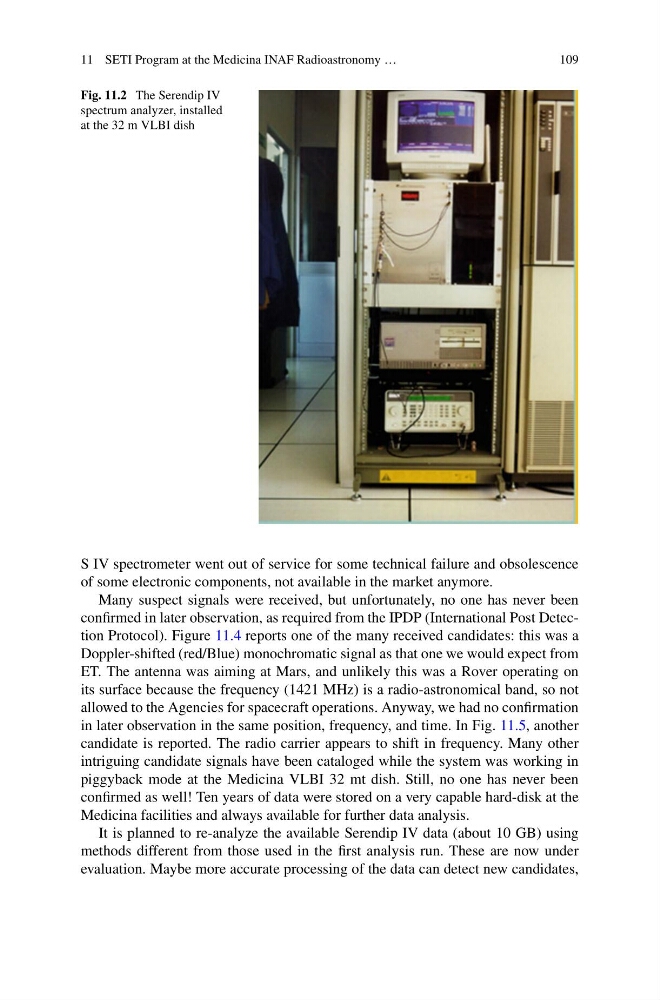
Fig. 11.2 The Serendip IV
spectrum analyzer, installed
at the 32 m VLBI dish
S IV spectrometer went out of service for some technical failure and obsolescence
of some electronic components, not available in the market anymore.
Many suspect signals were received, but unfortunately, no one has never been
confirmed in later observation, as required from the IPDP (International Post Detection Protocol). Figure 11.4 reports one of the many received candidates: this was a
Doppler-shifted (red/Blue) monochromatic signal as that one we would expect from
ET. The antenna was aiming at Mars, and unlikely this was a Rover operating on
its surface because the frequency (1421 MHz) is a radio-astronomical band, so not
allowed to the Agencies for spacecraft operations. Anyway, we had no confirmation
in later observation in the same position, frequency, and time. In Fig. 11.5, another
candidate is reported. The radio carrier appears to shift in frequency. Many other
intriguing candidate signals have been cataloged while the system was working in
piggyback mode at the Medicina VLBI 32 mt dish. Still, no one has never been
confirmed as well! Ten years of data were stored on a very capable hard-disk at the
Medicina facilities and always available for further data analysis.
It is planned to re-analyze the available Serendip IV data (about 10 GB) using
methods different from those used in the first analysis run. These are now under
evaluation. Maybe more accurate processing of the data can detect new candidates,
109
Fig. 11.2 The Serendip IV
spectrum analyzer, installed
at the 32 m VLBI dish
S IV spectrometer went out of service for some technical failure and obsolescence
of some electronic components, not available in the market anymore.
Many suspect signals were received, but unfortunately, no one has never been
confirmed in later observation, as required from the IPDP (International Post Detection Protocol). Figure 11.4 reports one of the many received candidates: this was a
Doppler-shifted (red/Blue) monochromatic signal as that one we would expect from
ET. The antenna was aiming at Mars, and unlikely this was a Rover operating on
its surface because the frequency (1421 MHz) is a radio-astronomical band, so not
allowed to the Agencies for spacecraft operations. Anyway, we had no confirmation
in later observation in the same position, frequency, and time. In Fig. 11.5, another
candidate is reported. The radio carrier appears to shift in frequency. Many other
intriguing candidate signals have been cataloged while the system was working in
piggyback mode at the Medicina VLBI 32 mt dish. Still, no one has never been
confirmed as well! Ten years of data were stored on a very capable hard-disk at the
Medicina facilities and always available for further data analysis.
It is planned to re-analyze the available Serendip IV data (about 10 GB) using
methods different from those used in the first analysis run. These are now under
evaluation. Maybe more accurate processing of the data can detect new candidates,