

9 Exobiolab: Different Life on Different Planets
93
However, previous overview papers of nearly a decade ago summarized the current
understanding of the instrumental requirements for observing M-dwarf planets, and
addressed outstanding questions concerning the impact on surface life of stellar flare
activity, synchronous rotation, and the likelihood of photosynthesis on M-dwarf
planets [9]. At the time of these papers, no terrestrial-sized planets had yet been
discovered around M-dwarf stars, and no statistical information about the occurrence
rate of exoplanets as a function of stellar type was available.
9.3.5 Plants on Exoplanets
In the Planetarium it will be possible to create various exoplanetary environments
with different kinds of plants, and lighting meant to simulate the light of distant
stars as filtered by the extrasolar atmosphere. It is not yet known what the surface
characteristics of such exoplanets are. Earth-like environments are assumed here.
On Earth there are plants of different colors: in very bright areas the photosynthetic
pigments are secreted by the plants in order to form a photosynthetic pigment which
is a sort of protective cream or protective filter to shield strongly energetic radiation.
In low light conditions, instead, the pigmentation tends to be a darker, color, to collect
a greater amount of the radiation that arrives. Light of any color from deep violet
through the near-infrared could power photosynthesis. Around stars hotter and bluer
than our Sun (F stars), plants would tend to absorb blue light and could look green
to yellow to red. In dim habitats, alien vegetation would need more photosynthetic
pigments that capture radiation in a wider range of wavelengths, which would give
them a dark appearance like many dark plants and flowers on Earth. Plants on planets
orbiting dim stars or in distant orbits around brighter stars may appear dark because
they need to capture more of the visual and even of the nearer parts of the infrared
and UV spectrum. The following types of trees and plants that do live on Earth are
suggested as a blueprint of sorts for possible extraterrestrial plants.
9.3.5.1 Plants on Exoplanets Around F Stars
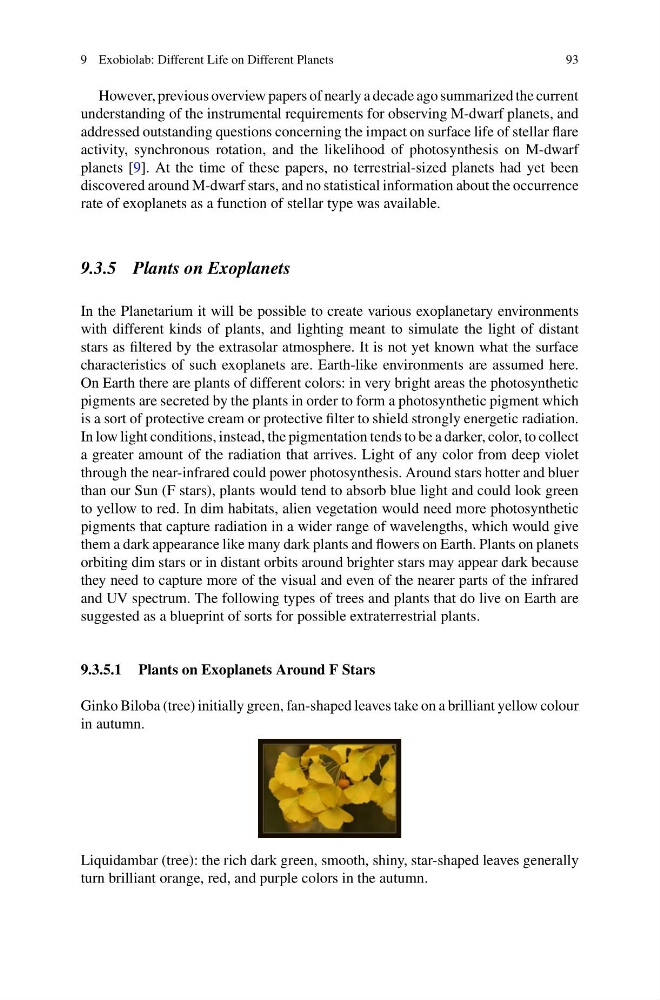
Ginko Biloba (tree) initially green, fan-shaped leaves take on a brilliant yellow colour
in autumn.
Liquidambar (tree): the rich dark green, smooth, shiny, star-shaped leaves generally
turn brilliant orange, red, and purple colors in the autumn.
93
However, previous overview papers of nearly a decade ago summarized the current
understanding of the instrumental requirements for observing M-dwarf planets, and
addressed outstanding questions concerning the impact on surface life of stellar flare
activity, synchronous rotation, and the likelihood of photosynthesis on M-dwarf
planets [9]. At the time of these papers, no terrestrial-sized planets had yet been
discovered around M-dwarf stars, and no statistical information about the occurrence
rate of exoplanets as a function of stellar type was available.
9.3.5 Plants on Exoplanets
In the Planetarium it will be possible to create various exoplanetary environments
with different kinds of plants, and lighting meant to simulate the light of distant
stars as filtered by the extrasolar atmosphere. It is not yet known what the surface
characteristics of such exoplanets are. Earth-like environments are assumed here.
On Earth there are plants of different colors: in very bright areas the photosynthetic
pigments are secreted by the plants in order to form a photosynthetic pigment which
is a sort of protective cream or protective filter to shield strongly energetic radiation.
In low light conditions, instead, the pigmentation tends to be a darker, color, to collect
a greater amount of the radiation that arrives. Light of any color from deep violet
through the near-infrared could power photosynthesis. Around stars hotter and bluer
than our Sun (F stars), plants would tend to absorb blue light and could look green
to yellow to red. In dim habitats, alien vegetation would need more photosynthetic
pigments that capture radiation in a wider range of wavelengths, which would give
them a dark appearance like many dark plants and flowers on Earth. Plants on planets
orbiting dim stars or in distant orbits around brighter stars may appear dark because
they need to capture more of the visual and even of the nearer parts of the infrared
and UV spectrum. The following types of trees and plants that do live on Earth are
suggested as a blueprint of sorts for possible extraterrestrial plants.
9.3.5.1 Plants on Exoplanets Around F Stars
Ginko Biloba (tree) initially green, fan-shaped leaves take on a brilliant yellow colour
in autumn.
Liquidambar (tree): the rich dark green, smooth, shiny, star-shaped leaves generally
turn brilliant orange, red, and purple colors in the autumn.