

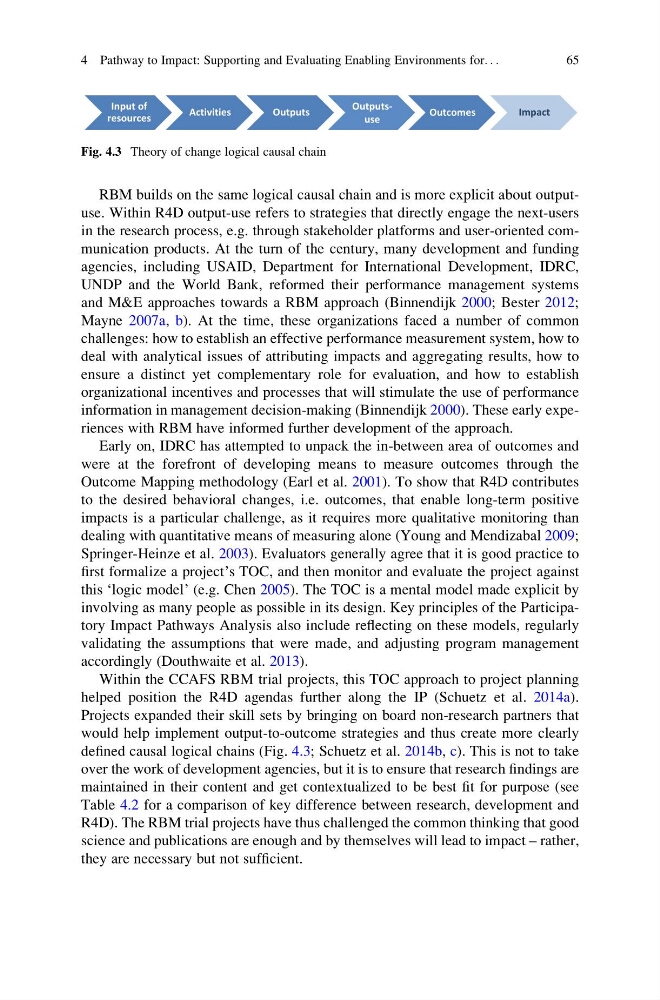
RBM builds on the same logical causal chain and is more explicit about outputuse. Within R4D output-use refers to strategies that directly engage the next-users
in the research process, e.g. through stakeholder platforms and user-oriented communication products. At the turn of the century, many development and funding
agencies, including USAID, Department for International Development, IDRC,
UNDP and the World Bank, reformed their performance management systems
and M&E approaches towards a RBM approach (Binnendijk 2000; Bester 2012;
Mayne 2007a, b). At the time, these organizations faced a number of common
challenges: how to establish an effective performance measurement system, how to
deal with analytical issues of attributing impacts and aggregating results, how to
ensure a distinct yet complementary role for evaluation, and how to establish
organizational incentives and processes that will stimulate the use of performance
information in management decision-making (Binnendijk 2000). These early experiences with RBM have informed further development of the approach.
Early on, IDRC has attempted to unpack the in-between area of outcomes and
were at the forefront of developing means to measure outcomes through the
Outcome Mapping methodology (Earl et al. 2001). To show that R4D contributes
to the desired behavioral changes, i.e. outcomes, that enable long-term positive
impacts is a particular challenge, as it requires more qualitative monitoring than
dealing with quantitative means of measuring alone (Young and Mendizabal 2009;
Springer-Heinze et al. 2003). Evaluators generally agree that it is good practice to
first formalize a project’s TOC, and then monitor and evaluate the project against
this ‘logic model’ (e.g. Chen 2005). The TOC is a mental model made explicit by
involving as many people as possible in its design. Key principles of the Participatory Impact Pathways Analysis also include reflecting on these models, regularly
validating the assumptions that were made, and adjusting program management
accordingly (Douthwaite et al. 2013).
Within the CCAFS RBM trial projects, this TOC approach to project planning
helped position the R4D agendas further along the IP (Schuetz et al. 2014a).
Projects expanded their skill sets by bringing on board non-research partners that
would help implement output-to-outcome strategies and thus create more clearly
defined causal logical chains (Fig. 4.3; Schuetz et al. 2014b, c). This is not to take
over the work of development agencies, but it is to ensure that research findings are
maintained in their content and get contextualized to be best fit for purpose (see
Table 4.2 for a comparison of key difference between research, development and
R4D). The RBM trial projects have thus challenged the common thinking that good
science and publications are enough and by themselves will lead to impact – rather,
they are necessary but not sufficient.
Input of
resources
Activities
Outputs
Outputsuse
Outcomes
Impact
Fig. 4.3 Theory of change logical causal chain
4 Pathway to Impact: Supporting and Evaluating Enabling Environments for. . .
65
in the research process, e.g. through stakeholder platforms and user-oriented communication products. At the turn of the century, many development and funding
agencies, including USAID, Department for International Development, IDRC,
UNDP and the World Bank, reformed their performance management systems
and M&E approaches towards a RBM approach (Binnendijk 2000; Bester 2012;
Mayne 2007a, b). At the time, these organizations faced a number of common
challenges: how to establish an effective performance measurement system, how to
deal with analytical issues of attributing impacts and aggregating results, how to
ensure a distinct yet complementary role for evaluation, and how to establish
organizational incentives and processes that will stimulate the use of performance
information in management decision-making (Binnendijk 2000). These early experiences with RBM have informed further development of the approach.
Early on, IDRC has attempted to unpack the in-between area of outcomes and
were at the forefront of developing means to measure outcomes through the
Outcome Mapping methodology (Earl et al. 2001). To show that R4D contributes
to the desired behavioral changes, i.e. outcomes, that enable long-term positive
impacts is a particular challenge, as it requires more qualitative monitoring than
dealing with quantitative means of measuring alone (Young and Mendizabal 2009;
Springer-Heinze et al. 2003). Evaluators generally agree that it is good practice to
first formalize a project’s TOC, and then monitor and evaluate the project against
this ‘logic model’ (e.g. Chen 2005). The TOC is a mental model made explicit by
involving as many people as possible in its design. Key principles of the Participatory Impact Pathways Analysis also include reflecting on these models, regularly
validating the assumptions that were made, and adjusting program management
accordingly (Douthwaite et al. 2013).
Within the CCAFS RBM trial projects, this TOC approach to project planning
helped position the R4D agendas further along the IP (Schuetz et al. 2014a).
Projects expanded their skill sets by bringing on board non-research partners that
would help implement output-to-outcome strategies and thus create more clearly
defined causal logical chains (Fig. 4.3; Schuetz et al. 2014b, c). This is not to take
over the work of development agencies, but it is to ensure that research findings are
maintained in their content and get contextualized to be best fit for purpose (see
Table 4.2 for a comparison of key difference between research, development and
R4D). The RBM trial projects have thus challenged the common thinking that good
science and publications are enough and by themselves will lead to impact – rather,
they are necessary but not sufficient.
Input of
resources
Activities
Outputs
Outputsuse
Outcomes
Impact
Fig. 4.3 Theory of change logical causal chain
4 Pathway to Impact: Supporting and Evaluating Enabling Environments for. . .
65