

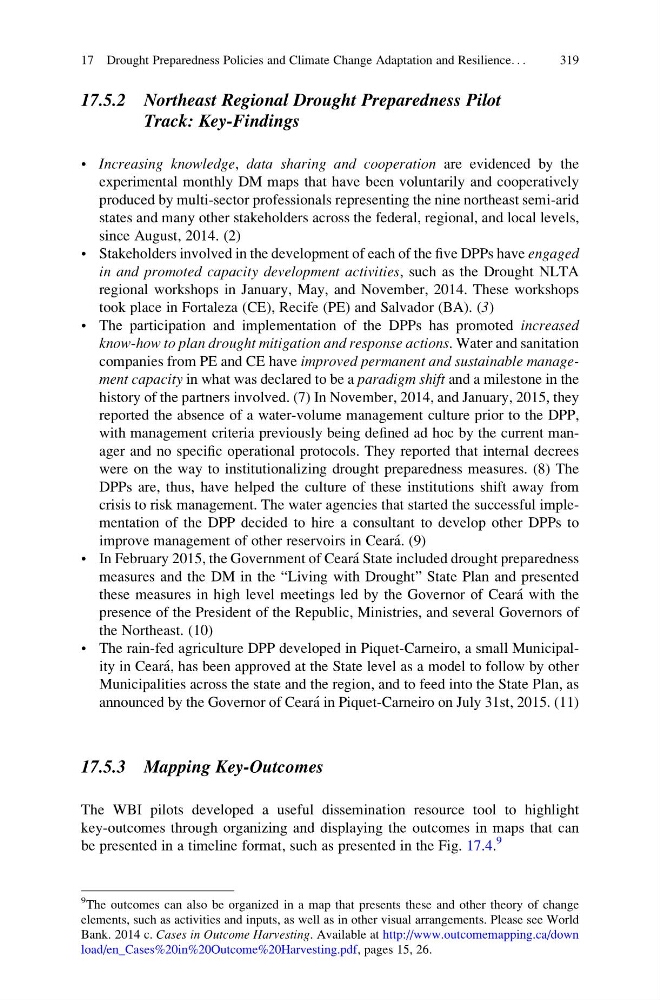
17.5.2 Northeast Regional Drought Preparedness Pilot
Track: Key-Findings
• Increasing knowledge, data sharing and cooperation are evidenced by the
experimental monthly DM maps that have been voluntarily and cooperatively
produced by multi-sector professionals representing the nine northeast semi-arid
states and many other stakeholders across the federal, regional, and local levels,
since August, 2014. (2)
• Stakeholders involved in the development of each of the five DPPs have engaged
in and promoted capacity development activities, such as the Drought NLTA
regional workshops in January, May, and November, 2014. These workshops
took place in Fortaleza (CE), Recife (PE) and Salvador (BA). (3)
• The participation and implementation of the DPPs has promoted increased
know-how to plan drought mitigation and response actions. Water and sanitation
companies from PE and CE have improved permanent and sustainable management capacity in what was declared to be a paradigm shift and a milestone in the
history of the partners involved. (7) In November, 2014, and January, 2015, they
reported the absence of a water-volume management culture prior to the DPP,
with management criteria previously being defined ad hoc by the current manager and no specific operational protocols. They reported that internal decrees
were on the way to institutionalizing drought preparedness measures. (8) The
DPPs are, thus, have helped the culture of these institutions shift away from
crisis to risk management. The water agencies that started the successful implementation of the DPP decided to hire a consultant to develop other DPPs to
improve management of other reservoirs in Ceara ´. (9)
• In February 2015, the Government of Ceara ´ State included drought preparedness
measures and the DM in the “Living with Drought” State Plan and presented
these measures in high level meetings led by the Governor of Ceara ´ with the
presence of the President of the Republic, Ministries, and several Governors of
the Northeast. (10)
• The rain-fed agriculture DPP developed in Piquet-Carneiro, a small Municipality in Ceara ´, has been approved at the State level as a model to follow by other
Municipalities across the state and the region, and to feed into the State Plan, as
announced by the Governor of Ceara ´ in Piquet-Carneiro on July 31st, 2015. (11)
17.5.3 Mapping Key-Outcomes
The WBI pilots developed a useful dissemination resource tool to highlight
key-outcomes through organizing and displaying the outcomes in maps that can
be presented in a timeline format, such as presented in the Fig. 17.4.
9
9 The outcomes can also be organized in a map that presents these and other theory of change
elements, such as activities and inputs, as well as in other visual arrangements. Please see World
Bank. 2014 c. Cases in Outcome Harvesting. Available at http://www.outcomemapping.ca/down
load/en_Cases%20in%20Outcome%20Harvesting.pdf, pages 15, 26.
17 Drought Preparedness Policies and Climate Change Adaptation and Resilience. . .
319
Track: Key-Findings
• Increasing knowledge, data sharing and cooperation are evidenced by the
experimental monthly DM maps that have been voluntarily and cooperatively
produced by multi-sector professionals representing the nine northeast semi-arid
states and many other stakeholders across the federal, regional, and local levels,
since August, 2014. (2)
• Stakeholders involved in the development of each of the five DPPs have engaged
in and promoted capacity development activities, such as the Drought NLTA
regional workshops in January, May, and November, 2014. These workshops
took place in Fortaleza (CE), Recife (PE) and Salvador (BA). (3)
• The participation and implementation of the DPPs has promoted increased
know-how to plan drought mitigation and response actions. Water and sanitation
companies from PE and CE have improved permanent and sustainable management capacity in what was declared to be a paradigm shift and a milestone in the
history of the partners involved. (7) In November, 2014, and January, 2015, they
reported the absence of a water-volume management culture prior to the DPP,
with management criteria previously being defined ad hoc by the current manager and no specific operational protocols. They reported that internal decrees
were on the way to institutionalizing drought preparedness measures. (8) The
DPPs are, thus, have helped the culture of these institutions shift away from
crisis to risk management. The water agencies that started the successful implementation of the DPP decided to hire a consultant to develop other DPPs to
improve management of other reservoirs in Ceara ´. (9)
• In February 2015, the Government of Ceara ´ State included drought preparedness
measures and the DM in the “Living with Drought” State Plan and presented
these measures in high level meetings led by the Governor of Ceara ´ with the
presence of the President of the Republic, Ministries, and several Governors of
the Northeast. (10)
• The rain-fed agriculture DPP developed in Piquet-Carneiro, a small Municipality in Ceara ´, has been approved at the State level as a model to follow by other
Municipalities across the state and the region, and to feed into the State Plan, as
announced by the Governor of Ceara ´ in Piquet-Carneiro on July 31st, 2015. (11)
17.5.3 Mapping Key-Outcomes
The WBI pilots developed a useful dissemination resource tool to highlight
key-outcomes through organizing and displaying the outcomes in maps that can
be presented in a timeline format, such as presented in the Fig. 17.4.
9
9 The outcomes can also be organized in a map that presents these and other theory of change
elements, such as activities and inputs, as well as in other visual arrangements. Please see World
Bank. 2014 c. Cases in Outcome Harvesting. Available at http://www.outcomemapping.ca/down
load/en_Cases%20in%20Outcome%20Harvesting.pdf, pages 15, 26.
17 Drought Preparedness Policies and Climate Change Adaptation and Resilience. . .
319