

the use of knowledge or innovative solutions. Outcomes might also describe deeper
institutional changes relating to policy, citizen engagement or government accountability and organizational arrangements.
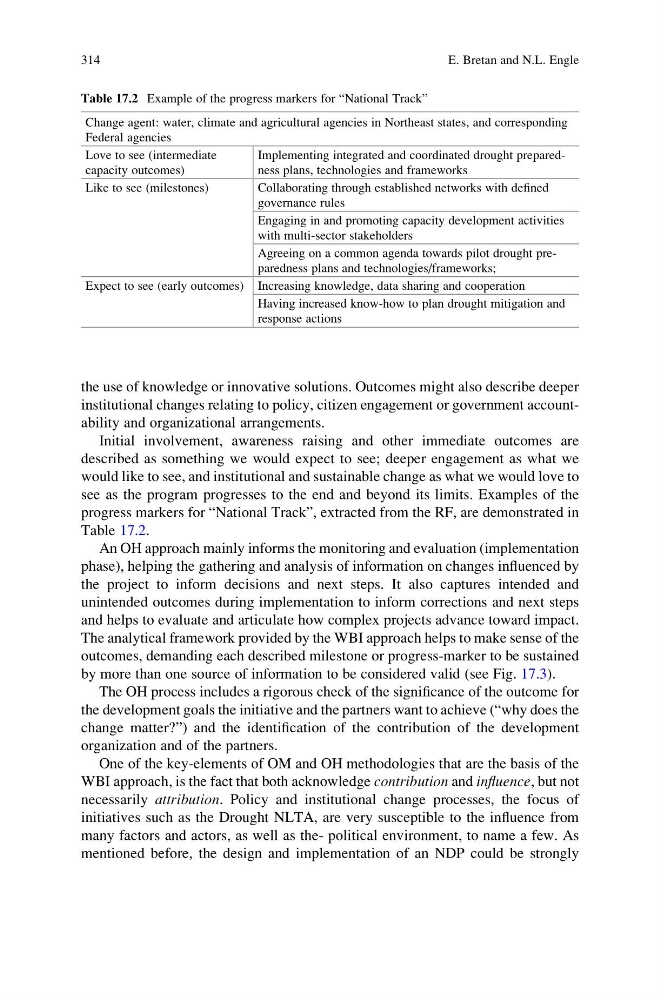
Initial involvement, awareness raising and other immediate outcomes are
described as something we would expect to see; deeper engagement as what we
would like to see, and institutional and sustainable change as what we would love to
see as the program progresses to the end and beyond its limits. Examples of the
progress markers for “National Track”, extracted from the RF, are demonstrated in
Table 17.2.
An OH approach mainly informs the monitoring and evaluation (implementation
phase), helping the gathering and analysis of information on changes influenced by
the project to inform decisions and next steps. It also captures intended and
unintended outcomes during implementation to inform corrections and next steps
and helps to evaluate and articulate how complex projects advance toward impact.
The analytical framework provided by the WBI approach helps to make sense of the
outcomes, demanding each described milestone or progress-marker to be sustained
by more than one source of information to be considered valid (see Fig. 17.3).
The OH process includes a rigorous check of the significance of the outcome for
the development goals the initiative and the partners want to achieve (“why does the
change matter?”) and the identification of the contribution of the development
organization and of the partners.
One of the key-elements of OM and OH methodologies that are the basis of the
WBI approach, is the fact that both acknowledge contribution and influence, but not
necessarily attribution. Policy and institutional change processes, the focus of
initiatives such as the Drought NLTA, are very susceptible to the influence from
many factors and actors, as well as the- political environment, to name a few. As
mentioned before, the design and implementation of an NDP could be strongly
Table 17.2 Example of the progress markers for “National Track”
Change agent: water, climate and agricultural agencies in Northeast states, and corresponding
Federal agencies
Love to see (intermediate
capacity outcomes)
Implementing integrated and coordinated drought preparedness plans, technologies and frameworks
Like to see (milestones)
Collaborating through established networks with defined
governance rules
Engaging in and promoting capacity development activities
with multi-sector stakeholders
Agreeing on a common agenda towards pilot drought preparedness plans and technologies/frameworks;
Expect to see (early outcomes) Increasing knowledge, data sharing and cooperation
Having increased know-how to plan drought mitigation and
response actions
314
E. Bretan and N.L. Engle
institutional changes relating to policy, citizen engagement or government accountability and organizational arrangements.
Initial involvement, awareness raising and other immediate outcomes are
described as something we would expect to see; deeper engagement as what we
would like to see, and institutional and sustainable change as what we would love to
see as the program progresses to the end and beyond its limits. Examples of the
progress markers for “National Track”, extracted from the RF, are demonstrated in
Table 17.2.
An OH approach mainly informs the monitoring and evaluation (implementation
phase), helping the gathering and analysis of information on changes influenced by
the project to inform decisions and next steps. It also captures intended and
unintended outcomes during implementation to inform corrections and next steps
and helps to evaluate and articulate how complex projects advance toward impact.
The analytical framework provided by the WBI approach helps to make sense of the
outcomes, demanding each described milestone or progress-marker to be sustained
by more than one source of information to be considered valid (see Fig. 17.3).
The OH process includes a rigorous check of the significance of the outcome for
the development goals the initiative and the partners want to achieve (“why does the
change matter?”) and the identification of the contribution of the development
organization and of the partners.
One of the key-elements of OM and OH methodologies that are the basis of the
WBI approach, is the fact that both acknowledge contribution and influence, but not
necessarily attribution. Policy and institutional change processes, the focus of
initiatives such as the Drought NLTA, are very susceptible to the influence from
many factors and actors, as well as the- political environment, to name a few. As
mentioned before, the design and implementation of an NDP could be strongly
Table 17.2 Example of the progress markers for “National Track”
Change agent: water, climate and agricultural agencies in Northeast states, and corresponding
Federal agencies
Love to see (intermediate
capacity outcomes)
Implementing integrated and coordinated drought preparedness plans, technologies and frameworks
Like to see (milestones)
Collaborating through established networks with defined
governance rules
Engaging in and promoting capacity development activities
with multi-sector stakeholders
Agreeing on a common agenda towards pilot drought preparedness plans and technologies/frameworks;
Expect to see (early outcomes) Increasing knowledge, data sharing and cooperation
Having increased know-how to plan drought mitigation and
response actions
314
E. Bretan and N.L. Engle