

• Counterfactuals: According to the TAMD operational framework, researchers
are expected to collect data on attribution and this requires counterfactual data.
This became a challenge in Isiolo because the research team had to find a
community in Isiolo where climate change adaptation (CCA) interventions
were not being undertaken. This proved to be difficult as there are many civil
society actors undertaking CCA activities similar to the CAF in other parts of
Isiolo. In addition the CAF interventions were public investment goods that were
to benefit over 70 % of Isiolo’s population: the remaining population comprises
the urban population whose livelihoods are different from the targeted communities. They therefore, did not qualify as good counterfactuals. As such the
research team made a decision to develop the before and after approach using
the theory of change to measure contribution/attribution to resilience.
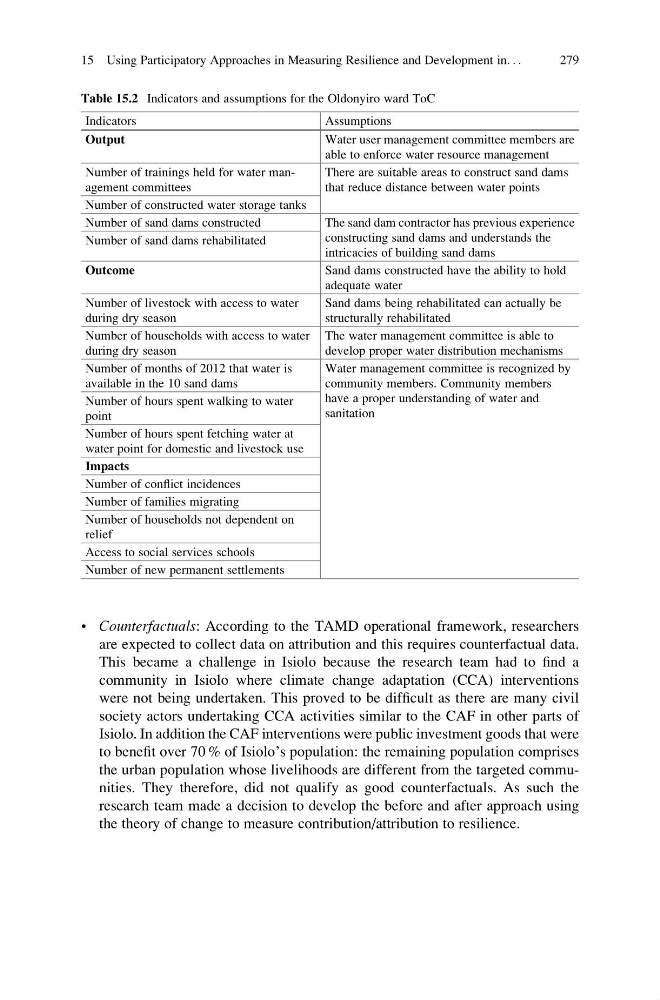
Table 15.2 Indicators and assumptions for the Oldonyiro ward ToC
Indicators
Assumptions
Output
Water user management committee members are
able to enforce water resource management
Number of trainings held for water management committees
There are suitable areas to construct sand dams
that reduce distance between water points
Number of constructed water storage tanks
Number of sand dams constructed
The sand dam contractor has previous experience
constructing sand dams and understands the
intricacies of building sand dams
Number of sand dams rehabilitated
Outcome
Sand dams constructed have the ability to hold
adequate water
Number of livestock with access to water
during dry season
Sand dams being rehabilitated can actually be
structurally rehabilitated
Number of households with access to water
during dry season
The water management committee is able to
develop proper water distribution mechanisms
Number of months of 2012 that water is
available in the 10 sand dams
Water management committee is recognized by
community members. Community members
have a proper understanding of water and
sanitation
Number of hours spent walking to water
point
Number of hours spent fetching water at
water point for domestic and livestock use
Impacts
Number of conflict incidences
Number of families migrating
Number of households not dependent on
relief
Access to social services schools
Number of new permanent settlements
15 Using Participatory Approaches in Measuring Resilience and Development in. . .
279
are expected to collect data on attribution and this requires counterfactual data.
This became a challenge in Isiolo because the research team had to find a
community in Isiolo where climate change adaptation (CCA) interventions
were not being undertaken. This proved to be difficult as there are many civil
society actors undertaking CCA activities similar to the CAF in other parts of
Isiolo. In addition the CAF interventions were public investment goods that were
to benefit over 70 % of Isiolo’s population: the remaining population comprises
the urban population whose livelihoods are different from the targeted communities. They therefore, did not qualify as good counterfactuals. As such the
research team made a decision to develop the before and after approach using
the theory of change to measure contribution/attribution to resilience.
Table 15.2 Indicators and assumptions for the Oldonyiro ward ToC
Indicators
Assumptions
Output
Water user management committee members are
able to enforce water resource management
Number of trainings held for water management committees
There are suitable areas to construct sand dams
that reduce distance between water points
Number of constructed water storage tanks
Number of sand dams constructed
The sand dam contractor has previous experience
constructing sand dams and understands the
intricacies of building sand dams
Number of sand dams rehabilitated
Outcome
Sand dams constructed have the ability to hold
adequate water
Number of livestock with access to water
during dry season
Sand dams being rehabilitated can actually be
structurally rehabilitated
Number of households with access to water
during dry season
The water management committee is able to
develop proper water distribution mechanisms
Number of months of 2012 that water is
available in the 10 sand dams
Water management committee is recognized by
community members. Community members
have a proper understanding of water and
sanitation
Number of hours spent walking to water
point
Number of hours spent fetching water at
water point for domestic and livestock use
Impacts
Number of conflict incidences
Number of families migrating
Number of households not dependent on
relief
Access to social services schools
Number of new permanent settlements
15 Using Participatory Approaches in Measuring Resilience and Development in. . .
279