

commissioned work, of the 88 people interviewed who are directly involved with
the field-level implementation of the projects under review, only one person cited
“commissioned work” favorably. Payment structures varied among the three projects, but there was near consensus from workers that a salary was preferable to
commissioned pay. The single respondent who positively described the commissioned payment structure had been hired just 2 months prior to the interview.
“Salaried” work receives the highest score in the index.
Evidence of job satisfaction (SAT) is a qualitative assessment based on the openended interviews wherein the self-reported ability to save and/or self-reported
personal benefits from doing the job are volunteered within the interview process.
All interviewees were asked to nominate their favorite and least favorite aspects of
their job: mention of looking for a new job ranked at zero, while apparently genuine
and detailed feelings of pride in the work and specific reasons that the job was
appreciated (i.e. job location and the ability to achieve work/life balance) garnered
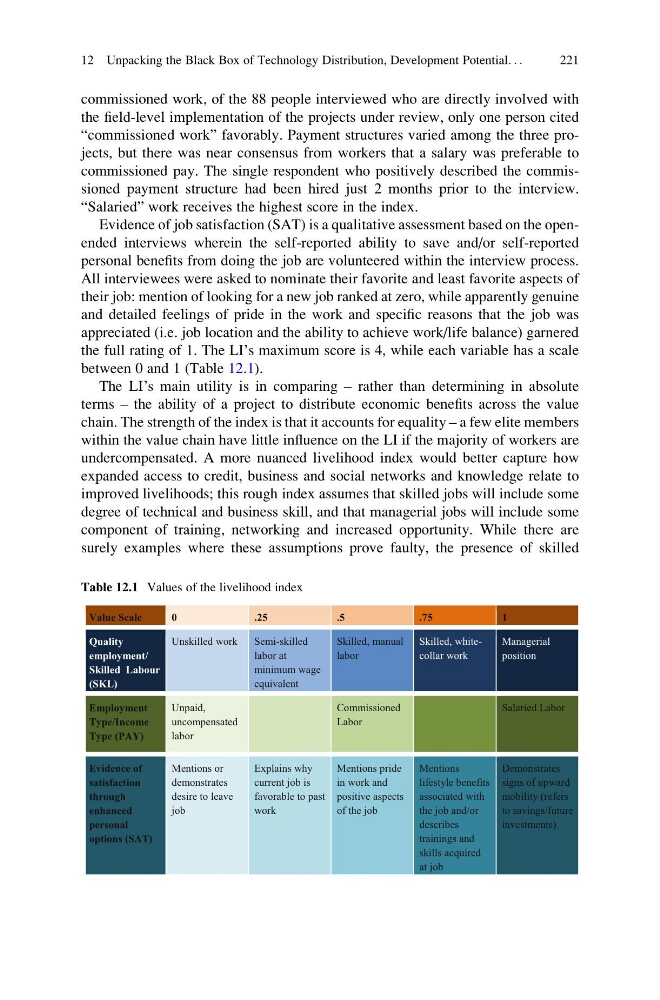
the full rating of 1. The LI’s maximum score is 4, while each variable has a scale
between 0 and 1 (Table 12.1).
The LI’s main utility is in comparing – rather than determining in absolute
terms – the ability of a project to distribute economic benefits across the value
chain. The strength of the index is that it accounts for equality – a few elite members
within the value chain have little influence on the LI if the majority of workers are
undercompensated. A more nuanced livelihood index would better capture how
expanded access to credit, business and social networks and knowledge relate to
improved livelihoods; this rough index assumes that skilled jobs will include some
degree of technical and business skill, and that managerial jobs will include some
component of training, networking and increased opportunity. While there are
surely examples where these assumptions prove faulty, the presence of skilled
Table 12.1 Values of the livelihood index
Value Scale
0
.25
.5
.75
1
Quality
employment/
Skilled Labour
(SKL)
Unskilled work
Semi-skilled
labor at
minimum wage
equivalent
Skilled, manual
labor
Skilled, whitecollar work
Managerial
position
Employment
Type/Income
Type (PAY)
Unpaid,
uncompensated
labor
Commissioned
Labor
Salaried Labor
Evidence of
satisfaction
through
enhanced
personal
options (SAT)
Mentions or
demonstrates
desire to leave
job
Explains why
current job is
favorable to past
work
Mentions pride
in work and
positive aspects
of the job
Mentions
lifestyle benefits
associated with
the job and/or
describes
trainings and
skills acquired
at job
Demonstrates
signs of upward
mobility (refers
to savings/future
investments).
12 Unpacking the Black Box of Technology Distribution, Development Potential. . .
221
the field-level implementation of the projects under review, only one person cited
“commissioned work” favorably. Payment structures varied among the three projects, but there was near consensus from workers that a salary was preferable to
commissioned pay. The single respondent who positively described the commissioned payment structure had been hired just 2 months prior to the interview.
“Salaried” work receives the highest score in the index.
Evidence of job satisfaction (SAT) is a qualitative assessment based on the openended interviews wherein the self-reported ability to save and/or self-reported
personal benefits from doing the job are volunteered within the interview process.
All interviewees were asked to nominate their favorite and least favorite aspects of
their job: mention of looking for a new job ranked at zero, while apparently genuine
and detailed feelings of pride in the work and specific reasons that the job was
appreciated (i.e. job location and the ability to achieve work/life balance) garnered
the full rating of 1. The LI’s maximum score is 4, while each variable has a scale
between 0 and 1 (Table 12.1).
The LI’s main utility is in comparing – rather than determining in absolute
terms – the ability of a project to distribute economic benefits across the value
chain. The strength of the index is that it accounts for equality – a few elite members
within the value chain have little influence on the LI if the majority of workers are
undercompensated. A more nuanced livelihood index would better capture how
expanded access to credit, business and social networks and knowledge relate to
improved livelihoods; this rough index assumes that skilled jobs will include some
degree of technical and business skill, and that managerial jobs will include some
component of training, networking and increased opportunity. While there are
surely examples where these assumptions prove faulty, the presence of skilled
Table 12.1 Values of the livelihood index
Value Scale
0
.25
.5
.75
1
Quality
employment/
Skilled Labour
(SKL)
Unskilled work
Semi-skilled
labor at
minimum wage
equivalent
Skilled, manual
labor
Skilled, whitecollar work
Managerial
position
Employment
Type/Income
Type (PAY)
Unpaid,
uncompensated
labor
Commissioned
Labor
Salaried Labor
Evidence of
satisfaction
through
enhanced
personal
options (SAT)
Mentions or
demonstrates
desire to leave
job
Explains why
current job is
favorable to past
work
Mentions pride
in work and
positive aspects
of the job
Mentions
lifestyle benefits
associated with
the job and/or
describes
trainings and
skills acquired
at job
Demonstrates
signs of upward
mobility (refers
to savings/future
investments).
12 Unpacking the Black Box of Technology Distribution, Development Potential. . .
221