

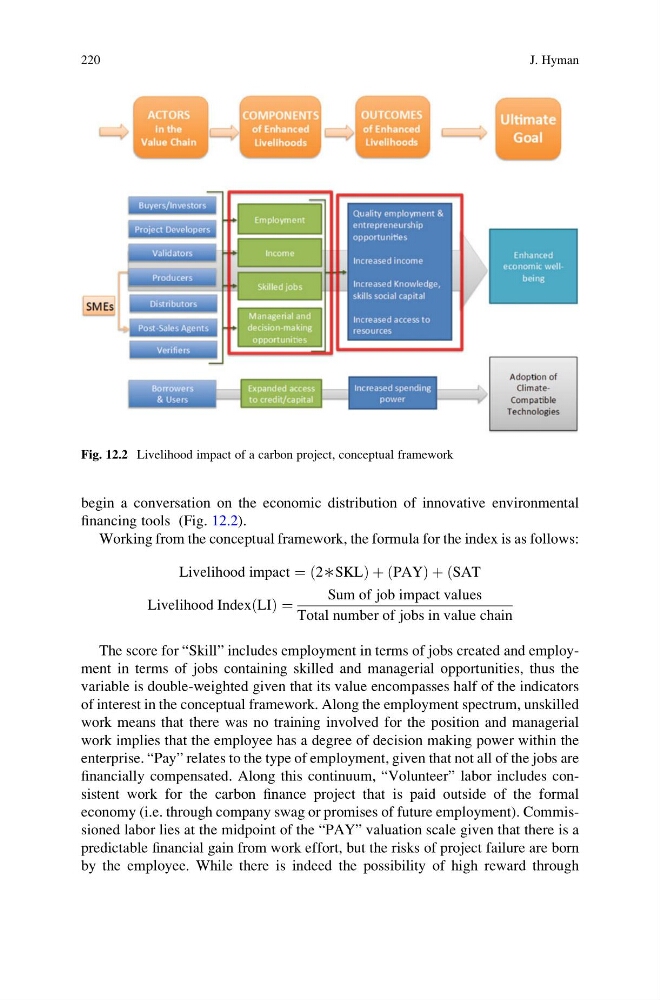
begin a conversation on the economic distribution of innovative environmental
financing tools (Fig. 12.2).
Working from the conceptual framework, the formula for the index is as follows:
Livelihood impact ¼ 2∗SKL
ð
Þþ PAY
ð
Þþ SAT
ð
Livelihood Index LI
ð Þ ¼
Sum of job impact values
Total number of jobs in value chain
The score for “Skill” includes employment in terms of jobs created and employment in terms of jobs containing skilled and managerial opportunities, thus the
variable is double-weighted given that its value encompasses half of the indicators
of interest in the conceptual framework. Along the employment spectrum, unskilled
work means that there was no training involved for the position and managerial
work implies that the employee has a degree of decision making power within the
enterprise. “Pay” relates to the type of employment, given that not all of the jobs are
financially compensated. Along this continuum, “Volunteer” labor includes consistent work for the carbon finance project that is paid outside of the formal
economy (i.e. through company swag or promises of future employment). Commissioned labor lies at the midpoint of the “PAY” valuation scale given that there is a
predictable financial gain from work effort, but the risks of project failure are born
by the employee. While there is indeed the possibility of high reward through
Fig. 12.2 Livelihood impact of a carbon project, conceptual framework
220
J. Hyman
financing tools (Fig. 12.2).
Working from the conceptual framework, the formula for the index is as follows:
Livelihood impact ¼ 2∗SKL
ð
Þþ PAY
ð
Þþ SAT
ð
Livelihood Index LI
ð Þ ¼
Sum of job impact values
Total number of jobs in value chain
The score for “Skill” includes employment in terms of jobs created and employment in terms of jobs containing skilled and managerial opportunities, thus the
variable is double-weighted given that its value encompasses half of the indicators
of interest in the conceptual framework. Along the employment spectrum, unskilled
work means that there was no training involved for the position and managerial
work implies that the employee has a degree of decision making power within the
enterprise. “Pay” relates to the type of employment, given that not all of the jobs are
financially compensated. Along this continuum, “Volunteer” labor includes consistent work for the carbon finance project that is paid outside of the formal
economy (i.e. through company swag or promises of future employment). Commissioned labor lies at the midpoint of the “PAY” valuation scale given that there is a
predictable financial gain from work effort, but the risks of project failure are born
by the employee. While there is indeed the possibility of high reward through
Fig. 12.2 Livelihood impact of a carbon project, conceptual framework
220
J. Hyman