

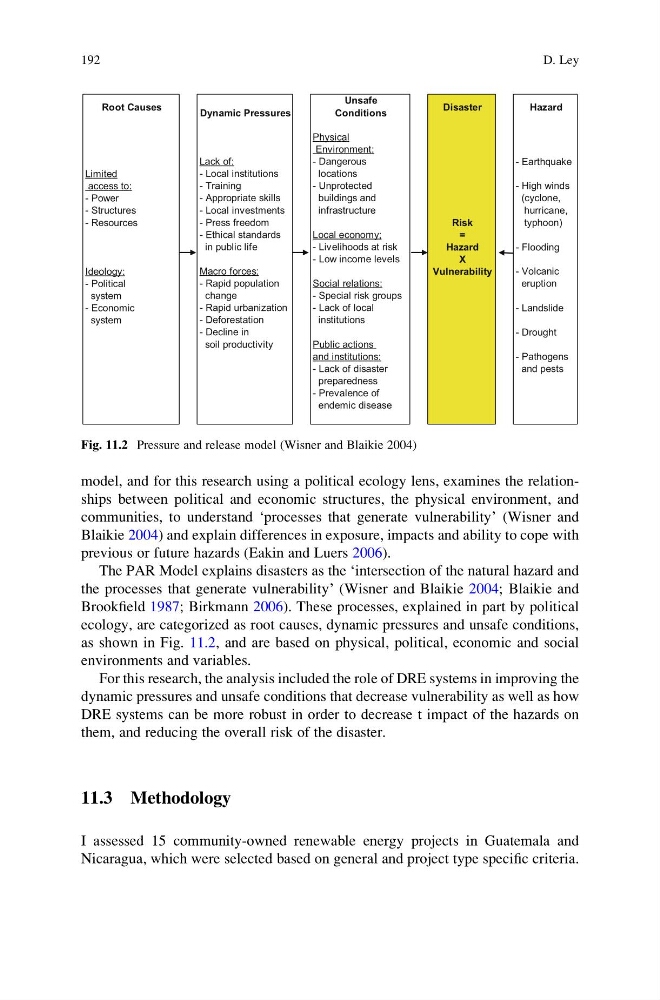
model, and for this research using a political ecology lens, examines the relationships between political and economic structures, the physical environment, and
communities, to understand ‘processes that generate vulnerability’ (Wisner and
Blaikie 2004) and explain differences in exposure, impacts and ability to cope with
previous or future hazards (Eakin and Luers 2006).
The PAR Model explains disasters as the ‘intersection of the natural hazard and
the processes that generate vulnerability’ (Wisner and Blaikie 2004; Blaikie and
Brookfield 1987; Birkmann 2006). These processes, explained in part by political
ecology, are categorized as root causes, dynamic pressures and unsafe conditions,
as shown in Fig. 11.2, and are based on physical, political, economic and social
environments and variables.
For this research, the analysis included the role of DRE systems in improving the
dynamic pressures and unsafe conditions that decrease vulnerability as well as how
DRE systems can be more robust in order to decrease t impact of the hazards on
them, and reducing the overall risk of the disaster.
11.3 Methodology
I assessed 15 community-owned renewable energy projects in Guatemala and
Nicaragua, which were selected based on general and project type specific criteria.
Root Causes
Dynamic Pressures
Unsafe
Conditions
Disaster
Hazard
Physical
Environment:
Lack of:
- Dangerous
- Earthquake
Limited
- Local institutions
locations
access to:
- Training
- Unprotected
- High winds
- Power
- Appropriate skills
buildings and
(cyclone,
- Structures
- Local investments
infrastructure
hurricane,
- Resources
- Press freedom
Risk
typhoon)
- Ethical standards
Local economy;
=
in public life
- Livelihoods at risk
Hazard
- Flooding
- Low income levels
X
Ideology:
Macro forces:
Vulnerability
- Volcanic
- Political
- Rapid population
Social relations:
eruption
system
change
- Special risk groups
- Economic
- Rapid urbanization
- Lack of local
- Landslide
system
- Deforestation
institutions
- Decline in
- Drought
soil productivity
Public actions
and institutions:
- Pathogens
- Lack of disaster
and pests
preparedness
- Prevalence of
endemic disease
Fig. 11.2 Pressure and release model (Wisner and Blaikie 2004)
192
D. Ley
communities, to understand ‘processes that generate vulnerability’ (Wisner and
Blaikie 2004) and explain differences in exposure, impacts and ability to cope with
previous or future hazards (Eakin and Luers 2006).
The PAR Model explains disasters as the ‘intersection of the natural hazard and
the processes that generate vulnerability’ (Wisner and Blaikie 2004; Blaikie and
Brookfield 1987; Birkmann 2006). These processes, explained in part by political
ecology, are categorized as root causes, dynamic pressures and unsafe conditions,
as shown in Fig. 11.2, and are based on physical, political, economic and social
environments and variables.
For this research, the analysis included the role of DRE systems in improving the
dynamic pressures and unsafe conditions that decrease vulnerability as well as how
DRE systems can be more robust in order to decrease t impact of the hazards on
them, and reducing the overall risk of the disaster.
11.3 Methodology
I assessed 15 community-owned renewable energy projects in Guatemala and
Nicaragua, which were selected based on general and project type specific criteria.
Root Causes
Dynamic Pressures
Unsafe
Conditions
Disaster
Hazard
Physical
Environment:
Lack of:
- Dangerous
- Earthquake
Limited
- Local institutions
locations
access to:
- Training
- Unprotected
- High winds
- Power
- Appropriate skills
buildings and
(cyclone,
- Structures
- Local investments
infrastructure
hurricane,
- Resources
- Press freedom
Risk
typhoon)
- Ethical standards
Local economy;
=
in public life
- Livelihoods at risk
Hazard
- Flooding
- Low income levels
X
Ideology:
Macro forces:
Vulnerability
- Volcanic
- Political
- Rapid population
Social relations:
eruption
system
change
- Special risk groups
- Economic
- Rapid urbanization
- Lack of local
- Landslide
system
- Deforestation
institutions
- Decline in
- Drought
soil productivity
Public actions
and institutions:
- Pathogens
- Lack of disaster
and pests
preparedness
- Prevalence of
endemic disease
Fig. 11.2 Pressure and release model (Wisner and Blaikie 2004)
192
D. Ley