

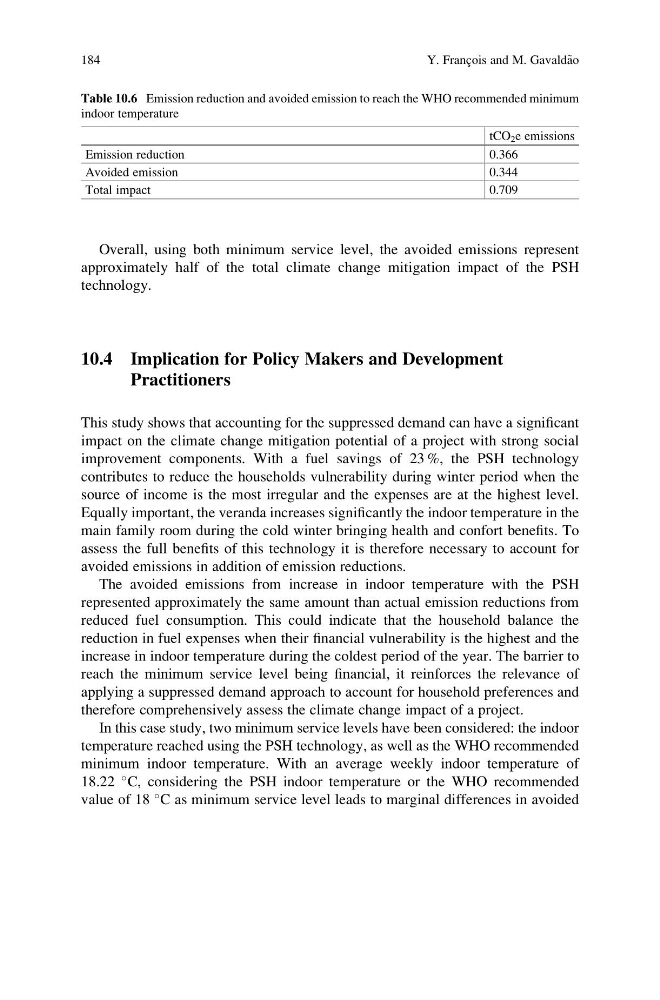
Overall, using both minimum service level, the avoided emissions represent
approximately half of the total climate change mitigation impact of the PSH
technology.
10.4 Implication for Policy Makers and Development
Practitioners
This study shows that accounting for the suppressed demand can have a significant
impact on the climate change mitigation potential of a project with strong social
improvement components. With a fuel savings of 23 %, the PSH technology
contributes to reduce the households vulnerability during winter period when the
source of income is the most irregular and the expenses are at the highest level.
Equally important, the veranda increases significantly the indoor temperature in the
main family room during the cold winter bringing health and confort benefits. To
assess the full benefits of this technology it is therefore necessary to account for
avoided emissions in addition of emission reductions.
The avoided emissions from increase in indoor temperature with the PSH
represented approximately the same amount than actual emission reductions from
reduced fuel consumption. This could indicate that the household balance the
reduction in fuel expenses when their financial vulnerability is the highest and the
increase in indoor temperature during the coldest period of the year. The barrier to
reach the minimum service level being financial, it reinforces the relevance of
applying a suppressed demand approach to account for household preferences and
therefore comprehensively assess the climate change impact of a project.
In this case study, two minimum service levels have been considered: the indoor
temperature reached using the PSH technology, as well as the WHO recommended
minimum indoor temperature. With an average weekly indoor temperature of
18.22
C, considering the PSH indoor temperature or the WHO recommended
value of 18
C as minimum service level leads to marginal differences in avoided
Table 10.6 Emission reduction and avoided emission to reach the WHO recommended minimum
indoor temperature
tCO 2 e emissions
Emission reduction
0.366
Avoided emission
0.344
Total impact
0.709
184
Y. Franc ¸ois and M. Gavald~ ao
approximately half of the total climate change mitigation impact of the PSH
technology.
10.4 Implication for Policy Makers and Development
Practitioners
This study shows that accounting for the suppressed demand can have a significant
impact on the climate change mitigation potential of a project with strong social
improvement components. With a fuel savings of 23 %, the PSH technology
contributes to reduce the households vulnerability during winter period when the
source of income is the most irregular and the expenses are at the highest level.
Equally important, the veranda increases significantly the indoor temperature in the
main family room during the cold winter bringing health and confort benefits. To
assess the full benefits of this technology it is therefore necessary to account for
avoided emissions in addition of emission reductions.
The avoided emissions from increase in indoor temperature with the PSH
represented approximately the same amount than actual emission reductions from
reduced fuel consumption. This could indicate that the household balance the
reduction in fuel expenses when their financial vulnerability is the highest and the
increase in indoor temperature during the coldest period of the year. The barrier to
reach the minimum service level being financial, it reinforces the relevance of
applying a suppressed demand approach to account for household preferences and
therefore comprehensively assess the climate change impact of a project.
In this case study, two minimum service levels have been considered: the indoor
temperature reached using the PSH technology, as well as the WHO recommended
minimum indoor temperature. With an average weekly indoor temperature of
18.22
C, considering the PSH indoor temperature or the WHO recommended
value of 18
C as minimum service level leads to marginal differences in avoided
Table 10.6 Emission reduction and avoided emission to reach the WHO recommended minimum
indoor temperature
tCO 2 e emissions
Emission reduction
0.366
Avoided emission
0.344
Total impact
0.709
184
Y. Franc ¸ois and M. Gavald~ ao