

Some of the projects provided relevant actors an opportunity to learn about new
technologies and approaches, whereas others were geared towards providing support to the locally nurtured initiatives on climate change mitigation. Of the 14 projects where indirect GHG emission reductions were reported, 9 projects were part of
the ongoing process within the country for addressing barriers related to the
targeted market/technology. In five instances the GEF supported project supported
the first application of the promoted technology in the country. Project design and
delineation of project boundary were assessed to be a major factor on whether GHG
are counted as direct or indirect result of the project.
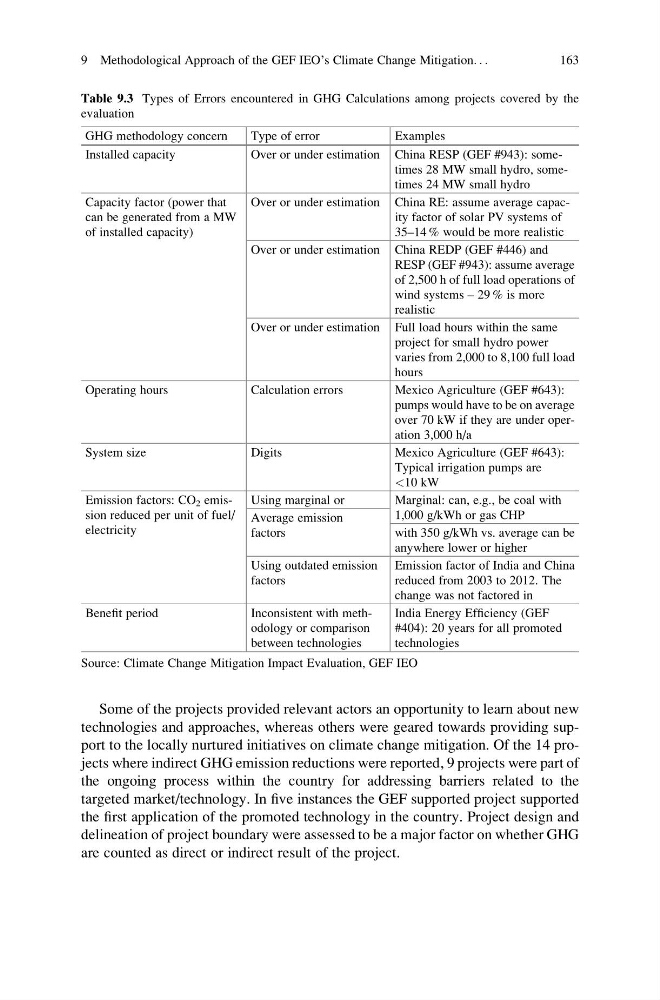
Table 9.3 Types of Errors encountered in GHG Calculations among projects covered by the
evaluation
GHG methodology concern
Type of error
Examples
Installed capacity
Over or under estimation China RESP (GEF #943): sometimes 28 MW small hydro, sometimes 24 MW small hydro
Capacity factor (power that
can be generated from a MW
of installed capacity)
Over or under estimation China RE: assume average capacity factor of solar PV systems of
35–14 % would be more realistic
Over or under estimation China REDP (GEF #446) and
RESP (GEF #943): assume average
of 2,500 h of full load operations of
wind systems – 29 % is more
realistic
Over or under estimation Full load hours within the same
project for small hydro power
varies from 2,000 to 8,100 full load
hours
Operating hours
Calculation errors
Mexico Agriculture (GEF #643):
pumps would have to be on average
over 70 kW if they are under operation 3,000 h/a
System size
Digits
Mexico Agriculture (GEF #643):
Typical irrigation pumps are
<10 kW
Emission factors: CO 2 emission reduced per unit of fuel/
electricity
Using marginal or
Marginal: can, e.g., be coal with
1,000 g/kWh or gas CHP
Average emission
factors
with 350 g/kWh vs. average can be
anywhere lower or higher
Using outdated emission
factors
Emission factor of India and China
reduced from 2003 to 2012. The
change was not factored in
Benefit period
Inconsistent with methodology or comparison
between technologies
India Energy Efficiency (GEF
#404): 20 years for all promoted
technologies
Source: Climate Change Mitigation Impact Evaluation, GEF IEO
9 Methodological Approach of the GEF IEO’s Climate Change Mitigation. . .
163
technologies and approaches, whereas others were geared towards providing support to the locally nurtured initiatives on climate change mitigation. Of the 14 projects where indirect GHG emission reductions were reported, 9 projects were part of
the ongoing process within the country for addressing barriers related to the
targeted market/technology. In five instances the GEF supported project supported
the first application of the promoted technology in the country. Project design and
delineation of project boundary were assessed to be a major factor on whether GHG
are counted as direct or indirect result of the project.
Table 9.3 Types of Errors encountered in GHG Calculations among projects covered by the
evaluation
GHG methodology concern
Type of error
Examples
Installed capacity
Over or under estimation China RESP (GEF #943): sometimes 28 MW small hydro, sometimes 24 MW small hydro
Capacity factor (power that
can be generated from a MW
of installed capacity)
Over or under estimation China RE: assume average capacity factor of solar PV systems of
35–14 % would be more realistic
Over or under estimation China REDP (GEF #446) and
RESP (GEF #943): assume average
of 2,500 h of full load operations of
wind systems – 29 % is more
realistic
Over or under estimation Full load hours within the same
project for small hydro power
varies from 2,000 to 8,100 full load
hours
Operating hours
Calculation errors
Mexico Agriculture (GEF #643):
pumps would have to be on average
over 70 kW if they are under operation 3,000 h/a
System size
Digits
Mexico Agriculture (GEF #643):
Typical irrigation pumps are
<10 kW
Emission factors: CO 2 emission reduced per unit of fuel/
electricity
Using marginal or
Marginal: can, e.g., be coal with
1,000 g/kWh or gas CHP
Average emission
factors
with 350 g/kWh vs. average can be
anywhere lower or higher
Using outdated emission
factors
Emission factor of India and China
reduced from 2003 to 2012. The
change was not factored in
Benefit period
Inconsistent with methodology or comparison
between technologies
India Energy Efficiency (GEF
#404): 20 years for all promoted
technologies
Source: Climate Change Mitigation Impact Evaluation, GEF IEO
9 Methodological Approach of the GEF IEO’s Climate Change Mitigation. . .
163