

9.4 Assessing Impacts of GEF Support
An intervention theory of change is meant to explain how inputs and activities will
lead to outputs and impacts and to make explicit the key assumptions about how
impacts will be achieved. Many publications discuss the use of theories of change in
evaluation (Chen 1990; van den Berg and Todd 2011; Weiss 1972). These
approaches are particularly well suited to evaluate specific projects or programs.
The climate change evaluation included a wide variety of projects covering diverse
technologies and markets that are affected by different factors and conditions
including policy instruments, institutions, and interactions among producers, suppliers and consumers. Thus, this specific challenge required an overall framework
that allowed systematic comparison among such different interventions. Since its
inception, GEF has been supporting generation of global environmental benefits in
different focal areas. However, for a long period there was no consistent overall
conceptual framework that was applicable across its different focal areas to assess
how GEF intends to achieve the global environmental benefits. The GEF IEO has,
however, found that having such an explicit framework is important for its impact
evaluation work. GEF IEO has prepared a generic framework for the development
of theories of change (TOC framework) to facilitate these comparative analysis
(GEF IEO 2012, 2013, 2014). This general framework was used as a basis to assess
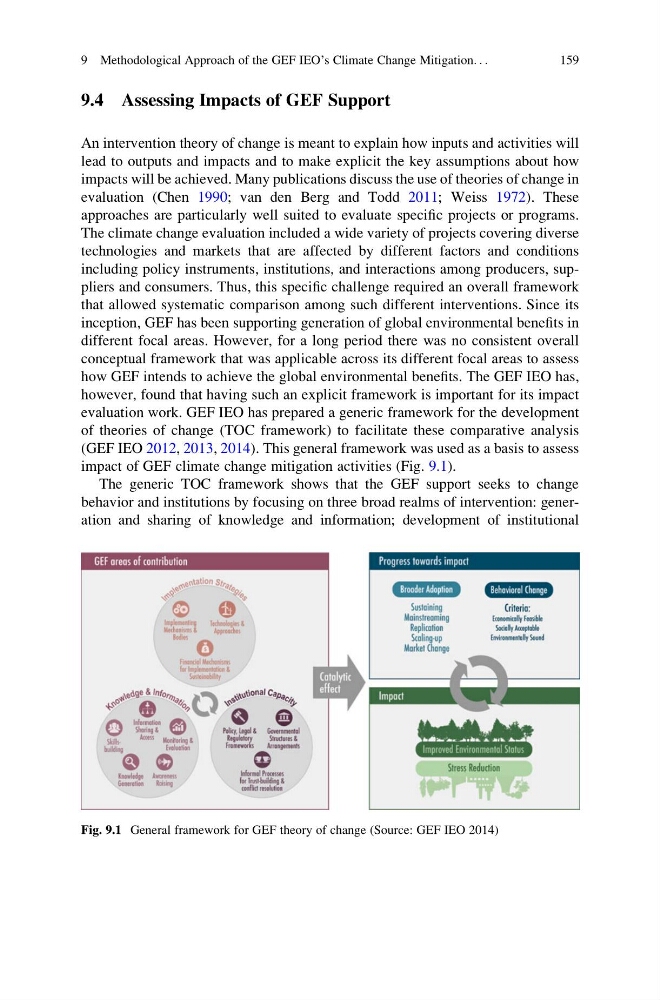
impact of GEF climate change mitigation activities (Fig. 9.1).
The generic TOC framework shows that the GEF support seeks to change
behavior and institutions by focusing on three broad realms of intervention: generation and sharing of knowledge and information; development of institutional
Fig. 9.1 General framework for GEF theory of change (Source: GEF IEO 2014)
9 Methodological Approach of the GEF IEO’s Climate Change Mitigation. . .
159
An intervention theory of change is meant to explain how inputs and activities will
lead to outputs and impacts and to make explicit the key assumptions about how
impacts will be achieved. Many publications discuss the use of theories of change in
evaluation (Chen 1990; van den Berg and Todd 2011; Weiss 1972). These
approaches are particularly well suited to evaluate specific projects or programs.
The climate change evaluation included a wide variety of projects covering diverse
technologies and markets that are affected by different factors and conditions
including policy instruments, institutions, and interactions among producers, suppliers and consumers. Thus, this specific challenge required an overall framework
that allowed systematic comparison among such different interventions. Since its
inception, GEF has been supporting generation of global environmental benefits in
different focal areas. However, for a long period there was no consistent overall
conceptual framework that was applicable across its different focal areas to assess
how GEF intends to achieve the global environmental benefits. The GEF IEO has,
however, found that having such an explicit framework is important for its impact
evaluation work. GEF IEO has prepared a generic framework for the development
of theories of change (TOC framework) to facilitate these comparative analysis
(GEF IEO 2012, 2013, 2014). This general framework was used as a basis to assess
impact of GEF climate change mitigation activities (Fig. 9.1).
The generic TOC framework shows that the GEF support seeks to change
behavior and institutions by focusing on three broad realms of intervention: generation and sharing of knowledge and information; development of institutional
Fig. 9.1 General framework for GEF theory of change (Source: GEF IEO 2014)
9 Methodological Approach of the GEF IEO’s Climate Change Mitigation. . .
159