

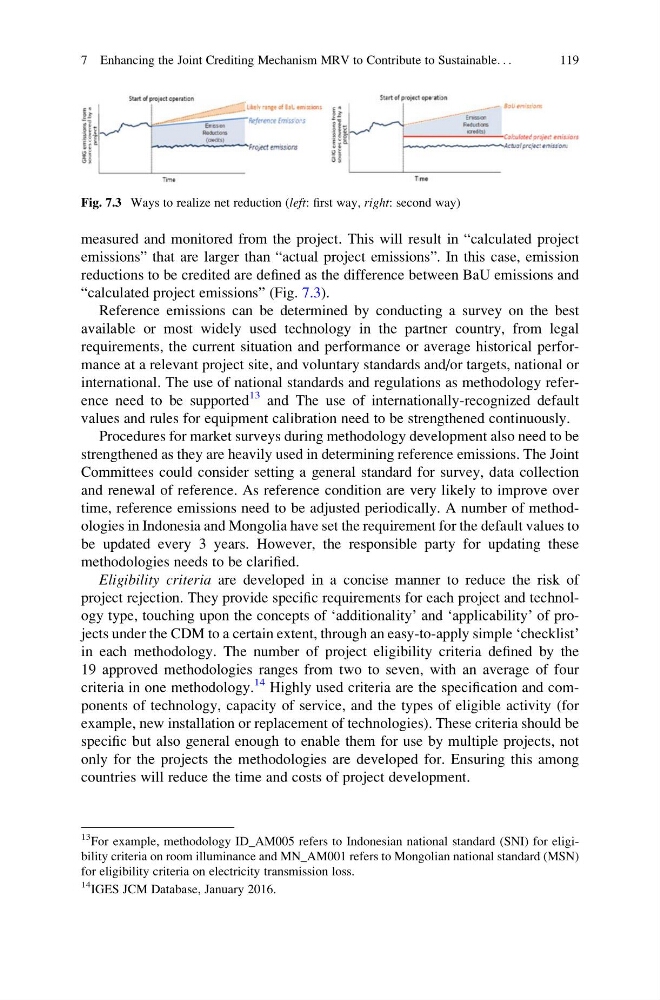
measured and monitored from the project. This will result in “calculated project
emissions” that are larger than “actual project emissions”. In this case, emission
reductions to be credited are defined as the difference between BaU emissions and
“calculated project emissions” (Fig. 7.3).
Reference emissions can be determined by conducting a survey on the best
available or most widely used technology in the partner country, from legal
requirements, the current situation and performance or average historical performance at a relevant project site, and voluntary standards and/or targets, national or
international. The use of national standards and regulations as methodology reference need to be supported
13 and The use of internationally-recognized default
values and rules for equipment calibration need to be strengthened continuously.
Procedures for market surveys during methodology development also need to be
strengthened as they are heavily used in determining reference emissions. The Joint
Committees could consider setting a general standard for survey, data collection
and renewal of reference. As reference condition are very likely to improve over
time, reference emissions need to be adjusted periodically. A number of methodologies in Indonesia and Mongolia have set the requirement for the default values to
be updated every 3 years. However, the responsible party for updating these
methodologies needs to be clarified.
Eligibility criteria are developed in a concise manner to reduce the risk of
project rejection. They provide specific requirements for each project and technology type, touching upon the concepts of ‘additionality’ and ‘applicability’ of projects under the CDM to a certain extent, through an easy-to-apply simple ‘checklist’
in each methodology. The number of project eligibility criteria defined by the
19 approved methodologies ranges from two to seven, with an average of four
criteria in one methodology.
14 Highly used criteria are the specification and components of technology, capacity of service, and the types of eligible activity (for
example, new installation or replacement of technologies). These criteria should be
specific but also general enough to enable them for use by multiple projects, not
only for the projects the methodologies are developed for. Ensuring this among
countries will reduce the time and costs of project development.
Fig. 7.3 Ways to realize net reduction (left: first way, right: second way)
13 For example, methodology ID_AM005 refers to Indonesian national standard (SNI) for eligibility criteria on room illuminance and MN_AM001 refers to Mongolian national standard (MSN)
for eligibility criteria on electricity transmission loss.
14 IGES JCM Database, January 2016.
7 Enhancing the Joint Crediting Mechanism MRV to Contribute to Sustainable. . .
119
emissions” that are larger than “actual project emissions”. In this case, emission
reductions to be credited are defined as the difference between BaU emissions and
“calculated project emissions” (Fig. 7.3).
Reference emissions can be determined by conducting a survey on the best
available or most widely used technology in the partner country, from legal
requirements, the current situation and performance or average historical performance at a relevant project site, and voluntary standards and/or targets, national or
international. The use of national standards and regulations as methodology reference need to be supported
13 and The use of internationally-recognized default
values and rules for equipment calibration need to be strengthened continuously.
Procedures for market surveys during methodology development also need to be
strengthened as they are heavily used in determining reference emissions. The Joint
Committees could consider setting a general standard for survey, data collection
and renewal of reference. As reference condition are very likely to improve over
time, reference emissions need to be adjusted periodically. A number of methodologies in Indonesia and Mongolia have set the requirement for the default values to
be updated every 3 years. However, the responsible party for updating these
methodologies needs to be clarified.
Eligibility criteria are developed in a concise manner to reduce the risk of
project rejection. They provide specific requirements for each project and technology type, touching upon the concepts of ‘additionality’ and ‘applicability’ of projects under the CDM to a certain extent, through an easy-to-apply simple ‘checklist’
in each methodology. The number of project eligibility criteria defined by the
19 approved methodologies ranges from two to seven, with an average of four
criteria in one methodology.
14 Highly used criteria are the specification and components of technology, capacity of service, and the types of eligible activity (for
example, new installation or replacement of technologies). These criteria should be
specific but also general enough to enable them for use by multiple projects, not
only for the projects the methodologies are developed for. Ensuring this among
countries will reduce the time and costs of project development.
Fig. 7.3 Ways to realize net reduction (left: first way, right: second way)
13 For example, methodology ID_AM005 refers to Indonesian national standard (SNI) for eligibility criteria on room illuminance and MN_AM001 refers to Mongolian national standard (MSN)
for eligibility criteria on electricity transmission loss.
14 IGES JCM Database, January 2016.
7 Enhancing the Joint Crediting Mechanism MRV to Contribute to Sustainable. . .
119