

institution are required to represent the consortium and apply to the Japanese
government for subsidy through open biddings. Financial support for selected
projects are disbursed directly to participants or indirectly through intermediary
organizations. For MOEJ Model Project financing program, the financing is limited
only to those costs that can be verified as having been spent for implementation of
eligible projects.
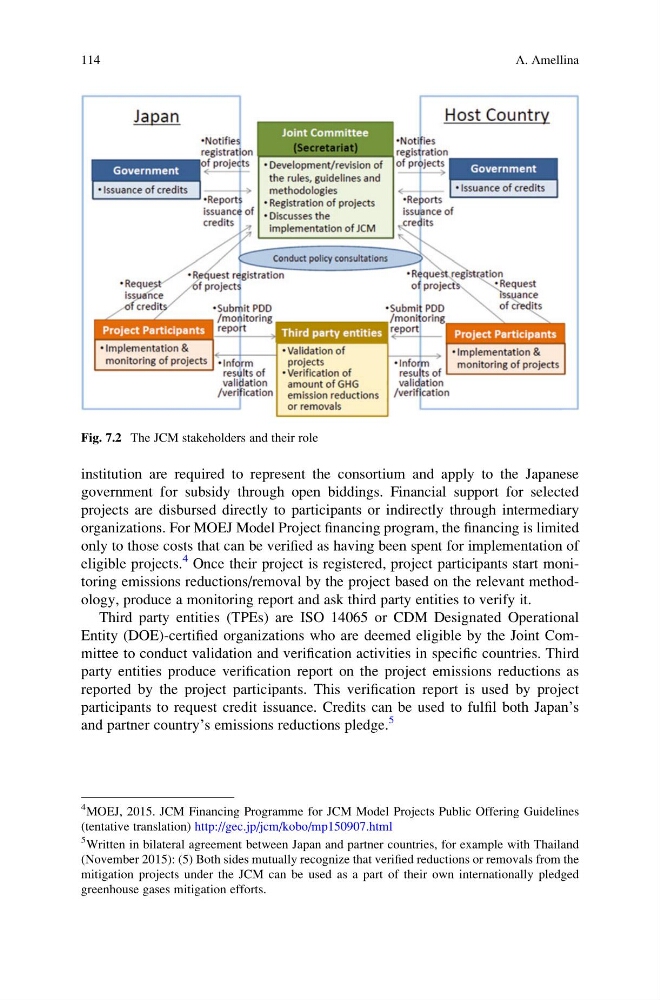
4 Once their project is registered, project participants start monitoring emissions reductions/removal by the project based on the relevant methodology, produce a monitoring report and ask third party entities to verify it.
Third party entities (TPEs) are ISO 14065 or CDM Designated Operational
Entity (DOE)-certified organizations who are deemed eligible by the Joint Committee to conduct validation and verification activities in specific countries. Third
party entities produce verification report on the project emissions reductions as
reported by the project participants. This verification report is used by project
participants to request credit issuance. Credits can be used to fulfil both Japan’s
and partner country’s emissions reductions pledge.
5
Fig. 7.2 The JCM stakeholders and their role
4 MOEJ, 2015. JCM Financing Programme for JCM Model Projects Public Offering Guidelines
(tentative translation) http://gec.jp/jcm/kobo/mp150907.html
5 Written in bilateral agreement between Japan and partner countries, for example with Thailand
(November 2015): (5) Both sides mutually recognize that verified reductions or removals from the
mitigation projects under the JCM can be used as a part of their own internationally pledged
greenhouse gases mitigation efforts.
114
A. Amellina
government for subsidy through open biddings. Financial support for selected
projects are disbursed directly to participants or indirectly through intermediary
organizations. For MOEJ Model Project financing program, the financing is limited
only to those costs that can be verified as having been spent for implementation of
eligible projects.
4 Once their project is registered, project participants start monitoring emissions reductions/removal by the project based on the relevant methodology, produce a monitoring report and ask third party entities to verify it.
Third party entities (TPEs) are ISO 14065 or CDM Designated Operational
Entity (DOE)-certified organizations who are deemed eligible by the Joint Committee to conduct validation and verification activities in specific countries. Third
party entities produce verification report on the project emissions reductions as
reported by the project participants. This verification report is used by project
participants to request credit issuance. Credits can be used to fulfil both Japan’s
and partner country’s emissions reductions pledge.
5
Fig. 7.2 The JCM stakeholders and their role
4 MOEJ, 2015. JCM Financing Programme for JCM Model Projects Public Offering Guidelines
(tentative translation) http://gec.jp/jcm/kobo/mp150907.html
5 Written in bilateral agreement between Japan and partner countries, for example with Thailand
(November 2015): (5) Both sides mutually recognize that verified reductions or removals from the
mitigation projects under the JCM can be used as a part of their own internationally pledged
greenhouse gases mitigation efforts.
114
A. Amellina