

81
5.5.1 Traditional Rules and Practices Followed by IPLCs
5.5.1.1 Rules Followed by the Mouals (Honey/Wax Collectors)
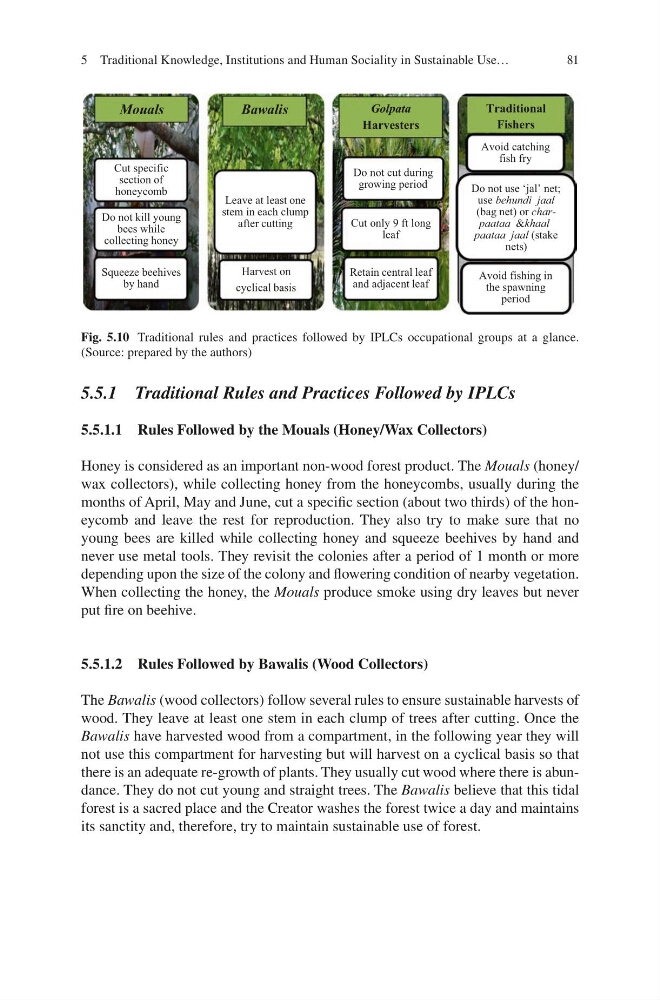
Honey is considered as an important non-wood forest product. The Mouals (honey/
wax collectors), while collecting honey from the honeycombs, usually during the
months of April, May and June, cut a specific section (about two thirds) of the honeycomb and leave the rest for reproduction. They also try to make sure that no
young bees are killed while collecting honey and squeeze beehives by hand and
never use metal tools. They revisit the colonies after a period of 1 month or more
depending upon the size of the colony and flowering condition of nearby vegetation.
When collecting the honey, the Mouals produce smoke using dry leaves but never
put fire on beehive.
5.5.1.2 Rules Followed by Bawalis (Wood Collectors)
The Bawalis (wood collectors) follow several rules to ensure sustainable harvests of
wood. They leave at least one stem in each clump of trees after cutting. Once the
Bawalis have harvested wood from a compartment, in the following year they will
not use this compartment for harvesting but will harvest on a cyclical basis so that
there is an adequate re-growth of plants. They usually cut wood where there is abundance. They do not cut young and straight trees. The Bawalis believe that this tidal
forest is a sacred place and the Creator washes the forest twice a day and maintains
its sanctity and, therefore, try to maintain sustainable use of forest.
Cut specific
section of
honeycomb
Do not kill young
bees while
collecting honey
Squeeze beehives
by hand
Leave at least one
stem in each clump
after cutting
Harvest on
cyclical basis
Do not cut during
growing period
Cut only 9 ft long
leaf
Retain central leaf
and adjacent leaf
Do not use ‘jal’ net;
use behundi jaal
(bag net) or charpaataa &khaalpaataa jaal (stake
nets)
Avoid catching
fish fry
Traditional
Fishers
Golpata
Harvesters
Bawalis
Mouals
Avoid fishing in
the spawning
period
Fig. 5.10 Traditional rules and practices followed by IPLCs occupational groups at a glance.
(Source: prepared by the authors)
5 Traditional Knowledge, Institutions and Human Sociality in Sustainable Use…
5.5.1 Traditional Rules and Practices Followed by IPLCs
5.5.1.1 Rules Followed by the Mouals (Honey/Wax Collectors)
Honey is considered as an important non-wood forest product. The Mouals (honey/
wax collectors), while collecting honey from the honeycombs, usually during the
months of April, May and June, cut a specific section (about two thirds) of the honeycomb and leave the rest for reproduction. They also try to make sure that no
young bees are killed while collecting honey and squeeze beehives by hand and
never use metal tools. They revisit the colonies after a period of 1 month or more
depending upon the size of the colony and flowering condition of nearby vegetation.
When collecting the honey, the Mouals produce smoke using dry leaves but never
put fire on beehive.
5.5.1.2 Rules Followed by Bawalis (Wood Collectors)
The Bawalis (wood collectors) follow several rules to ensure sustainable harvests of
wood. They leave at least one stem in each clump of trees after cutting. Once the
Bawalis have harvested wood from a compartment, in the following year they will
not use this compartment for harvesting but will harvest on a cyclical basis so that
there is an adequate re-growth of plants. They usually cut wood where there is abundance. They do not cut young and straight trees. The Bawalis believe that this tidal
forest is a sacred place and the Creator washes the forest twice a day and maintains
its sanctity and, therefore, try to maintain sustainable use of forest.
Cut specific
section of
honeycomb
Do not kill young
bees while
collecting honey
Squeeze beehives
by hand
Leave at least one
stem in each clump
after cutting
Harvest on
cyclical basis
Do not cut during
growing period
Cut only 9 ft long
leaf
Retain central leaf
and adjacent leaf
Do not use ‘jal’ net;
use behundi jaal
(bag net) or charpaataa &khaalpaataa jaal (stake
nets)
Avoid catching
fish fry
Traditional
Fishers
Golpata
Harvesters
Bawalis
Mouals
Avoid fishing in
the spawning
period
Fig. 5.10 Traditional rules and practices followed by IPLCs occupational groups at a glance.
(Source: prepared by the authors)
5 Traditional Knowledge, Institutions and Human Sociality in Sustainable Use…