

80
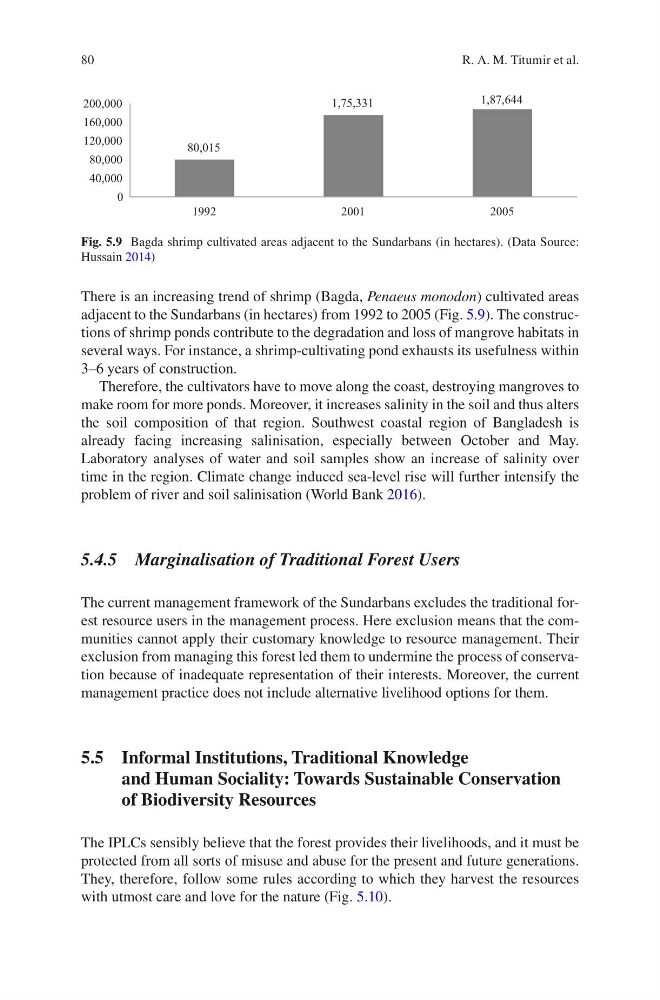
There is an increasing trend of shrimp (Bagda, Penaeus monodon) cultivated areas
adjacent to the Sundarbans (in hectares) from 1992 to 2005 (Fig. 5.9). The constructions of shrimp ponds contribute to the degradation and loss of mangrove habitats in
several ways. For instance, a shrimp-cultivating pond exhausts its usefulness within
3–6 years of construction.
Therefore, the cultivators have to move along the coast, destroying mangroves to
make room for more ponds. Moreover, it increases salinity in the soil and thus alters
the soil composition of that region. Southwest coastal region of Bangladesh is
already facing increasing salinisation, especially between October and May.
Laboratory analyses of water and soil samples show an increase of salinity over
time in the region. Climate change induced sea-level rise will further intensify the
problem of river and soil salinisation (World Bank 2016).
5.4.5 Marginalisation of Traditional Forest Users
The current management framework of the Sundarbans excludes the traditional forest resource users in the management process. Here exclusion means that the communities cannot apply their customary knowledge to resource management. Their
exclusion from managing this forest led them to undermine the process of conservation because of inadequate representation of their interests. Moreover, the current
management practice does not include alternative livelihood options for them.
5.5 Informal Institutions, Traditional Knowledge
and Human Sociality: Towards Sustainable Conservation
of Biodiversity Resources
The IPLCs sensibly believe that the forest provides their livelihoods, and it must be
protected from all sorts of misuse and abuse for the present and future generations.
They, therefore, follow some rules according to which they harvest the resources
with utmost care and love for the nature (Fig. 5.10).
80,015
1,75,331
1,87,644
0
40,000
80,000
120,000
160,000
200,000
1992
2001
2005
Fig. 5.9 Bagda shrimp cultivated areas adjacent to the Sundarbans (in hectares). (Data Source:
Hussain 2014)
R. A. M. Titumir et al.
There is an increasing trend of shrimp (Bagda, Penaeus monodon) cultivated areas
adjacent to the Sundarbans (in hectares) from 1992 to 2005 (Fig. 5.9). The constructions of shrimp ponds contribute to the degradation and loss of mangrove habitats in
several ways. For instance, a shrimp-cultivating pond exhausts its usefulness within
3–6 years of construction.
Therefore, the cultivators have to move along the coast, destroying mangroves to
make room for more ponds. Moreover, it increases salinity in the soil and thus alters
the soil composition of that region. Southwest coastal region of Bangladesh is
already facing increasing salinisation, especially between October and May.
Laboratory analyses of water and soil samples show an increase of salinity over
time in the region. Climate change induced sea-level rise will further intensify the
problem of river and soil salinisation (World Bank 2016).
5.4.5 Marginalisation of Traditional Forest Users
The current management framework of the Sundarbans excludes the traditional forest resource users in the management process. Here exclusion means that the communities cannot apply their customary knowledge to resource management. Their
exclusion from managing this forest led them to undermine the process of conservation because of inadequate representation of their interests. Moreover, the current
management practice does not include alternative livelihood options for them.
5.5 Informal Institutions, Traditional Knowledge
and Human Sociality: Towards Sustainable Conservation
of Biodiversity Resources
The IPLCs sensibly believe that the forest provides their livelihoods, and it must be
protected from all sorts of misuse and abuse for the present and future generations.
They, therefore, follow some rules according to which they harvest the resources
with utmost care and love for the nature (Fig. 5.10).
80,015
1,75,331
1,87,644
0
40,000
80,000
120,000
160,000
200,000
1992
2001
2005
Fig. 5.9 Bagda shrimp cultivated areas adjacent to the Sundarbans (in hectares). (Data Source:
Hussain 2014)
R. A. M. Titumir et al.