

77
ence of many political economic factors. A brief overview has been provided here
firstly on the current structure of property rights of the Sundarbans. The major drivers of resource degradation have been identified thereafter.
5.4.1 Structure of Property Rights of the Sundarbans
The nature of property rights of the Sundarbans was ambiguous since formulation
process. It was treated as open access forest for harvesting and conversion for agriculture particularly during Mughal period. The British colonisers ruling over Indian
subcontinent became aware of the importance of this mangrove forest and declared
it as Reserve Forest (RF) in 1878. The right over the forest was, thus, kept in the
hands of the government. After the independence of Bangladesh in 1971, the forest
of Bangladesh part was declared as RF again under the Forest Act 1927. Then, the
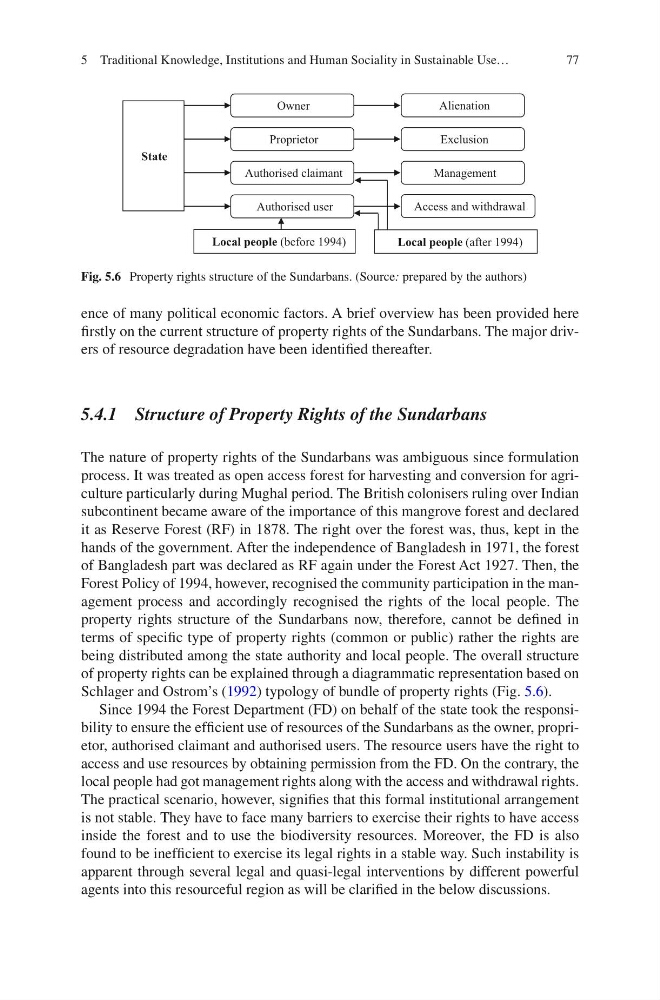
Forest Policy of 1994, however, recognised the community participation in the management process and accordingly recognised the rights of the local people. The
property rights structure of the Sundarbans now, therefore, cannot be defined in
terms of specific type of property rights (common or public) rather the rights are
being distributed among the state authority and local people. The overall structure
of property rights can be explained through a diagrammatic representation based on
Schlager and Ostrom’s (1992) typology of bundle of property rights (Fig. 5.6).
Since 1994 the Forest Department (FD) on behalf of the state took the responsibility to ensure the efficient use of resources of the Sundarbans as the owner, proprietor, authorised claimant and authorised users. The resource users have the right to
access and use resources by obtaining permission from the FD. On the contrary, the
local people had got management rights along with the access and withdrawal rights.
The practical scenario, however, signifies that this formal institutional arrangement
is not stable. They have to face many barriers to exercise their rights to have access
inside the forest and to use the biodiversity resources. Moreover, the FD is also
found to be inefficient to exercise its legal rights in a stable way. Such instability is
apparent through several legal and quasi-legal interventions by different powerful
agents into this resourceful region as will be clarified in the below discussions.
State
Proprietor
Local people (after 1994)
Local people (before 1994)
Authorised claimant
Authorised user
Owner
Alienation
Exclusion
Management
Access and withdrawal
Fig. 5.6 Property rights structure of the Sundarbans. (Source: prepared by the authors)
5 Traditional Knowledge, Institutions and Human Sociality in Sustainable Use…
ence of many political economic factors. A brief overview has been provided here
firstly on the current structure of property rights of the Sundarbans. The major drivers of resource degradation have been identified thereafter.
5.4.1 Structure of Property Rights of the Sundarbans
The nature of property rights of the Sundarbans was ambiguous since formulation
process. It was treated as open access forest for harvesting and conversion for agriculture particularly during Mughal period. The British colonisers ruling over Indian
subcontinent became aware of the importance of this mangrove forest and declared
it as Reserve Forest (RF) in 1878. The right over the forest was, thus, kept in the
hands of the government. After the independence of Bangladesh in 1971, the forest
of Bangladesh part was declared as RF again under the Forest Act 1927. Then, the
Forest Policy of 1994, however, recognised the community participation in the management process and accordingly recognised the rights of the local people. The
property rights structure of the Sundarbans now, therefore, cannot be defined in
terms of specific type of property rights (common or public) rather the rights are
being distributed among the state authority and local people. The overall structure
of property rights can be explained through a diagrammatic representation based on
Schlager and Ostrom’s (1992) typology of bundle of property rights (Fig. 5.6).
Since 1994 the Forest Department (FD) on behalf of the state took the responsibility to ensure the efficient use of resources of the Sundarbans as the owner, proprietor, authorised claimant and authorised users. The resource users have the right to
access and use resources by obtaining permission from the FD. On the contrary, the
local people had got management rights along with the access and withdrawal rights.
The practical scenario, however, signifies that this formal institutional arrangement
is not stable. They have to face many barriers to exercise their rights to have access
inside the forest and to use the biodiversity resources. Moreover, the FD is also
found to be inefficient to exercise its legal rights in a stable way. Such instability is
apparent through several legal and quasi-legal interventions by different powerful
agents into this resourceful region as will be clarified in the below discussions.
State
Proprietor
Local people (after 1994)
Local people (before 1994)
Authorised claimant
Authorised user
Owner
Alienation
Exclusion
Management
Access and withdrawal
Fig. 5.6 Property rights structure of the Sundarbans. (Source: prepared by the authors)
5 Traditional Knowledge, Institutions and Human Sociality in Sustainable Use…