

76
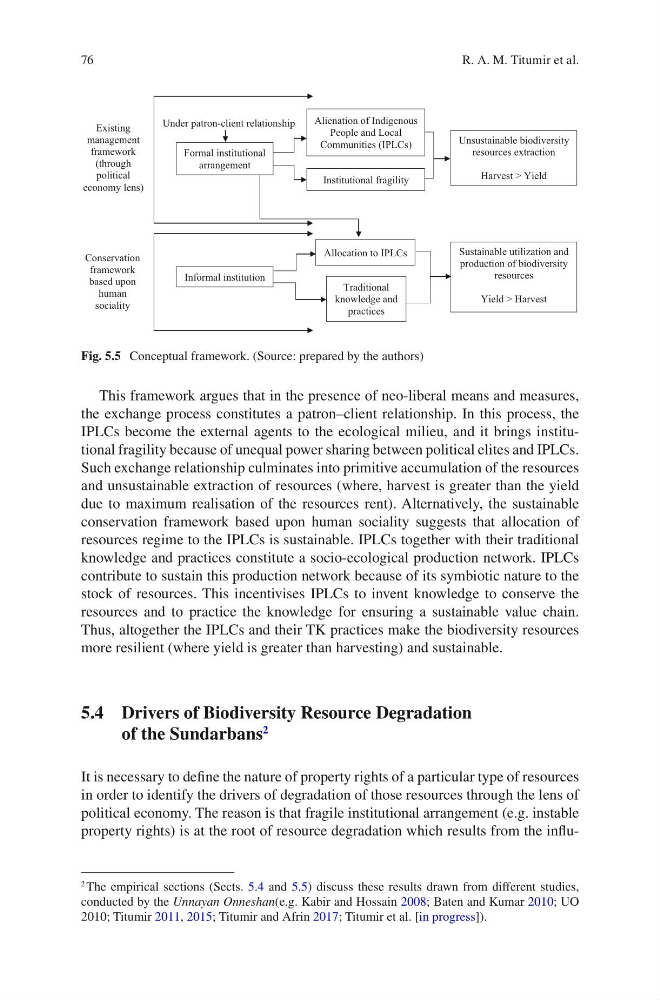
This framework argues that in the presence of neo-liberal means and measures,
the exchange process constitutes a patron–client relationship. In this process, the
IPLCs become the external agents to the ecological milieu, and it brings institutional fragility because of unequal power sharing between political elites and IPLCs.
Such exchange relationship culminates into primitive accumulation of the resources
and unsustainable extraction of resources (where, harvest is greater than the yield
due to maximum realisation of the resources rent). Alternatively, the sustainable
conservation framework based upon human sociality suggests that allocation of
resources regime to the IPLCs is sustainable. IPLCs together with their traditional
knowledge and practices constitute a socio-ecological production network. IPLCs
contribute to sustain this production network because of its symbiotic nature to the
stock of resources. This incentivises IPLCs to invent knowledge to conserve the
resources and to practice the knowledge for ensuring a sustainable value chain.
Thus, altogether the IPLCs and their TK practices make the biodiversity resources
more resilient (where yield is greater than harvesting) and sustainable.
5.4 Drivers of Biodiversity Resource Degradation
of the Sundarbans
2
It is necessary to define the nature of property rights of a particular type of resources
in order to identify the drivers of degradation of those resources through the lens of
political economy. The reason is that fragile institutional arrangement (e.g. instable
property rights) is at the root of resource degradation which results from the influ2 The empirical sections (Sects. 5.4 and 5.5) discuss these results drawn from different studies,
conducted by the Unnayan Onneshan(e.g. Kabir and Hossain 2008; Baten and Kumar 2010; UO
2010; Titumir 2011, 2015; Titumir and Afrin 2017; Titumir et al. [in progress]).
Allocation to IPLCs
Conservation
framework
based upon
human
sociality
Formal institutional
arrangement
Alienation of Indigenous
People and Local
Communities (IPLCs)
Informal institution
Traditional
knowledge and
practices
Unsustainable biodiversity
resources extraction
Harvest > Yield
Sustainable utilization and
production of biodiversity
resources
Yield > Harvest
Institutional fragility
Existing
management
framework
(through
political
economy lens)
Under patron-client relationship
Fig. 5.5 Conceptual framework. (Source: prepared by the authors)
R. A. M. Titumir et al.
This framework argues that in the presence of neo-liberal means and measures,
the exchange process constitutes a patron–client relationship. In this process, the
IPLCs become the external agents to the ecological milieu, and it brings institutional fragility because of unequal power sharing between political elites and IPLCs.
Such exchange relationship culminates into primitive accumulation of the resources
and unsustainable extraction of resources (where, harvest is greater than the yield
due to maximum realisation of the resources rent). Alternatively, the sustainable
conservation framework based upon human sociality suggests that allocation of
resources regime to the IPLCs is sustainable. IPLCs together with their traditional
knowledge and practices constitute a socio-ecological production network. IPLCs
contribute to sustain this production network because of its symbiotic nature to the
stock of resources. This incentivises IPLCs to invent knowledge to conserve the
resources and to practice the knowledge for ensuring a sustainable value chain.
Thus, altogether the IPLCs and their TK practices make the biodiversity resources
more resilient (where yield is greater than harvesting) and sustainable.
5.4 Drivers of Biodiversity Resource Degradation
of the Sundarbans
2
It is necessary to define the nature of property rights of a particular type of resources
in order to identify the drivers of degradation of those resources through the lens of
political economy. The reason is that fragile institutional arrangement (e.g. instable
property rights) is at the root of resource degradation which results from the influ2 The empirical sections (Sects. 5.4 and 5.5) discuss these results drawn from different studies,
conducted by the Unnayan Onneshan(e.g. Kabir and Hossain 2008; Baten and Kumar 2010; UO
2010; Titumir 2011, 2015; Titumir and Afrin 2017; Titumir et al. [in progress]).
Allocation to IPLCs
Conservation
framework
based upon
human
sociality
Formal institutional
arrangement
Alienation of Indigenous
People and Local
Communities (IPLCs)
Informal institution
Traditional
knowledge and
practices
Unsustainable biodiversity
resources extraction
Harvest > Yield
Sustainable utilization and
production of biodiversity
resources
Yield > Harvest
Institutional fragility
Existing
management
framework
(through
political
economy lens)
Under patron-client relationship
Fig. 5.5 Conceptual framework. (Source: prepared by the authors)
R. A. M. Titumir et al.