

62
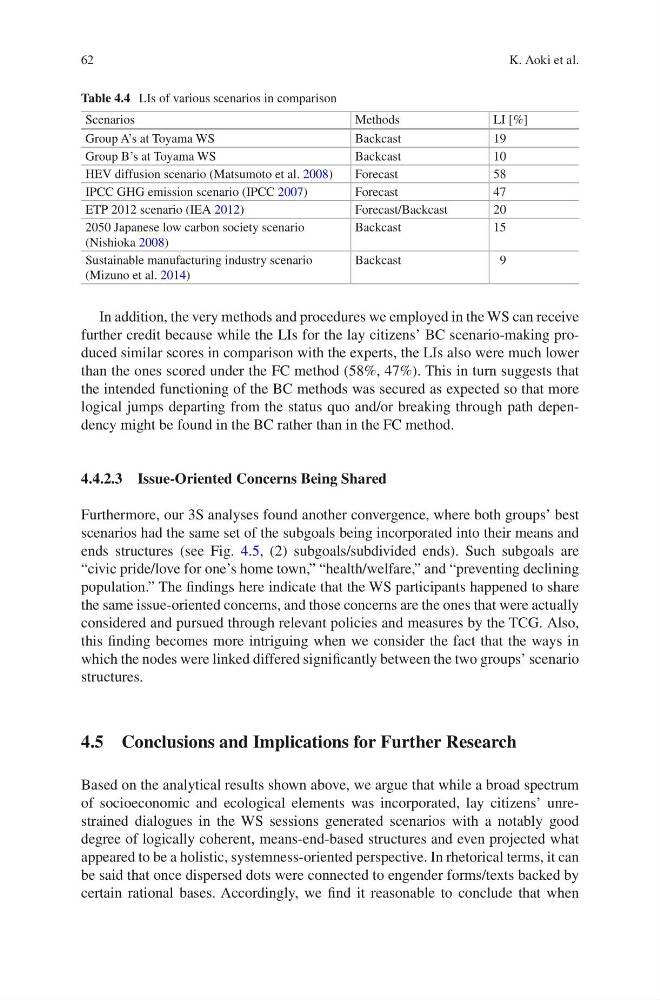
In addition, the very methods and procedures we employed in the WS can receive
further credit because while the LIs for the lay citizens’ BC scenario-making produced similar scores in comparison with the experts, the LIs also were much lower
than the ones scored under the FC method (58%, 47%). This in turn suggests that
the intended functioning of the BC methods was secured as expected so that more
logical jumps departing from the status quo and/or breaking through path dependency might be found in the BC rather than in the FC method.
4.4.2.3 Issue-Oriented Concerns Being Shared
Furthermore, our 3S analyses found another convergence, where both groups’ best
scenarios had the same set of the subgoals being incorporated into their means and
ends structures (see Fig. 4.5, (2) subgoals/subdivided ends). Such subgoals are
“civic pride/love for one’s home town,” “health/welfare,” and “preventing declining
population.” The findings here indicate that the WS participants happened to share
the same issue-oriented concerns, and those concerns are the ones that were actually
considered and pursued through relevant policies and measures by the TCG. Also,
this finding becomes more intriguing when we consider the fact that the ways in
which the nodes were linked differed significantly between the two groups’ scenario
structures.
4.5 Conclusions and Implications for Further Research
Based on the analytical results shown above, we argue that while a broad spectrum
of socioeconomic and ecological elements was incorporated, lay citizens’ unrestrained dialogues in the WS sessions generated scenarios with a notably good
degree of logically coherent, means-end-based structures and even projected what
appeared to be a holistic, systemness-oriented perspective. In rhetorical terms, it can
be said that once dispersed dots were connected to engender forms/texts backed by
certain rational bases. Accordingly, we find it reasonable to conclude that when
Table 4.4 LIs of various scenarios in comparison
Scenarios
Methods
LI [%]
Group A’s at Toyama WS
Backcast
19
Group B’s at Toyama WS
Backcast
10
HEV diffusion scenario (Matsumoto et al. 2008)
Forecast
58
IPCC GHG emission scenario (IPCC 2007)
Forecast
47
ETP 2012 scenario (IEA 2012)
Forecast/Backcast
20
2050 Japanese low carbon society scenario
(Nishioka 2008)
Backcast
15
Sustainable manufacturing industry scenario
(Mizuno et al. 2014)
Backcast
9
K. Aoki et al.
In addition, the very methods and procedures we employed in the WS can receive
further credit because while the LIs for the lay citizens’ BC scenario-making produced similar scores in comparison with the experts, the LIs also were much lower
than the ones scored under the FC method (58%, 47%). This in turn suggests that
the intended functioning of the BC methods was secured as expected so that more
logical jumps departing from the status quo and/or breaking through path dependency might be found in the BC rather than in the FC method.
4.4.2.3 Issue-Oriented Concerns Being Shared
Furthermore, our 3S analyses found another convergence, where both groups’ best
scenarios had the same set of the subgoals being incorporated into their means and
ends structures (see Fig. 4.5, (2) subgoals/subdivided ends). Such subgoals are
“civic pride/love for one’s home town,” “health/welfare,” and “preventing declining
population.” The findings here indicate that the WS participants happened to share
the same issue-oriented concerns, and those concerns are the ones that were actually
considered and pursued through relevant policies and measures by the TCG. Also,
this finding becomes more intriguing when we consider the fact that the ways in
which the nodes were linked differed significantly between the two groups’ scenario
structures.
4.5 Conclusions and Implications for Further Research
Based on the analytical results shown above, we argue that while a broad spectrum
of socioeconomic and ecological elements was incorporated, lay citizens’ unrestrained dialogues in the WS sessions generated scenarios with a notably good
degree of logically coherent, means-end-based structures and even projected what
appeared to be a holistic, systemness-oriented perspective. In rhetorical terms, it can
be said that once dispersed dots were connected to engender forms/texts backed by
certain rational bases. Accordingly, we find it reasonable to conclude that when
Table 4.4 LIs of various scenarios in comparison
Scenarios
Methods
LI [%]
Group A’s at Toyama WS
Backcast
19
Group B’s at Toyama WS
Backcast
10
HEV diffusion scenario (Matsumoto et al. 2008)
Forecast
58
IPCC GHG emission scenario (IPCC 2007)
Forecast
47
ETP 2012 scenario (IEA 2012)
Forecast/Backcast
20
2050 Japanese low carbon society scenario
(Nishioka 2008)
Backcast
15
Sustainable manufacturing industry scenario
(Mizuno et al. 2014)
Backcast
9
K. Aoki et al.