

55
4.3.2 Use of the Sustainable Society Scenario (3S) Simulator
The second approach is the use of a simulation technique called the “sustainable
society scenario simulator” (hereafter 3S simulator) proposed by one of the authors
(Umeda et al. 2009; Kishita et al. 2009, 2010). The 3S simulator consists of an integrated supporting system developed for assisting us to comprehend, generate, and
analyze scenarios concerning sustainable societies. The 3S simulator utilizes a computational model and algorithms to describe, with visualization, cause-and-effect
relationships, logic, and structures that are endogenous to particular scenarios.
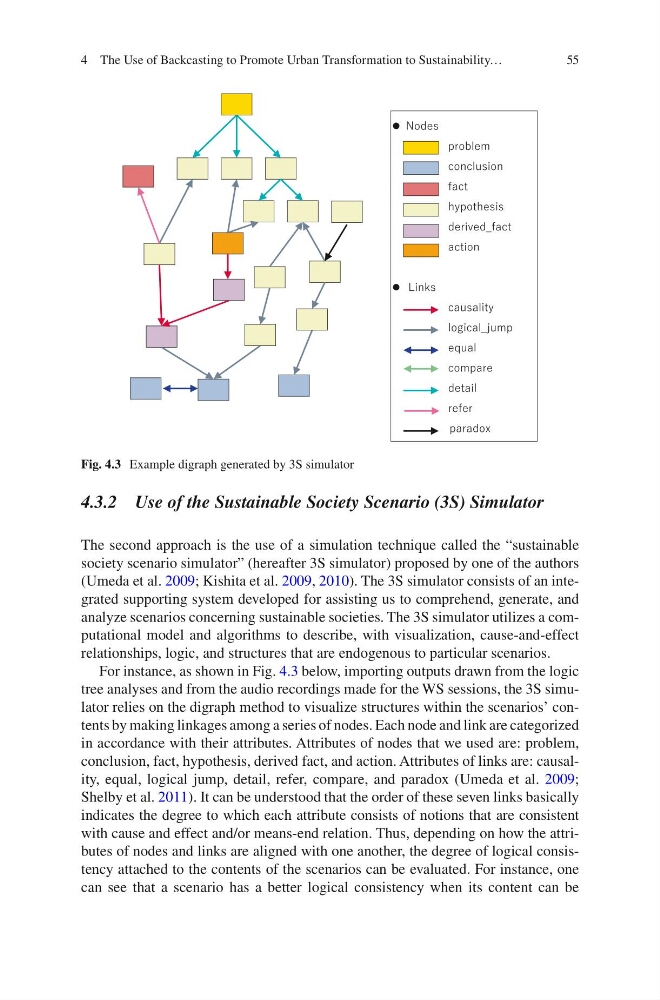
For instance, as shown in Fig. 4.3 below, importing outputs drawn from the logic
tree analyses and from the audio recordings made for the WS sessions, the 3S simulator relies on the digraph method to visualize structures within the scenarios’ contents by making linkages among a series of nodes. Each node and link are categorized
in accordance with their attributes. Attributes of nodes that we used are: problem,
conclusion, fact, hypothesis, derived fact, and action. Attributes of links are: causality, equal, logical jump, detail, refer, compare, and paradox (Umeda et al. 2009;
Shelby et al. 2011). It can be understood that the order of these seven links basically
indicates the degree to which each attribute consists of notions that are consistent
with cause and effect and/or means-end relation. Thus, depending on how the attributes of nodes and links are aligned with one another, the degree of logical consistency attached to the contents of the scenarios can be evaluated. For instance, one
can see that a scenario has a better logical consistency when its content can be
Fig. 4.3 Example digraph generated by 3S simulator
4 The Use of Backcasting to Promote Urban Transformation to Sustainability…
4.3.2 Use of the Sustainable Society Scenario (3S) Simulator
The second approach is the use of a simulation technique called the “sustainable
society scenario simulator” (hereafter 3S simulator) proposed by one of the authors
(Umeda et al. 2009; Kishita et al. 2009, 2010). The 3S simulator consists of an integrated supporting system developed for assisting us to comprehend, generate, and
analyze scenarios concerning sustainable societies. The 3S simulator utilizes a computational model and algorithms to describe, with visualization, cause-and-effect
relationships, logic, and structures that are endogenous to particular scenarios.
For instance, as shown in Fig. 4.3 below, importing outputs drawn from the logic
tree analyses and from the audio recordings made for the WS sessions, the 3S simulator relies on the digraph method to visualize structures within the scenarios’ contents by making linkages among a series of nodes. Each node and link are categorized
in accordance with their attributes. Attributes of nodes that we used are: problem,
conclusion, fact, hypothesis, derived fact, and action. Attributes of links are: causality, equal, logical jump, detail, refer, compare, and paradox (Umeda et al. 2009;
Shelby et al. 2011). It can be understood that the order of these seven links basically
indicates the degree to which each attribute consists of notions that are consistent
with cause and effect and/or means-end relation. Thus, depending on how the attributes of nodes and links are aligned with one another, the degree of logical consistency attached to the contents of the scenarios can be evaluated. For instance, one
can see that a scenario has a better logical consistency when its content can be
Fig. 4.3 Example digraph generated by 3S simulator
4 The Use of Backcasting to Promote Urban Transformation to Sustainability…