

54
reach their consensus on how to decide their best vision to begin with. By employing this method, we sought to go beyond mere aggregation of established interests
and preferences of the participants and to see if anything emerged to reshape and
restructuralize a constellation of interests and preferences being manifested in the
processes of their vision-making (Knight and Johnson 1994; Landemore 2013). The
participants were to create a pathway only to the best vision, and a combination of
such pathway and the best vision forms “the best scenario.” This technique was used
partly because of time constraints in the WS. As the final output, the WS resulted in
the two best scenarios from the entire dialogues.
4.3 Verification Approaches to Research Questions
4.3.1 Examination of Multiple Visions
In verification processes, we first examined the processes and outcomes of the making of eight visions and the two best scenarios. In doing so, we basically look into
an underlying question as to whether the contents of the visions could reflect and
capture diverged interests, preferences, and knowledge of the participants despite
the fact that the same methods and techniques (such as rules for dialogue, list of key
items, logic tree, and scoring method) were evenly applied to the processes between
Groups A and B. We in turn examine the processes by which the participants reached
a consensus regarding the way to choose the best of their four visions, and in so
doing, we also compare the outcomes of such visions between Groups A and B.
In taking these two approaches, we had presupposed that the more divergence
reflected in the processes, the more the outcomes of the resulting four visions and
best scenarios become independent of one another, meaning that they do not overlap
in terms of their substance, by describing starkly different, or even mutually exclusive, states of the desirable future sustainable city.
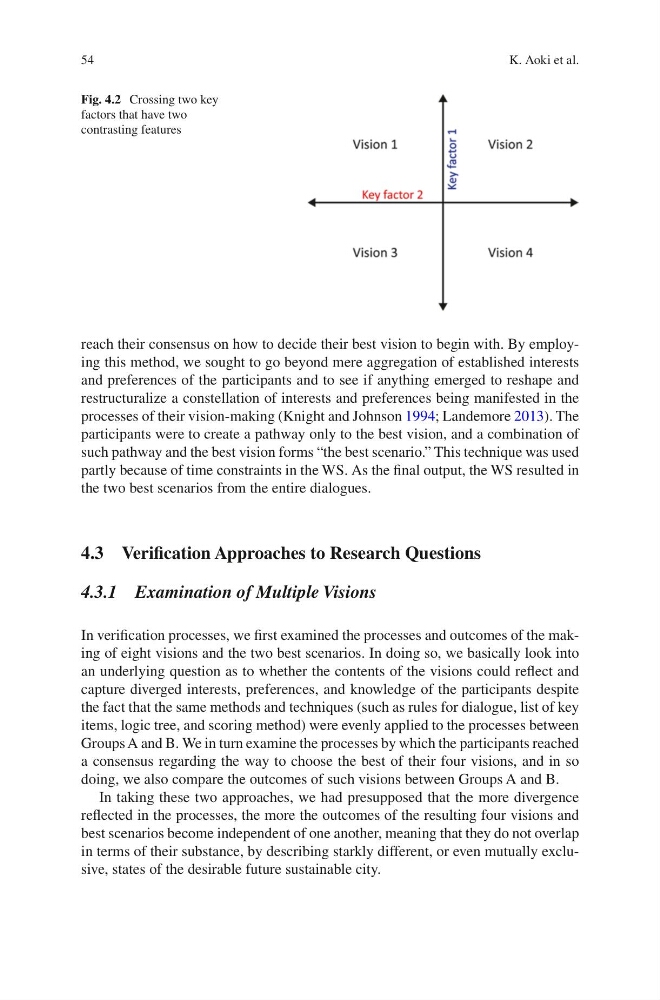
Fig. 4.2 Crossing two key
factors that have two
contrasting features
K. Aoki et al.
reach their consensus on how to decide their best vision to begin with. By employing this method, we sought to go beyond mere aggregation of established interests
and preferences of the participants and to see if anything emerged to reshape and
restructuralize a constellation of interests and preferences being manifested in the
processes of their vision-making (Knight and Johnson 1994; Landemore 2013). The
participants were to create a pathway only to the best vision, and a combination of
such pathway and the best vision forms “the best scenario.” This technique was used
partly because of time constraints in the WS. As the final output, the WS resulted in
the two best scenarios from the entire dialogues.
4.3 Verification Approaches to Research Questions
4.3.1 Examination of Multiple Visions
In verification processes, we first examined the processes and outcomes of the making of eight visions and the two best scenarios. In doing so, we basically look into
an underlying question as to whether the contents of the visions could reflect and
capture diverged interests, preferences, and knowledge of the participants despite
the fact that the same methods and techniques (such as rules for dialogue, list of key
items, logic tree, and scoring method) were evenly applied to the processes between
Groups A and B. We in turn examine the processes by which the participants reached
a consensus regarding the way to choose the best of their four visions, and in so
doing, we also compare the outcomes of such visions between Groups A and B.
In taking these two approaches, we had presupposed that the more divergence
reflected in the processes, the more the outcomes of the resulting four visions and
best scenarios become independent of one another, meaning that they do not overlap
in terms of their substance, by describing starkly different, or even mutually exclusive, states of the desirable future sustainable city.
Fig. 4.2 Crossing two key
factors that have two
contrasting features
K. Aoki et al.