

26
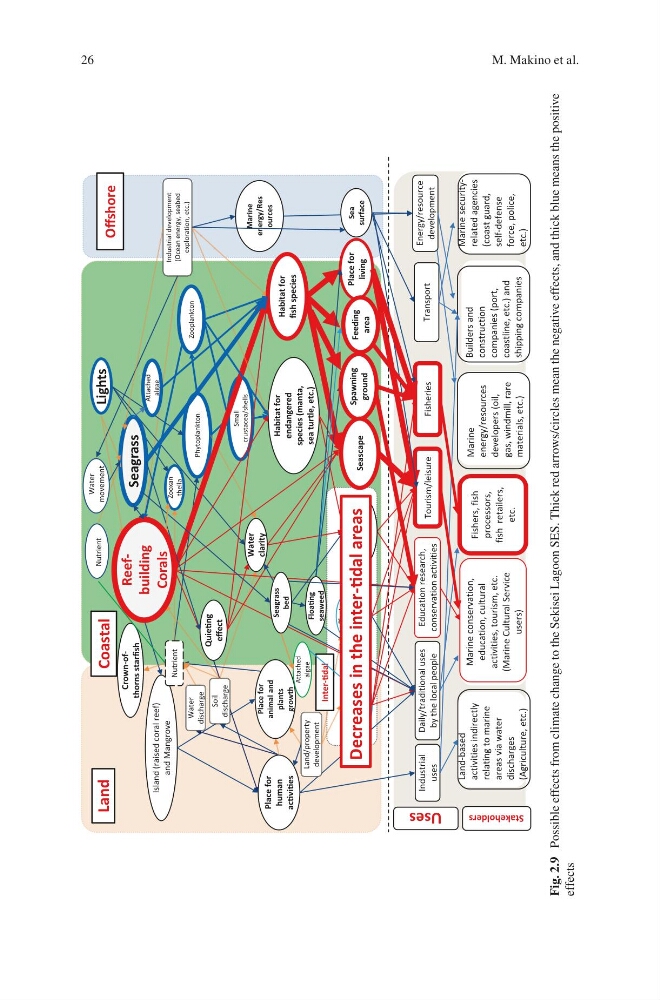
Fig. 2.9 Possible effects from climate change to the Sekisei Lagoon SES. Thick red arrows/circles mean the negative effects, and thick blue means the positive
effects
s
r
e
d
l
o
h
e
k
a
t
S
Marine conservation,
education, cultural
activities, tourism, etc.
(Marine Cultural Service
users)
Fishers, fish
processors,
fish retailers,
etc.
Marine
energy/resources
developers (oil,
gas, windmill, rare
materials, etc.)
Builders and
construction
companies (port,
coastline, etc.) and
shipping companies
Marine securityrelated agencies
(coast guard,
self-defense
force, police,
etc.)
Land-based
activities indirectly
relating to marine
areas via water
discharges
(Agriculture, etc.)
s
e
s
U
Industrial
uses
Daily/traditional uses
by the local people
Education research,
conservation activities
Tourism/leisure
Fisheries
Transport
Spawning
ground
Seascape
Feedin
g area
Place for
human
acƟviƟes
Marine
energy/Res
ources
Phytoplankton
Zooplankton
Small
crustacea/shells
Energy/resource
development
Island (raised coral reef)
and Mangrove
QuieƟng
effect
Place for
living
Industrial development
(Ocean energy, seabed
exploration, etc.)
Seascape
Plant
/animal
nursery
ground
Fish
nursery
ground
Coastal
Land
Offshore
Habitat for
endangered
species (manta,
sea turtle, etc.)
Place for
animal and
plants
growth
Zooxan
thella
Land/property
development
Water
discharge
Soil
discharge
Inter-Ɵdal
Habitat for
fish species
Crown-ofthorns starfish
Water
clarity
Seagrass
Seagrass
bed
FloaƟng
seaweed
Attached
algae
Reefbuilding
Corals
Sea
surface
Attached
algae
Nutrient
Spawning
ground
Feeding
area
Seascape
Decreases in the inter-Ɵdal areas
Water
movement
Nutrient
Lights
M. Makino et al.
Fig. 2.9 Possible effects from climate change to the Sekisei Lagoon SES. Thick red arrows/circles mean the negative effects, and thick blue means the positive
effects
s
r
e
d
l
o
h
e
k
a
t
S
Marine conservation,
education, cultural
activities, tourism, etc.
(Marine Cultural Service
users)
Fishers, fish
processors,
fish retailers,
etc.
Marine
energy/resources
developers (oil,
gas, windmill, rare
materials, etc.)
Builders and
construction
companies (port,
coastline, etc.) and
shipping companies
Marine securityrelated agencies
(coast guard,
self-defense
force, police,
etc.)
Land-based
activities indirectly
relating to marine
areas via water
discharges
(Agriculture, etc.)
s
e
s
U
Industrial
uses
Daily/traditional uses
by the local people
Education research,
conservation activities
Tourism/leisure
Fisheries
Transport
Spawning
ground
Seascape
Feedin
g area
Place for
human
acƟviƟes
Marine
energy/Res
ources
Phytoplankton
Zooplankton
Small
crustacea/shells
Energy/resource
development
Island (raised coral reef)
and Mangrove
QuieƟng
effect
Place for
living
Industrial development
(Ocean energy, seabed
exploration, etc.)
Seascape
Plant
/animal
nursery
ground
Fish
nursery
ground
Coastal
Land
Offshore
Habitat for
endangered
species (manta,
sea turtle, etc.)
Place for
animal and
plants
growth
Zooxan
thella
Land/property
development
Water
discharge
Soil
discharge
Inter-Ɵdal
Habitat for
fish species
Crown-ofthorns starfish
Water
clarity
Seagrass
Seagrass
bed
FloaƟng
seaweed
Attached
algae
Reefbuilding
Corals
Sea
surface
Attached
algae
Nutrient
Spawning
ground
Feeding
area
Seascape
Decreases in the inter-Ɵdal areas
Water
movement
Nutrient
Lights
M. Makino et al.