

108
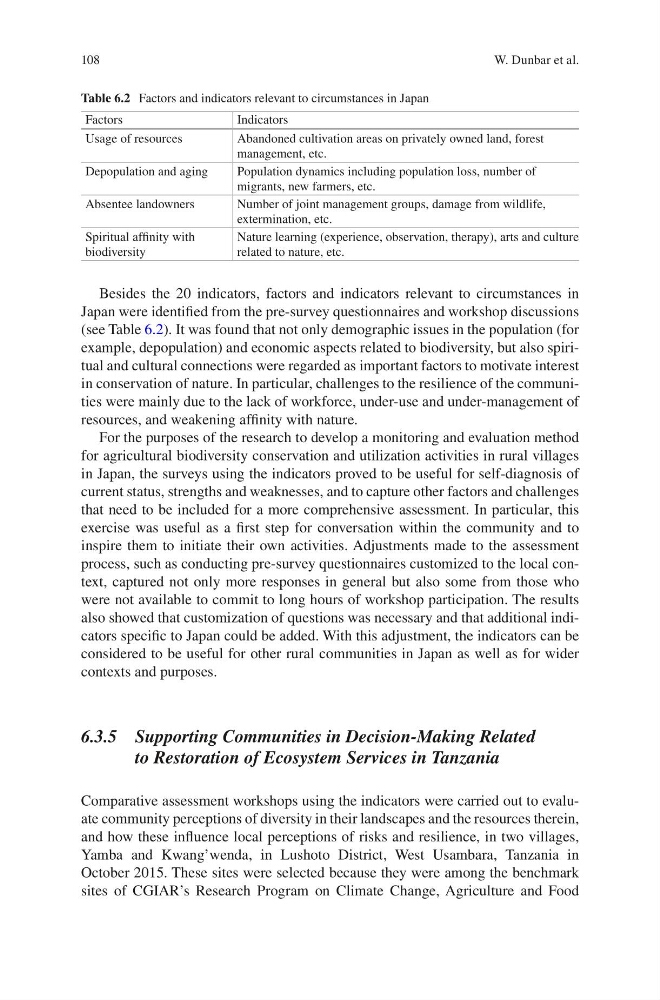
Besides the 20 indicators, factors and indicators relevant to circumstances in
Japan were identified from the pre-survey questionnaires and workshop discussions
(see Table 6.2). It was found that not only demographic issues in the population (for
example, depopulation) and economic aspects related to biodiversity, but also spiritual and cultural connections were regarded as important factors to motivate interest
in conservation of nature. In particular, challenges to the resilience of the communities were mainly due to the lack of workforce, under-use and under-management of
resources, and weakening affinity with nature.
For the purposes of the research to develop a monitoring and evaluation method
for agricultural biodiversity conservation and utilization activities in rural villages
in Japan, the surveys using the indicators proved to be useful for self-diagnosis of
current status, strengths and weaknesses, and to capture other factors and challenges
that need to be included for a more comprehensive assessment. In particular, this
exercise was useful as a first step for conversation within the community and to
inspire them to initiate their own activities. Adjustments made to the assessment
process, such as conducting pre-survey questionnaires customized to the local context, captured not only more responses in general but also some from those who
were not available to commit to long hours of workshop participation. The results
also showed that customization of questions was necessary and that additional indicators specific to Japan could be added. With this adjustment, the indicators can be
considered to be useful for other rural communities in Japan as well as for wider
contexts and purposes.
6.3.5 Supporting Communities in Decision-Making Related
to Restoration of Ecosystem Services in Tanzania
Comparative assessment workshops using the indicators were carried out to evaluate community perceptions of diversity in their landscapes and the resources therein,
and how these influence local perceptions of risks and resilience, in two villages,
Yamba and Kwang’wenda, in Lushoto District, West Usambara, Tanzania in
October 2015. These sites were selected because they were among the benchmark
sites of CGIAR’s Research Program on Climate Change, Agriculture and Food
Table 6.2 Factors and indicators relevant to circumstances in Japan
Factors
Indicators
Usage of resources
Abandoned cultivation areas on privately owned land, forest
management, etc.
Depopulation and aging
Population dynamics including population loss, number of
migrants, new farmers, etc.
Absentee landowners
Number of joint management groups, damage from wildlife,
extermination, etc.
Spiritual affinity with
biodiversity
Nature learning (experience, observation, therapy), arts and culture
related to nature, etc.
W. Dunbar et al.
Besides the 20 indicators, factors and indicators relevant to circumstances in
Japan were identified from the pre-survey questionnaires and workshop discussions
(see Table 6.2). It was found that not only demographic issues in the population (for
example, depopulation) and economic aspects related to biodiversity, but also spiritual and cultural connections were regarded as important factors to motivate interest
in conservation of nature. In particular, challenges to the resilience of the communities were mainly due to the lack of workforce, under-use and under-management of
resources, and weakening affinity with nature.
For the purposes of the research to develop a monitoring and evaluation method
for agricultural biodiversity conservation and utilization activities in rural villages
in Japan, the surveys using the indicators proved to be useful for self-diagnosis of
current status, strengths and weaknesses, and to capture other factors and challenges
that need to be included for a more comprehensive assessment. In particular, this
exercise was useful as a first step for conversation within the community and to
inspire them to initiate their own activities. Adjustments made to the assessment
process, such as conducting pre-survey questionnaires customized to the local context, captured not only more responses in general but also some from those who
were not available to commit to long hours of workshop participation. The results
also showed that customization of questions was necessary and that additional indicators specific to Japan could be added. With this adjustment, the indicators can be
considered to be useful for other rural communities in Japan as well as for wider
contexts and purposes.
6.3.5 Supporting Communities in Decision-Making Related
to Restoration of Ecosystem Services in Tanzania
Comparative assessment workshops using the indicators were carried out to evaluate community perceptions of diversity in their landscapes and the resources therein,
and how these influence local perceptions of risks and resilience, in two villages,
Yamba and Kwang’wenda, in Lushoto District, West Usambara, Tanzania in
October 2015. These sites were selected because they were among the benchmark
sites of CGIAR’s Research Program on Climate Change, Agriculture and Food
Table 6.2 Factors and indicators relevant to circumstances in Japan
Factors
Indicators
Usage of resources
Abandoned cultivation areas on privately owned land, forest
management, etc.
Depopulation and aging
Population dynamics including population loss, number of
migrants, new farmers, etc.
Absentee landowners
Number of joint management groups, damage from wildlife,
extermination, etc.
Spiritual affinity with
biodiversity
Nature learning (experience, observation, therapy), arts and culture
related to nature, etc.
W. Dunbar et al.