

106
For the pre-survey questionnaires, questions for each indicator were customized to
fit the local context, so that respondents would understand what they were actually
being asked. Factors and indicators relevant to the actual circumstances of Japan
were then extracted from the questionnaire results and workshop discussions for
development of the monitoring and evaluation method. Figure 6.1 summarizes
results from the pre-survey questionnaires.
The results of both surveys show that the indicators are useful in providing a
broad overview of biodiversity use and conservation status. They were also found to
be useful in self-diagnosis to give an overall picture of strengths and weaknesses of
the community. Evaluation of biodiversity related to natural resources and agriculture (indicators 1, 2, 3, and 4) tended to be relatively high in both districts, while
their evaluation of infrastructure and livelihood (indicators 16, 18, and 19) was
lower. Participants understood the importance of evaluating not only ecological and
environmental aspects related to conservation and use of biodiversity, but also
socioeconomic impacts and how their lives and livelihoods were affected. The
assessment captured a wide variety of problems existing in the region and local residents’ perceptions of them. Periodic self-diagnosis and self-assessment of this type
can be an important monitoring process for local residents to understand changes in
their environment and impacts of their activities.
It was also found that the assessment process stimulates conservation in local
communities. The workshops turned out to be valuable opportunities for people of
different ages, genders, occupations, etc. to gather and discuss. Residents based
their assessments on their own daily lives and work experiences, and exchanged
views on these during the workshop. This kind of bottom-up, self-assessment
method was found useful in: promoting conversation among different age groups
and genders, where otherwise in daily life they would not speak directly or share
their views; increasing awareness among residents and promoting participation in
concrete activities; and helping to clarify roles that each person can and does play
in community activities. Thus, the indicators and discussion of results from their
implementation were found to be an effective initiating process to promote awareness, establish common understanding, and facilitate planning of activities for
resource management.
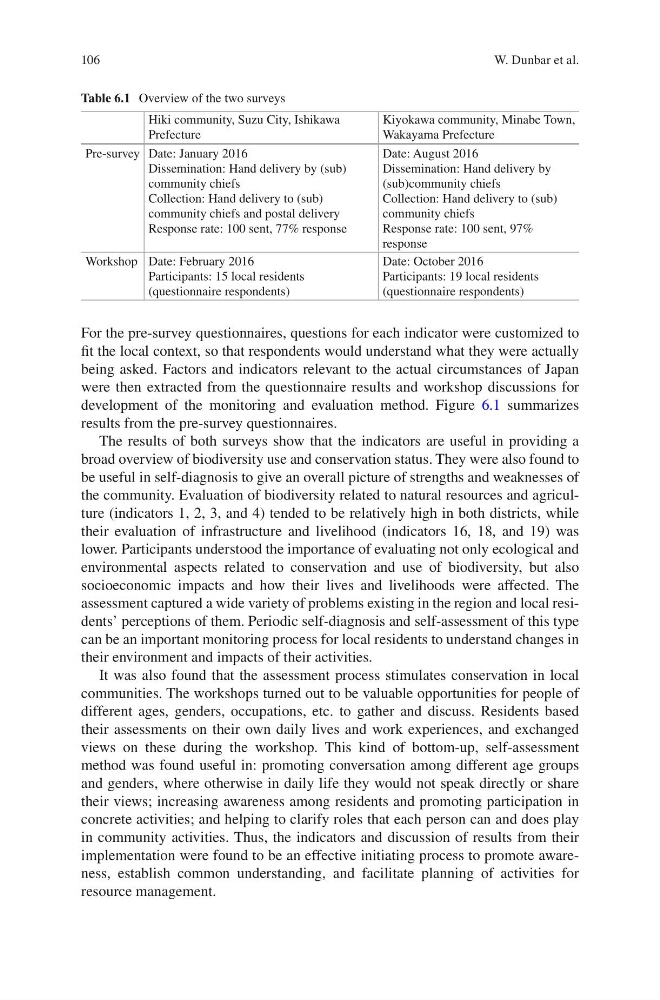
Table 6.1 Overview of the two surveys
Hiki community, Suzu City, Ishikawa
Prefecture
Kiyokawa community, Minabe Town,
Wakayama Prefecture
Pre- survey Date: January 2016
Dissemination: Hand delivery by (sub)
community chiefs
Collection: Hand delivery to (sub)
community chiefs and postal delivery
Response rate: 100 sent, 77% response
Date: August 2016
Dissemination: Hand delivery by
(sub)community chiefs
Collection: Hand delivery to (sub)
community chiefs
Response rate: 100 sent, 97%
response
Workshop Date: February 2016
Participants: 15 local residents
(questionnaire respondents)
Date: October 2016
Participants: 19 local residents
(questionnaire respondents)
W. Dunbar et al.
For the pre-survey questionnaires, questions for each indicator were customized to
fit the local context, so that respondents would understand what they were actually
being asked. Factors and indicators relevant to the actual circumstances of Japan
were then extracted from the questionnaire results and workshop discussions for
development of the monitoring and evaluation method. Figure 6.1 summarizes
results from the pre-survey questionnaires.
The results of both surveys show that the indicators are useful in providing a
broad overview of biodiversity use and conservation status. They were also found to
be useful in self-diagnosis to give an overall picture of strengths and weaknesses of
the community. Evaluation of biodiversity related to natural resources and agriculture (indicators 1, 2, 3, and 4) tended to be relatively high in both districts, while
their evaluation of infrastructure and livelihood (indicators 16, 18, and 19) was
lower. Participants understood the importance of evaluating not only ecological and
environmental aspects related to conservation and use of biodiversity, but also
socioeconomic impacts and how their lives and livelihoods were affected. The
assessment captured a wide variety of problems existing in the region and local residents’ perceptions of them. Periodic self-diagnosis and self-assessment of this type
can be an important monitoring process for local residents to understand changes in
their environment and impacts of their activities.
It was also found that the assessment process stimulates conservation in local
communities. The workshops turned out to be valuable opportunities for people of
different ages, genders, occupations, etc. to gather and discuss. Residents based
their assessments on their own daily lives and work experiences, and exchanged
views on these during the workshop. This kind of bottom-up, self-assessment
method was found useful in: promoting conversation among different age groups
and genders, where otherwise in daily life they would not speak directly or share
their views; increasing awareness among residents and promoting participation in
concrete activities; and helping to clarify roles that each person can and does play
in community activities. Thus, the indicators and discussion of results from their
implementation were found to be an effective initiating process to promote awareness, establish common understanding, and facilitate planning of activities for
resource management.
Table 6.1 Overview of the two surveys
Hiki community, Suzu City, Ishikawa
Prefecture
Kiyokawa community, Minabe Town,
Wakayama Prefecture
Pre- survey Date: January 2016
Dissemination: Hand delivery by (sub)
community chiefs
Collection: Hand delivery to (sub)
community chiefs and postal delivery
Response rate: 100 sent, 77% response
Date: August 2016
Dissemination: Hand delivery by
(sub)community chiefs
Collection: Hand delivery to (sub)
community chiefs
Response rate: 100 sent, 97%
response
Workshop Date: February 2016
Participants: 15 local residents
(questionnaire respondents)
Date: October 2016
Participants: 19 local residents
(questionnaire respondents)
W. Dunbar et al.