

It is natural and reasonable, even if the Fukushima Daiichi NPP accident had not
occurred, that external events including natural events should be considered among
the main factors for nuclear power plant accidents. In case of natural events, e.g.,
earthquakes and tsunamis, simultaneous occurrence of damage to many structures,
systems and components, both on-site and off-site, must be considered to prepare
for accident management and for off-site emergency response to the conditions that
are most likely to occur. Probabilistic risk assessment is considered one of the
effective approaches for estimating reasonable and realistic plant conditions.
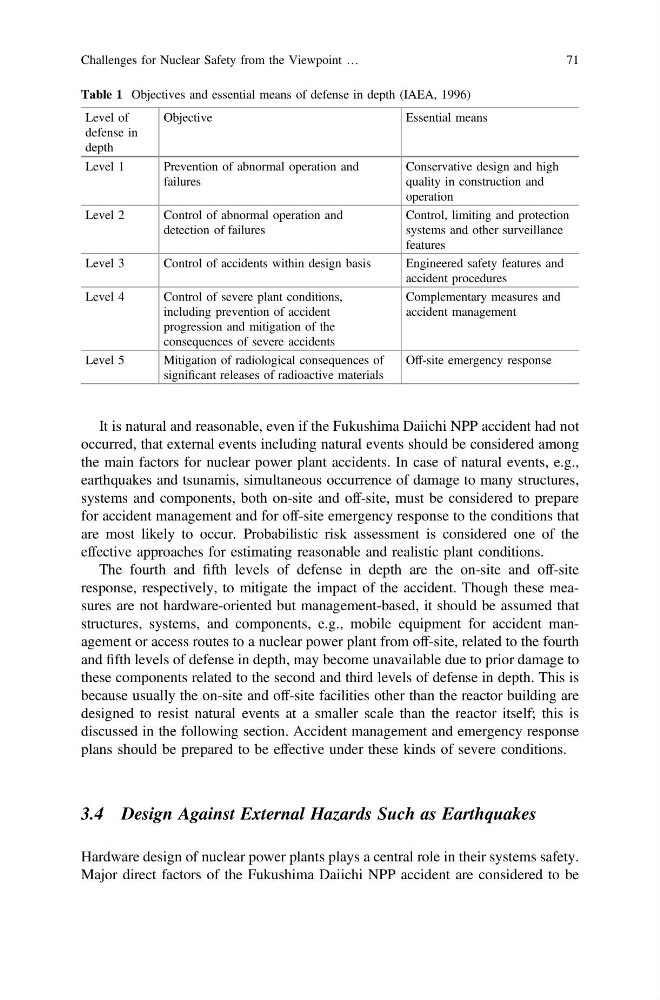
The fourth and fifth levels of defense in depth are the on-site and off-site
response, respectively, to mitigate the impact of the accident. Though these measures are not hardware-oriented but management-based, it should be assumed that
structures, systems, and components, e.g., mobile equipment for accident management or access routes to a nuclear power plant from off-site, related to the fourth
and fifth levels of defense in depth, may become unavailable due to prior damage to
these components related to the second and third levels of defense in depth. This is
because usually the on-site and off-site facilities other than the reactor building are
designed to resist natural events at a smaller scale than the reactor itself; this is
discussed in the following section. Accident management and emergency response
plans should be prepared to be effective under these kinds of severe conditions.
3.4 Design Against External Hazards Such as Earthquakes
Hardware design of nuclear power plants plays a central role in their systems safety.
Major direct factors of the Fukushima Daiichi NPP accident are considered to be
Table 1 Objectives and essential means of defense in depth (IAEA, 1996)
Level of
defense in
depth
Objective
Essential means
Level 1
Prevention of abnormal operation and
failures
Conservative design and high
quality in construction and
operation
Level 2
Control of abnormal operation and
detection of failures
Control, limiting and protection
systems and other surveillance
features
Level 3
Control of accidents within design basis
Engineered safety features and
accident procedures
Level 4
Control of severe plant conditions,
including prevention of accident
progression and mitigation of the
consequences of severe accidents
Complementary measures and
accident management
Level 5
Mitigation of radiological consequences of
significant releases of radioactive materials
Off-site emergency response
Challenges for Nuclear Safety from the Viewpoint …
71
occurred, that external events including natural events should be considered among
the main factors for nuclear power plant accidents. In case of natural events, e.g.,
earthquakes and tsunamis, simultaneous occurrence of damage to many structures,
systems and components, both on-site and off-site, must be considered to prepare
for accident management and for off-site emergency response to the conditions that
are most likely to occur. Probabilistic risk assessment is considered one of the
effective approaches for estimating reasonable and realistic plant conditions.
The fourth and fifth levels of defense in depth are the on-site and off-site
response, respectively, to mitigate the impact of the accident. Though these measures are not hardware-oriented but management-based, it should be assumed that
structures, systems, and components, e.g., mobile equipment for accident management or access routes to a nuclear power plant from off-site, related to the fourth
and fifth levels of defense in depth, may become unavailable due to prior damage to
these components related to the second and third levels of defense in depth. This is
because usually the on-site and off-site facilities other than the reactor building are
designed to resist natural events at a smaller scale than the reactor itself; this is
discussed in the following section. Accident management and emergency response
plans should be prepared to be effective under these kinds of severe conditions.
3.4 Design Against External Hazards Such as Earthquakes
Hardware design of nuclear power plants plays a central role in their systems safety.
Major direct factors of the Fukushima Daiichi NPP accident are considered to be
Table 1 Objectives and essential means of defense in depth (IAEA, 1996)
Level of
defense in
depth
Objective
Essential means
Level 1
Prevention of abnormal operation and
failures
Conservative design and high
quality in construction and
operation
Level 2
Control of abnormal operation and
detection of failures
Control, limiting and protection
systems and other surveillance
features
Level 3
Control of accidents within design basis
Engineered safety features and
accident procedures
Level 4
Control of severe plant conditions,
including prevention of accident
progression and mitigation of the
consequences of severe accidents
Complementary measures and
accident management
Level 5
Mitigation of radiological consequences of
significant releases of radioactive materials
Off-site emergency response
Challenges for Nuclear Safety from the Viewpoint …
71