

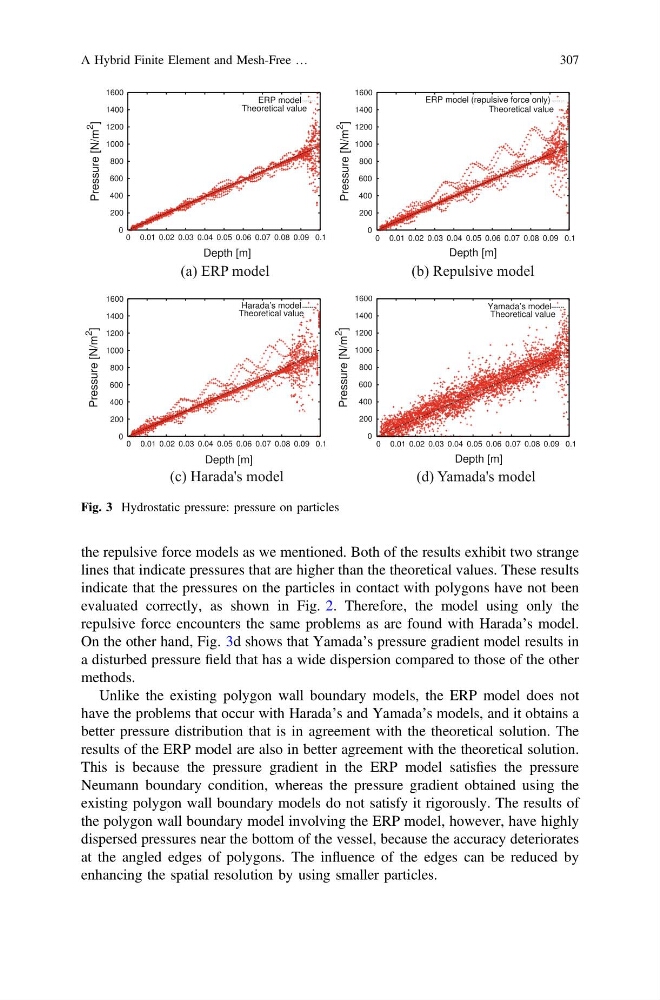
the repulsive force models as we mentioned. Both of the results exhibit two strange
lines that indicate pressures that are higher than the theoretical values. These results
indicate that the pressures on the particles in contact with polygons have not been
evaluated correctly, as shown in Fig. 2. Therefore, the model using only the
repulsive force encounters the same problems as are found with Harada’s model.
On the other hand, Fig. 3d shows that Yamada’s pressure gradient model results in
a disturbed pressure field that has a wide dispersion compared to those of the other
methods.
Unlike the existing polygon wall boundary models, the ERP model does not
have the problems that occur with Harada’s and Yamada’s models, and it obtains a
better pressure distribution that is in agreement with the theoretical solution. The
results of the ERP model are also in better agreement with the theoretical solution.
This is because the pressure gradient in the ERP model satisfies the pressure
Neumann boundary condition, whereas the pressure gradient obtained using the
existing polygon wall boundary models do not satisfy it rigorously. The results of
the polygon wall boundary model involving the ERP model, however, have highly
dispersed pressures near the bottom of the vessel, because the accuracy deteriorates
at the angled edges of polygons. The influence of the edges can be reduced by
enhancing the spatial resolution by using smaller particles.
Fig. 3 Hydrostatic pressure: pressure on particles
A Hybrid Finite Element and Mesh-Free …
307
lines that indicate pressures that are higher than the theoretical values. These results
indicate that the pressures on the particles in contact with polygons have not been
evaluated correctly, as shown in Fig. 2. Therefore, the model using only the
repulsive force encounters the same problems as are found with Harada’s model.
On the other hand, Fig. 3d shows that Yamada’s pressure gradient model results in
a disturbed pressure field that has a wide dispersion compared to those of the other
methods.
Unlike the existing polygon wall boundary models, the ERP model does not
have the problems that occur with Harada’s and Yamada’s models, and it obtains a
better pressure distribution that is in agreement with the theoretical solution. The
results of the ERP model are also in better agreement with the theoretical solution.
This is because the pressure gradient in the ERP model satisfies the pressure
Neumann boundary condition, whereas the pressure gradient obtained using the
existing polygon wall boundary models do not satisfy it rigorously. The results of
the polygon wall boundary model involving the ERP model, however, have highly
dispersed pressures near the bottom of the vessel, because the accuracy deteriorates
at the angled edges of polygons. The influence of the edges can be reduced by
enhancing the spatial resolution by using smaller particles.
Fig. 3 Hydrostatic pressure: pressure on particles
A Hybrid Finite Element and Mesh-Free …
307