

the item related to the utterance, and the second is whether the utterance is an
influence or not. If it is considered by the researcher as an influence, then it would
be decided whether it is a rational or non-rational influence.
One example of rational influence is as follows: for the item oxygen, someone
says, “The amount 2.5 kg is not sufficient”. The logical reason may be strong or
weak but at least the participant shows a fact-based argument. On the other hand, an
example of non-rational influence is as follows: for the item pistol, someone says,
“Pistol is really unimportant”, without providing any argument. The statement that
says whether an item is important or not is the expected decision, therefore when
someone mention their preference about a decision without any argument, it is
considered as a non-rational influence.
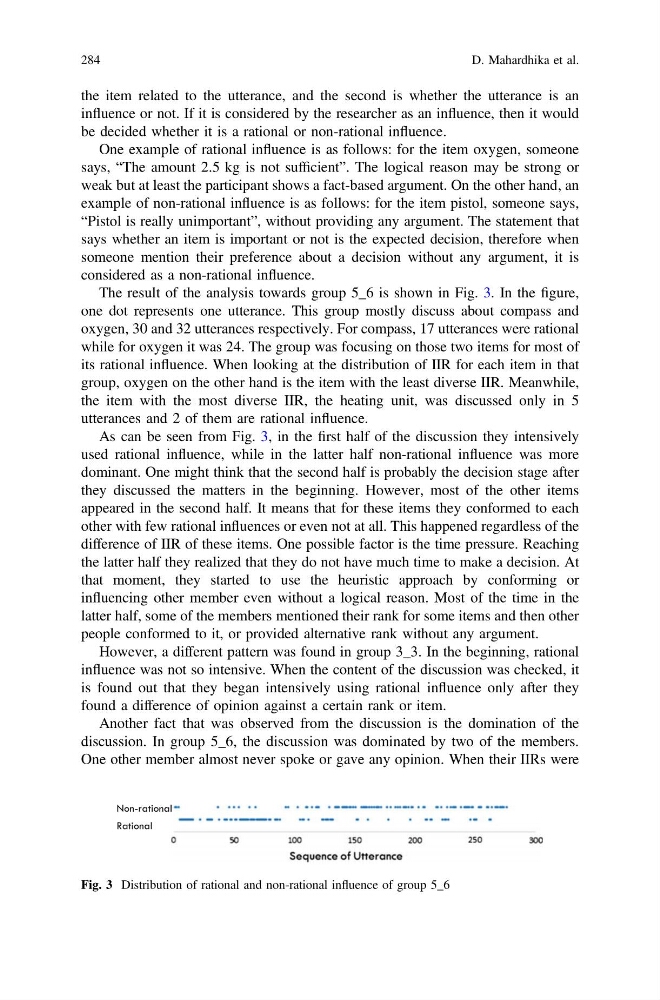
The result of the analysis towards group 5_6 is shown in Fig. 3. In the figure,
one dot represents one utterance. This group mostly discuss about compass and
oxygen, 30 and 32 utterances respectively. For compass, 17 utterances were rational
while for oxygen it was 24. The group was focusing on those two items for most of
its rational influence. When looking at the distribution of IIR for each item in that
group, oxygen on the other hand is the item with the least diverse IIR. Meanwhile,
the item with the most diverse IIR, the heating unit, was discussed only in 5
utterances and 2 of them are rational influence.
As can be seen from Fig. 3, in the first half of the discussion they intensively
used rational influence, while in the latter half non-rational influence was more
dominant. One might think that the second half is probably the decision stage after
they discussed the matters in the beginning. However, most of the other items
appeared in the second half. It means that for these items they conformed to each
other with few rational influences or even not at all. This happened regardless of the
difference of IIR of these items. One possible factor is the time pressure. Reaching
the latter half they realized that they do not have much time to make a decision. At
that moment, they started to use the heuristic approach by conforming or
influencing other member even without a logical reason. Most of the time in the
latter half, some of the members mentioned their rank for some items and then other
people conformed to it, or provided alternative rank without any argument.
However, a different pattern was found in group 3_3. In the beginning, rational
influence was not so intensive. When the content of the discussion was checked, it
is found out that they began intensively using rational influence only after they
found a difference of opinion against a certain rank or item.
Another fact that was observed from the discussion is the domination of the
discussion. In group 5_6, the discussion was dominated by two of the members.
One other member almost never spoke or gave any opinion. When their IIRs were
Fig. 3 Distribution of rational and non-rational influence of group 5_6
284
D. Mahardhika et al.
influence or not. If it is considered by the researcher as an influence, then it would
be decided whether it is a rational or non-rational influence.
One example of rational influence is as follows: for the item oxygen, someone
says, “The amount 2.5 kg is not sufficient”. The logical reason may be strong or
weak but at least the participant shows a fact-based argument. On the other hand, an
example of non-rational influence is as follows: for the item pistol, someone says,
“Pistol is really unimportant”, without providing any argument. The statement that
says whether an item is important or not is the expected decision, therefore when
someone mention their preference about a decision without any argument, it is
considered as a non-rational influence.
The result of the analysis towards group 5_6 is shown in Fig. 3. In the figure,
one dot represents one utterance. This group mostly discuss about compass and
oxygen, 30 and 32 utterances respectively. For compass, 17 utterances were rational
while for oxygen it was 24. The group was focusing on those two items for most of
its rational influence. When looking at the distribution of IIR for each item in that
group, oxygen on the other hand is the item with the least diverse IIR. Meanwhile,
the item with the most diverse IIR, the heating unit, was discussed only in 5
utterances and 2 of them are rational influence.
As can be seen from Fig. 3, in the first half of the discussion they intensively
used rational influence, while in the latter half non-rational influence was more
dominant. One might think that the second half is probably the decision stage after
they discussed the matters in the beginning. However, most of the other items
appeared in the second half. It means that for these items they conformed to each
other with few rational influences or even not at all. This happened regardless of the
difference of IIR of these items. One possible factor is the time pressure. Reaching
the latter half they realized that they do not have much time to make a decision. At
that moment, they started to use the heuristic approach by conforming or
influencing other member even without a logical reason. Most of the time in the
latter half, some of the members mentioned their rank for some items and then other
people conformed to it, or provided alternative rank without any argument.
However, a different pattern was found in group 3_3. In the beginning, rational
influence was not so intensive. When the content of the discussion was checked, it
is found out that they began intensively using rational influence only after they
found a difference of opinion against a certain rank or item.
Another fact that was observed from the discussion is the domination of the
discussion. In group 5_6, the discussion was dominated by two of the members.
One other member almost never spoke or gave any opinion. When their IIRs were
Fig. 3 Distribution of rational and non-rational influence of group 5_6
284
D. Mahardhika et al.